

HS Code 2710: Petroleum Oils, Refined Products and Waste Oils Classification Guide
A practical customs classification guide to HS Code 2710 for non-crude petroleum oils, oils obtained from bituminous minerals, qualifying petroleum-based preparations, products containing biodiesel and waste oils. The guide explains the international HS6 structure, the 70% by-weight rule, the light-oil distillation test, the biodiesel branch, the legal meaning of waste oils and the main classification boundaries across Chapters 27, 34 and 38.
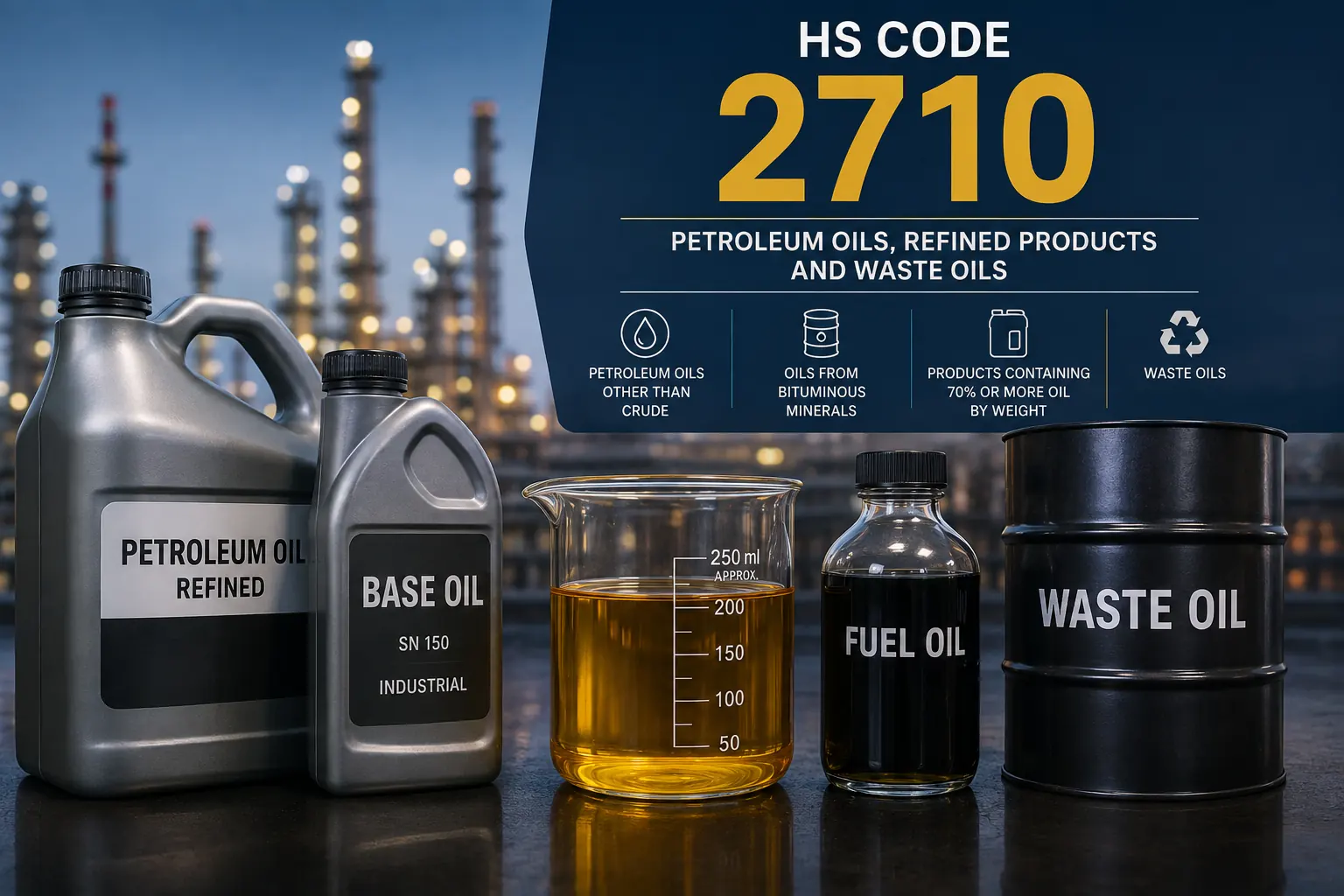
HS Code 2710 is one of the broadest and most commercially important headings in Chapter 27. It can cover non-crude petroleum oils, non-crude oils obtained from bituminous minerals, certain preparations in which qualifying oils form at least 70% by weight and are the basic constituents, products containing biodiesel under the relevant branch, and specified waste oils.
The word “refined” is useful commercial shorthand for many products encountered under this heading, but it is important to remember that the legal dividing concept is broader: the oils in this heading are generally other than crude.
This makes HS 2710 significantly more complex than Heading 2709.
A classifier may need to answer several separate questions:
- Is the product crude or non-crude?
- Is it a petroleum oil, a qualifying similar oil or a preparation?
- If it is a preparation, how much qualifying oil does it contain by weight?
- Are those oils the basic constituents of the preparation?
- Does the product contain biodiesel?
- Is it actually a waste oil rather than a primary product?
- If it is not waste oil, does it meet the international definition of a light oil?
- Could another, more specific heading outside Chapter 27 describe the product?
These questions matter for importers, exporters, refiners, distributors, lubricant companies, fuel traders and compliance teams dealing with Saudi Arabia, the United Arab Emirates (UAE), Qatar, Oman, Kuwait and Bahrain.
Where HS Code 2710 sits in Chapter 27
Heading 2710 belongs to Chapter 27, which covers mineral fuels, mineral oils, products of their distillation, bituminous substances and mineral waxes.
For the wider Chapter structure, see: HS Code Chapter 27 Classification Guide .
The position of 2710 immediately after 2709 is legally significant.
Heading 2709 deals with crude petroleum oils and crude oils obtained from bituminous minerals.
Heading 2710 then addresses the non-crude side of the petroleum-oil family, together with qualifying preparations and waste oils.
But 2710 does not operate in isolation. Products may also require comparison with:
- 2707 for certain coal-tar and aromatic-rich oils;
- 2712 for petroleum jelly and specified mineral waxes;
- 2713 for petroleum coke, petroleum bitumen and specified petroleum residues;
- 2715 for certain bituminous mixtures;
- 3403 for qualifying lubricating preparations;
- 3811 for prepared additives for mineral oils;
- 3819 for certain prepared hydraulic fluids; and
- 3826 for biodiesel and relevant biodiesel mixtures below the petroleum-oil threshold.
The three major legal branches inside Heading 2710
For practical classification, Heading 2710 can be understood as containing three major branches.
Branch 1 — Non-crude oils and qualifying preparations without biodiesel
This branch covers non-crude petroleum oils and oils obtained from bituminous minerals, together with qualifying preparations, where the goods are neither biodiesel-containing products of the dedicated branch nor waste oils.
The international HS6 choice within this branch is between:
- 2710.12 — Light oils and preparations; and
- 2710.19 — Other.
Branch 2 — Products containing biodiesel
A separate international subheading exists for relevant petroleum oils and qualifying preparations containing biodiesel, provided they are not waste oils:
- 2710.20.
Branch 3 — Waste oils
Waste oils are separated from primary petroleum products. Under HS 2022, the international structure is:
- 2710.91 for certain waste oils containing PCB, PCT or PBB; and
- 2710.99 for other waste oils.
International HS6 structure under Heading 2710
Current HS 2022 structure
The international six-digit structure is only the first level. Saudi Arabia, UAE, Qatar, Oman, Kuwait and Bahrain may apply more detailed tariff lines beneath the HS6 level, so the final declaration code must always be confirmed in the destination tariff.
Chapter 27 Note 2: the meaning of petroleum oils is broader than the name suggests
One of the most important legal provisions for Heading 2710 is Chapter 27 Note 2.
For purposes of Heading 2710, the reference to petroleum oils and oils obtained from bituminous minerals is not limited only to oils literally produced from petroleum or bituminous minerals.
The definition also reaches certain similar oils obtained by other processes, including oils mainly composed of mixed unsaturated hydrocarbons, provided the required relationship between non-aromatic and aromatic constituents is satisfied.
In practical terms, the weight of the non-aromatic constituents must exceed the weight of the aromatic constituents for these similar oils to fall within the Chapter Note concept.
This rule is particularly important when comparing Heading 2710 with Heading 2707.
Heading 2707 deals with specified coal-tar distillation products and similar products in which aromatic constituents predominate over non-aromatic constituents.
Therefore, a technical composition showing the balance between aromatic and non-aromatic constituents can become legally important for certain similar hydrocarbon oils.
Understanding the 70% by-weight rule
The 70% threshold is one of the most frequently misunderstood elements of Heading 2710.
It applies to the heading's preparations branch.
A preparation can fall within Heading 2710 when petroleum oils or qualifying oils from bituminous minerals account for 70% or more by weight and those oils are the basic constituents of the preparation, provided the preparation is not more specifically described elsewhere.
70% is not the only test
A common classification error is:
“The product contains 72% mineral oil, therefore it is automatically 2710.”
That reasoning is incomplete.
The classifier should ask:
- What is the exact petroleum-oil percentage by weight?
- Are the qualifying oils actually the basic constituents?
- Is the product a preparation rather than merely an oil?
- Is it elsewhere specified or included in another heading?
- Does it contain biodiesel?
- Is it waste oil?
A product exceeding the percentage threshold can still require review against a more specific heading.
The threshold is by weight, not volume
The heading uses a weight-based threshold for qualifying preparations.
Therefore, a formulation showing “75% by volume” does not automatically establish that the legal 70% by-weight requirement has been satisfied.
The technical documentation should provide weight composition or sufficient validated data to establish the percentage by weight.
“Basic constituents” also matters
Even when the petroleum oil content exceeds the numerical threshold, the legal wording also requires those oils to constitute the basic constituents of the preparation.
The percentage figure should therefore be evaluated together with the actual nature and function of the formulation.
HS 2710.12 — Light oils and preparations
The term light oils and preparations is not merely a commercial description such as “light fuel,” “light solvent” or “light petroleum.”
Chapter 27 contains a specific international subheading definition.
For HS 2710.12, the relevant products are those for which 90% or more by volume, including losses, distils at 210°C when tested using the specified ISO 3405 method, which is equivalent to ASTM D86 for this purpose.
Therefore, classification under 2710.12 should not be based simply on:
- colour;
- low viscosity;
- low density;
- a supplier calling the material “light oil”;
- flash point alone;
- boiling point of a single component; or
- end use as a fuel or solvent.
The relevant distillation data should be obtained where the choice between 2710.12 and 2710.19 depends on the light-oil definition.
HS 2710.19 — Other qualifying oils and preparations
2710.19 is the other international HS6 branch for the relevant non-crude petroleum oils and qualifying preparations that:
- do not fall under the light-oil subheading 2710.12;
- are not classified under the biodiesel branch 2710.20; and
- are not waste oils.
Depending on their actual properties and the detailed destination tariff, materials encountered in this broader group can include various middle or heavy petroleum streams, certain base oils and other non-crude petroleum products.
However, product names such as “base oil,” “fuel oil,” “process oil,” “white oil,” “mineral oil” or “industrial oil” should not be treated as automatic confirmation of 2710.19.
The composition, refining history, distillation characteristics, additives, intended formulation and competing headings still need to be reviewed.
Base oil versus finished lubricant
One recurring classification problem is the difference between a petroleum base oil and a formulated lubricating preparation.
A base oil may remain a petroleum oil of Heading 2710.
A finished lubricating formulation containing additives may require a comparison with Heading 3403.
The result can depend on the formulation and on the percentage and role of petroleum oils.
HS 2710.20 — Petroleum oils and preparations containing biodiesel
HS 2022 provides a dedicated subheading for qualifying Heading 2710 products that contain biodiesel and are not waste oils.
For Chapter 27 subheading purposes, biodiesel is defined by reference to mono-alkyl esters of fatty acids of a kind used as fuel, derived from animal, vegetable or microbial fats and oils.
This creates an important boundary with Heading 3826.
2710.20 versus 3826.00
Heading 3826 addresses biodiesel and biodiesel mixtures that either contain no qualifying petroleum oils or contain less than 70% by weight of those petroleum oils.
By contrast, the Heading 2710 preparation framework uses the 70%-or-more petroleum-oil threshold where those oils are the basic constituents.
Accordingly, a diesel/biodiesel blend should not be classified from the word “biodiesel” alone.
The classifier should establish:
- the biodiesel content;
- the petroleum-oil content by weight;
- whether petroleum oils are the basic constituents;
- whether the product is waste oil;
- and whether another heading applies.
Waste oils under HS Code 2710
Waste oil is not simply “cheap oil,” “off-spec oil” or oil that the buyer intends to recycle.
Chapter 27 contains a legal definition for waste oils.
In general, the term concerns waste containing mainly the qualifying petroleum oils described by Chapter 27 Note 2, whether or not mixed with water.
The Chapter Note specifically includes several important categories.
1. Used oils no longer fit for primary use
Examples include:
- used lubricating oils;
- used hydraulic oils; and
- used transformer oils.
The fact that such material may later be re-refined, recovered or processed does not by itself transform its condition at import into unused primary oil.
2. Petroleum storage-tank sludge oils
Certain sludge oils from petroleum-oil storage tanks can fall within the waste-oil concept.
These may mainly contain petroleum oils together with relatively high concentrations of additives or chemicals associated with the original petroleum products.
3. Petroleum oils in water emulsions or mixtures
Waste oils can also include qualifying oils mixed with water or present as emulsions.
Examples may arise from:
- oil spills;
- storage-tank washings; and
- used cutting-oil operations.
Therefore, the presence of water does not automatically remove material from the waste-oil definition.
2710.91 versus 2710.99 under HS 2022
After confirming that the material is waste oil, the next HS6 question under the current HS 2022 structure is whether the waste contains the specified PCB, PCT or PBB substances.
If the relevant hazardous substances are present within the current subheading description, 2710.91 is relevant.
Other qualifying waste oils fall under 2710.99 at the international level.
Because this area involves potentially hazardous contaminants and will change in HS 2028, laboratory analysis and current destination-country requirements can be particularly important.
Important classification boundaries for HS Code 2710
| Possible heading | Main distinction from 2710 | Evidence to review |
|---|---|---|
| 2707 | Certain coal-tar distillation products and similar aromatic-rich oils. | Feedstock, production process, aromatic versus non-aromatic composition. |
| 2709 | Crude petroleum oils and crude oils obtained from bituminous minerals. | Production history, refining/fractionation, crude assay, final product identity. |
| 2712 | Petroleum jelly and specified mineral waxes rather than ordinary petroleum oils. | Physical character, oil content, wax identity, technical specification. |
| 2713 | Petroleum coke, petroleum bitumen and specified petroleum residues. | Refinery process, residue identity, physical form, supplier specification. |
| 2715 | Certain prepared bituminous mixtures. | Formula, base material, additives, preparation identity. |
| 3403 | Lubricating preparations not meeting the exclusion based on petroleum oils being 70% or more by weight as basic constituents. | Full formulation, petroleum-oil percentage by weight, additive package, use and product identity. |
| 3811 | Prepared additives for mineral oils can be specifically described there. | Additive function, formulation, petroleum carrier content, TDS. |
| 3819 | Certain prepared hydraulic fluids with no petroleum oils or less than the specified petroleum-oil threshold. | Formula, petroleum-oil percentage, technical function. |
| 3826 | Biodiesel and mixtures containing no petroleum oil or less than 70% by weight of qualifying petroleum oils. | Biodiesel percentage, petroleum-oil percentage by weight, product formula. |
2709 versus 2710 — crude or non-crude?
This is the starting boundary for many petroleum products.
A material should not move from 2709 to 2710 simply because it has been transported, stored or subject to some handling operation.
Conversely, a refined or transformed petroleum product does not stay in 2709 merely because it originated as crude oil.
Classification follows the actual goods presented.
2707 versus 2710 — aromatic or non-aromatic predominance
When dealing with certain similar hydrocarbon oils, technical composition can become legally decisive.
The relationship between aromatic and non-aromatic constituents should be documented rather than inferred from colour, odour or commercial description.
2710 versus 3403 — petroleum oil or lubricating preparation?
A product marketed as a lubricant is not automatically Heading 3403.
Heading 3403 itself excludes certain preparations where qualifying petroleum oils form at least 70% by weight and are the basic constituents.
Consequently, the exact formula is central.
For a formulated lubricant, obtain the full composition by weight rather than relying solely on the product name or SDS range.
2710 versus 3811 — oil or additive package?
Products designed specifically as prepared additives for mineral oils can require consideration under Heading 3811.
A petroleum carrier in an additive package does not necessarily make the product itself an ordinary petroleum oil of 2710.
2710 versus 3826 — petroleum-dominant biodiesel blend or biodiesel product?
This boundary is strongly linked to petroleum-oil content by weight.
Accurate blending records and composition certificates can therefore be essential.
Technical information to review for HS Code 2710
| Information | Why it matters |
|---|---|
| Exact product name and grade | Helps distinguish base oil, finished lubricant, fuel blend, process oil, biodiesel blend, waste oil and other petroleum products. |
| Feedstock / source | Helps distinguish petroleum products from coal-tar-derived or other similar oils. |
| Refining and production process | Helps establish whether the product is crude, non-crude, a fraction, residue or preparation. |
| Full composition by weight | Essential where the 70% rule or another composition threshold is relevant. |
| Petroleum-oil percentage by weight | Critical for preparations and boundaries with headings such as 3403 and 3826. |
| Role of petroleum oils in formulation | Helps establish whether the oils are the basic constituents of the preparation. |
| ASTM D86 / ISO 3405 distillation data | Critical when distinguishing 2710.12 light oils from 2710.19. |
| Aromatic / non-aromatic composition | Can be important for the Chapter 27 Note 2 boundary and comparison with 2707. |
| Biodiesel content | Necessary for distinguishing 2710.20 from the non-biodiesel branches and potentially 3826. |
| Additive package | Important for finished lubricants, fuel additives and other preparations. |
| Product use | Provides supporting context but normally does not determine classification by itself. |
| TDS | Can provide viscosity, density, flash point, distillation and application information. |
| SDS | Useful supporting evidence for composition and hazards, but not a binding HS determination. |
| CoA | Can verify shipment-specific properties against the declared grade. |
| Waste / used status | Central when deciding whether the goods belong in the waste-oil branch. |
| Previous use history | Particularly relevant for used lubricating, hydraulic and transformer oils. |
| Water content | Relevant for emulsions and mixtures that may still satisfy the waste-oil definition. |
| PCB / PCT / PBB analysis | Important for current waste-oil subheading classification and future HS 2028 changes. |
Step-by-step HS 2710 classification process
Identify the actual imported product
Record the precise commercial and technical identity of the goods as presented.
Determine whether the product is crude
If it remains crude petroleum oil, Heading 2709 should be evaluated before 2710.
Identify the oil source and production route
Determine whether it is petroleum-derived, obtained from bituminous minerals, or a similar oil covered by Chapter 27 Note 2.
Check aromatic versus non-aromatic composition where relevant
This may be important for distinguishing qualifying similar oils of 2710 from products of 2707.
Determine whether the goods are pure oils or preparations
If additives or other components are present, obtain the complete formulation.
For preparations, calculate petroleum-oil content by weight
Do not substitute volume percentage for the legal weight percentage.
Confirm whether the oils are basic constituents
Meeting the numerical threshold alone is not the complete legal test.
Check whether another heading specifically describes the preparation
Compare headings such as 3403, 3811, 3819 and 3826 where technically relevant.
Determine whether biodiesel is present
If yes, evaluate the dedicated 2710.20 branch and the boundary with Heading 3826.
Determine whether the goods are waste oils
Review previous use, product condition, tank sludge status, water mixture and other facts.
If waste oil, review PCB/PCT/PBB information
This determines the current international split between 2710.91 and 2710.99.
If not biodiesel and not waste, test the light-oil branch
Review ISO 3405 or ASTM D86 data where the distinction between 2710.12 and 2710.19 matters.
Apply GRI 1
Start with the legal terms of the heading and relevant Chapter Notes.
Apply GRI 6 for the HS6 choice
Compare only subheadings at the same level and apply the relevant Subheading Notes.
Document rejected alternatives
Explain why realistic alternatives such as 2709, 2707, 3403 or 3826 do not apply.
Verify the destination tariff
Confirm the detailed tariff code and declaration requirements for Saudi Arabia, UAE, Qatar, Oman, Kuwait or Bahrain.
Need help classifying a petroleum oil, lubricant, fuel blend or waste oil?
JAMAREK helps structure the classification analysis around product identity, composition, oil percentage, biodiesel content, waste status, technical evidence and competing tariff headings.
Practical HS Code 2710 classification scenarios
Scenario 1 — Non-crude petroleum oil with no biodiesel and no waste status
The product is confirmed as a non-crude petroleum oil. It contains no biodiesel and is not waste oil.
The next question is whether the product satisfies the international light-oil test for 2710.12 or falls into the other branch at 2710.19.
Scenario 2 — Supplier calls the product “light oil”
The invoice says “Light Petroleum Oil,” but no distillation report is supplied.
The name alone does not establish 2710.12.
Request relevant ISO 3405 or ASTM D86 distillation information if that HS6 boundary must be confirmed.
Scenario 3 — Product meets the light-oil distillation requirement
Valid test data show that at least 90% by volume, including losses, distils by the specified 210°C point.
If the other Heading 2710 conditions are satisfied and the product is neither biodiesel-containing goods of 2710.20 nor waste oil, 2710.12 becomes the relevant international candidate.
Scenario 4 — Base oil with no significant additive formulation
Technical documents identify the material as a non-crude petroleum base oil rather than a formulated lubricant.
Heading 2710 may be relevant. The final HS6 and detailed tariff depend on the actual characteristics.
Scenario 5 — Finished lubricant containing 85% petroleum base oil
The formulation contains 85% petroleum oil by weight and additives.
The 70% threshold is exceeded and the oils may be the basic constituents.
Compare Heading 2710 with the legal exclusion in Heading 3403 rather than classifying solely from the word “lubricant.”
Scenario 6 — Lubricating preparation containing 60% petroleum oil
The formulation contains less than the Heading 2710 preparation threshold.
If it is a lubricating preparation meeting the requirements of Heading 3403, that heading should be evaluated.
Scenario 7 — SDS gives petroleum-oil content of 60–80%
The range crosses the 70% legal threshold.
This SDS alone is insufficient to determine which side of the threshold the actual product occupies.
Request more precise composition information.
Scenario 8 — Petroleum-dominant diesel blend containing biodiesel
The product contains qualifying petroleum oils as the basic constituents and also contains biodiesel.
If the applicable Heading 2710 requirements are satisfied and the product is not waste oil, 2710.20 should be evaluated.
Scenario 9 — Biodiesel mixture with only 20% petroleum diesel
The petroleum-oil component is below 70% by weight.
Heading 3826 becomes an important alternative and should be evaluated rather than automatically selecting 2710.20.
Scenario 10 — Used engine lubricating oil collected for re-refining
The oil has already been used and is no longer fit for use as the original primary lubricant.
The fact that the buyer intends to recover or re-refine it does not erase its condition as presented.
The waste-oil branch of 2710 should be evaluated.
Scenario 11 — Used transformer oil
The product is used transformer oil and no longer suitable for continued use as the original primary product.
It fits one of the categories specifically contemplated by the Chapter 27 waste-oil definition.
Contaminant analysis may then be important for the HS6 choice.
Scenario 12 — Oil-water emulsion from tank washing
The material consists mainly of qualifying petroleum oils mixed or emulsified with water following tank cleaning.
The presence of water does not automatically exclude it from the waste-oil concept.
Scenario 13 — Storage-tank sludge rich in petroleum oil
The sludge originates from petroleum-oil storage and mainly contains such oil together with concentrated additives and contaminants.
The legal waste-oil definition should be evaluated.
Scenario 14 — Waste oil with PCB/PCT/PBB concern
Used oil is confirmed as waste oil and laboratory information identifies one of the substances relevant to the current 2710.91 structure.
The contaminant data becomes central to the international subheading choice.
Scenario 15 — Aromatic-rich process oil
The supplier calls the material “petroleum process oil,” but analysis shows an aromatic-dominant composition and a production route potentially relevant to Heading 2707.
Do not select 2710 merely from the commercial name.
Scenario 16 — Non-aromatic-dominant similar hydrocarbon oil
A similar oil is produced by another process and is not a conventional refinery stream.
If the Chapter 27 Note 2 conditions are satisfied, Heading 2710 may still be relevant despite the non-traditional production route.
Scenario 17 — Petroleum additive package
The product contains petroleum carrier oil but is specifically formulated and marketed as an additive package for mineral oil.
Heading 3811 should be reviewed rather than treating the carrier oil as automatically controlling classification.
Scenario 18 — Petroleum bitumen
The product originated from petroleum refining but is technically identified as petroleum bitumen.
Heading 2713 should be evaluated rather than 2710.
Common HS Code 2710 classification mistakes
1. Treating 2710 as a universal heading for every refined petroleum product
Some petroleum-related products have more specific headings.
2. Ignoring the crude versus non-crude boundary
Always compare 2709 when the product may still be crude.
3. Assuming every preparation with petroleum oil belongs in 2710
The preparation rules include both a percentage requirement and the basic-constituent requirement.
4. Using volume percentage for the 70% test
The legal preparation threshold is based on weight.
5. Treating 70% as the only legal condition
The product must also satisfy the remaining wording of the heading and not be more specifically classified elsewhere.
6. Ignoring the phrase “basic constituents”
The role of the petroleum oils in the preparation matters.
7. Calling every low-viscosity oil a “light oil”
HS 2710.12 has a defined distillation test.
8. Using flash point instead of the HS light-oil test
Flash point may be useful technical information but does not substitute for the specific subheading definition.
9. Relying on “light oil” in the supplier description
Commercial terminology does not override the international subheading rule.
10. Ignoring biodiesel content
Biodiesel can move an otherwise qualifying product into the 2710.20 branch.
11. Classifying every biodiesel blend in 2710.20
The boundary with 3826 and the petroleum-oil percentage must be checked.
12. Treating used oil as ordinary 2710.19 oil
Once the product meets the waste-oil definition, the waste branch must be evaluated.
13. Assuming water excludes waste oil
Chapter 27 expressly contemplates qualifying waste oils mixed with water or present as emulsions.
14. Ignoring PCB, PCT or PBB testing for certain waste oils
These contaminants are relevant to the current HS6 structure and become even more specifically differentiated in HS 2028.
15. Treating every lubricant as Heading 3403
High petroleum-oil content can bring the legal exclusion in Heading 3403 into play.
16. Treating every petroleum-containing additive as 2710
Prepared additives may be described more specifically by Heading 3811.
17. Using SDS alone when the composition range crosses 70%
A precise formulation may be necessary.
18. Ignoring aromatic versus non-aromatic composition
This can be legally relevant for certain similar oils and the 2707/2710 boundary.
19. Copying a supplier HS code without reviewing the formula
Supplier classification is supporting information, not a substitute for independent analysis.
20. Stopping at the six-digit HS code
The destination tariff may subdivide the international code further.
Building a defensible HS 2710 classification file
Heading 2710 often requires a stronger technical file than a simple commodity description.
Depending on the product, consider retaining:
- exact product name and grade;
- supplier and manufacturer technical declarations;
- feedstock and production route;
- refining or processing description;
- complete formulation by weight;
- exact petroleum-oil percentage;
- confirmation that petroleum oils are basic constituents where relevant;
- aromatic and non-aromatic composition where relevant;
- ASTM D86 or ISO 3405 distillation results;
- density and viscosity;
- flash point;
- boiling or distillation range;
- biodiesel content;
- additive package information;
- TDS;
- SDS;
- CoA;
- previous use history for suspected waste oil;
- waste declaration or recovery documentation where relevant;
- water content for waste emulsions;
- PCB/PCT/PBB laboratory data where relevant;
- assessment of Heading 2709;
- assessment of Heading 2707 where relevant;
- assessment of 3403, 3811, 3819 or 3826 where relevant;
- GRI 1 reasoning;
- GRI 6 reasoning for the international subheading;
- and the detailed destination-country tariff line.
HS Code 2710 in Saudi Arabia, UAE, Qatar, Oman, Kuwait and Bahrain
Saudi Arabia, the United Arab Emirates (UAE), Qatar, Oman, Kuwait and Bahrain use the international Harmonized System foundation for classifying petroleum oils and related goods.
At the HS6 level under HS 2022, the key 2710 branches are:
- 2710.12 — light oils and preparations;
- 2710.19 — other qualifying non-biodiesel, non-waste oils and preparations;
- 2710.20 — qualifying petroleum oils and preparations containing biodiesel, excluding waste oils;
- 2710.91 — specified contaminated waste oils under HS 2022; and
- 2710.99 — other waste oils.
The six-digit code is not necessarily the final customs declaration code.
Detailed national or regional tariff extensions may distinguish petroleum products further according to characteristics such as product category, intended tariff subdivision, specifications or statistical requirements.
Regulatory requirements can also differ depending on whether the shipment is a fuel, lubricant, chemical preparation, hazardous waste or another regulated petroleum product.
Accordingly, importers and exporters should verify the current tariff and regulatory requirements in the actual destination: Saudi Arabia, UAE, Qatar, Oman, Kuwait or Bahrain.
HS 2028: Heading 2710 will change
This article is based on HS 2022, which is the international Harmonized System edition applicable in 2026.
The World Customs Organization has approved the HS 2028 amendments, scheduled to enter into force on 1 January 2028.
Heading 2710 is directly affected by the published amendments.
Current HS 2022
The current waste-oil structure includes:
- 2710.91 for waste oils containing specified PCB/PCT/PBB substances; and
- 2710.99 for other waste oils.
Published HS 2028 change
The official WCO amendment recommendation deletes 2710.91.
It introduces two new subheadings:
- 2710.92 for waste oils containing PCBs at a concentration of at least 50 mg/kg; and
- 2710.93 for the specified other waste-oil category involving PCTs or PBBs, including the circumstances described in the published amendment for lower PCB concentration.
This is a meaningful future change because waste-oil classification will become more granular at the international HS6 level.
For declarations made under HS 2022, use the current structure applicable in the destination country. Do not begin using 2710.92 or 2710.93 merely because they have been announced. They belong to the HS 2028 structure scheduled for 1 January 2028, subject to implementation by the relevant customs authority.
Frequently asked questions about HS Code 2710
What does HS Code 2710 cover?
What is the difference between HS 2709 and HS 2710?
Does every refined petroleum oil fall under 2710?
What is the 70% rule in HS 2710?
Is the HS 2710 threshold measured by weight or volume?
Is 70% petroleum oil enough by itself to confirm HS 2710?
What is HS 2710.12?
How are light oils defined for HS 2710.12?
Does low viscosity prove that an oil is 2710.12?
Does flash point determine whether a product is 2710.12?
What is HS 2710.19?
Are base oils always classified under 2710.19?
Are finished lubricants classified under HS 2710?
What happens if a lubricant contains more than 70% petroleum oil?
What is HS 2710.20?
Is every biodiesel product HS 2710.20?
What is considered waste oil under Chapter 27?
Can waste oil contain water and still be classified under 2710?
Is used engine oil HS 2710.99?
Can used transformer oil require contaminant testing?
Is SDS enough to determine HS 2710?
What if the SDS says petroleum oil 60–80%?
Can an aromatic-rich oil be classified under 2710?
Does the intended use as fuel determine HS 2710?
Does the intended use as lubricant determine HS 2710 or 3403?
Do Saudi Arabia, UAE, Qatar, Oman, Kuwait and Bahrain use the same HS6 foundation?
Will HS Code 2710 change in HS 2028?
Should I use 2710.92 or 2710.93 now?
Will JAMAREK create separate articles for every 2710 HS6 subheading now?
Classify petroleum oils with the technical evidence behind the product
Whether the shipment is a base oil, fuel blend, lubricating formulation, biodiesel blend or used oil, the correct classification can depend on composition, refining history, petroleum-oil percentage, distillation data, waste status and competing headings.
Final takeaway
HS Code 2710 is much more than a general code for “refined petroleum.”
Its legal structure brings together several distinct classification pathways: non-crude petroleum oils, oils obtained from bituminous minerals, certain qualifying preparations, products containing biodiesel, and waste oils.
For preparations, the 70%-or-more by-weight threshold is highly important, but it must be read together with the requirement that the petroleum oils are the basic constituents and that the preparation is not more specifically classified elsewhere.
For non-biodiesel, non-waste products, the HS6 distinction between 2710.12 and 2710.19 can require formal distillation data.
A supplier's use of the words “light oil” is not enough.
For biodiesel-containing goods, 2710.20 must be considered together with the boundary to Heading 3826.
For used or contaminated oils, the classifier should first determine whether the goods satisfy the Chapter 27 waste-oil definition.
If they do, the current HS 2022 split between 2710.91 and 2710.99 becomes relevant.
This waste-oil structure will change under HS 2028, when the published WCO amendment introduces 2710.92 and 2710.93 in place of 2710.91.
Technical information that can materially affect the classification includes precise composition by weight, petroleum-oil percentage, aromatic/non-aromatic balance, distillation data, biodiesel content, additive package, previous-use history, water content, and PCB/PCT/PBB analysis.
TDS, SDS and CoA are valuable evidence, but none of them is a substitute for the legal heading, Chapter Notes and GRI analysis.
Finally, after establishing the correct international six-digit code, traders dealing with Saudi Arabia, the United Arab Emirates (UAE), Qatar, Oman, Kuwait and Bahrain should verify the detailed tariff extension and current regulatory requirements in the actual destination country.
Official Sources
- World Customs Organization — HS 2022 Chapter 27
- World Customs Organization — General Rules for Interpretation
- World Customs Organization — HS 2022 Chapter 34
- World Customs Organization — HS 2022 Chapter 38
- World Customs Organization — HS 2028 Amendments
- World Customs Organization — Official HS 2028 Amendment Recommendation
This guide is provided for general educational and informational purposes only. Correct customs classification depends on the actual identity, composition, origin, production method, refining history, petroleum-oil content, additives, biodiesel content, previous use, waste status, physical characteristics, laboratory results, technical documentation and the tariff legally in force at the time of import or export.
TDS, SDS, CoA, formulations, ASTM D86 or ISO 3405 reports, supplier declarations and laboratory reports can provide important technical evidence, but they do not replace the legal terms of the tariff, applicable Section or Chapter Notes, Subheading Notes or the General Rules for Interpretation.
Nothing in this article constitutes a binding customs ruling. Before applying a classification in Saudi Arabia, the United Arab Emirates, Qatar, Oman, Kuwait or Bahrain, verify the current detailed tariff, customs procedures and any applicable regulatory requirements in the destination country.