

HS Code 2715: Bituminous Mixtures, Mastics & Cut-Backs Classification Guide
A detailed customs classification guide to HS Code 2715 covering bituminous mixtures based on natural asphalt, natural bitumen, petroleum bitumen, mineral tar or mineral tar pitch. This guide explains the single international HS6 code, the legal importance of the mixture's base material, the treatment of bituminous mastics and cut-backs, the boundaries with petroleum bitumen, natural bitumen, non-bituminous mastics and finished asphalt articles, and the technical evidence required for defensible classification.
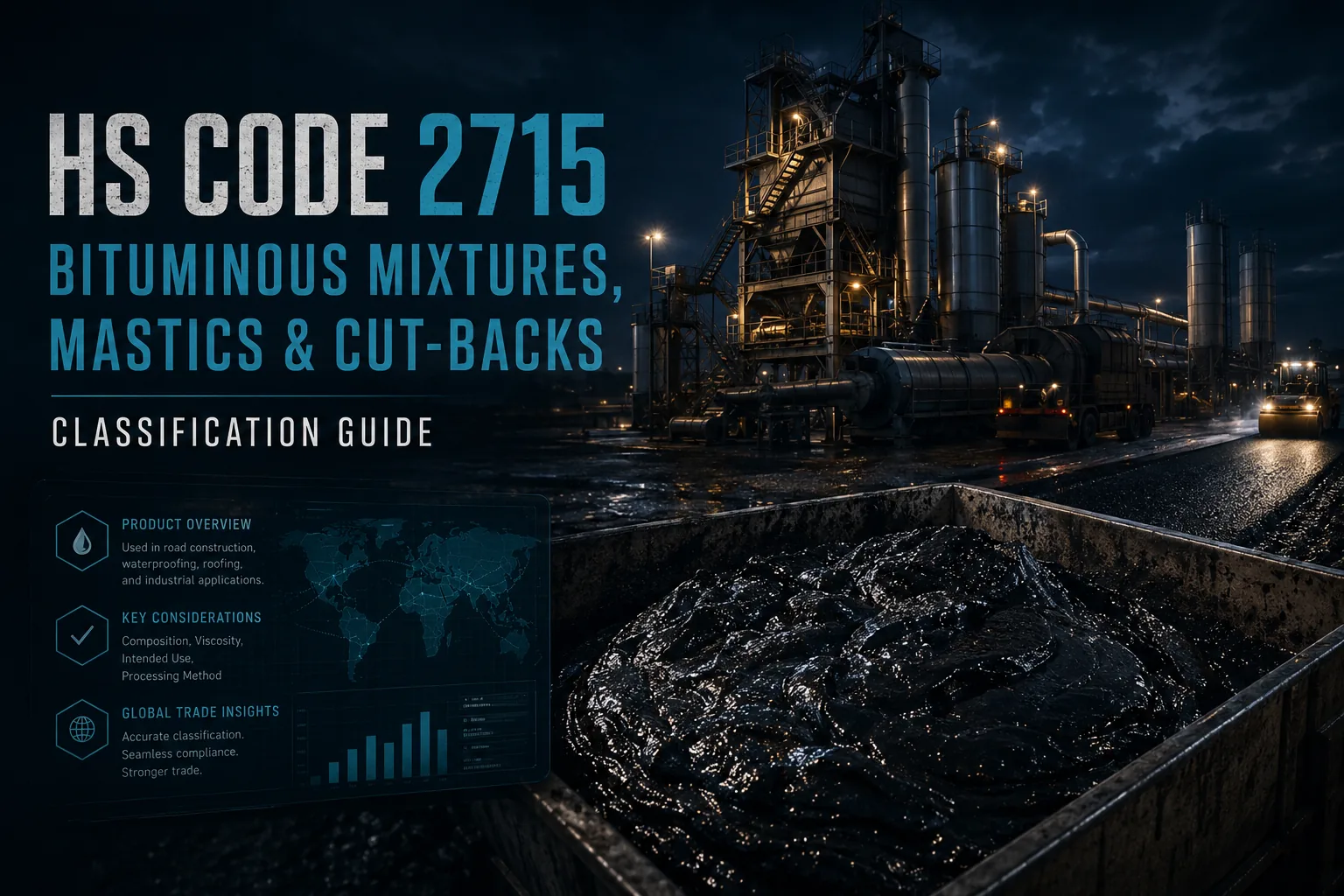
HS Code 2715 covers certain bituminous mixtures based on specific materials named in the legal heading: natural asphalt, natural bitumen, petroleum bitumen, mineral tar or mineral tar pitch.
At international HS6 level, the entire heading is represented by one code:
- 2715.00 — Bituminous mixtures based on the materials specified in heading 2715.
The legal wording expressly gives bituminous mastics and cut-backs as examples.
However, this does not mean that every product marketed as asphalt, bitumen coating, road compound, roofing compound, waterproofing material or mastic automatically belongs in 2715.
Classification begins by establishing:
- what the base material actually is;
- whether the imported product is a mixture;
- what additional components are present;
- what processing or formulation has occurred;
- and whether another heading more specifically describes the imported goods.
Where HS Code 2715 sits within Chapter 27
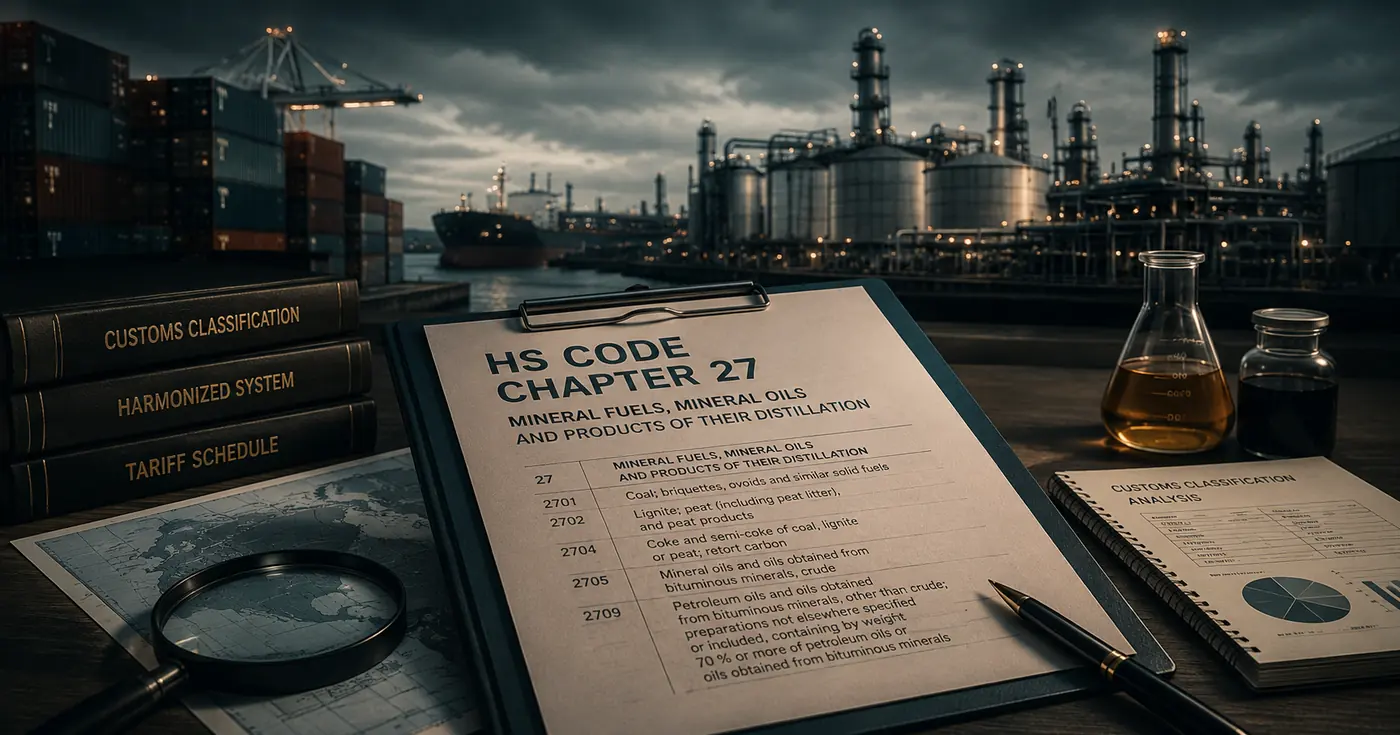
Heading 2715 is part of Chapter 27: mineral fuels, mineral oils and products of their distillation; bituminous substances; mineral waxes.
For the wider chapter structure, see: HS Code Chapter 27 Classification Guide .
Heading 2715 sits immediately after:
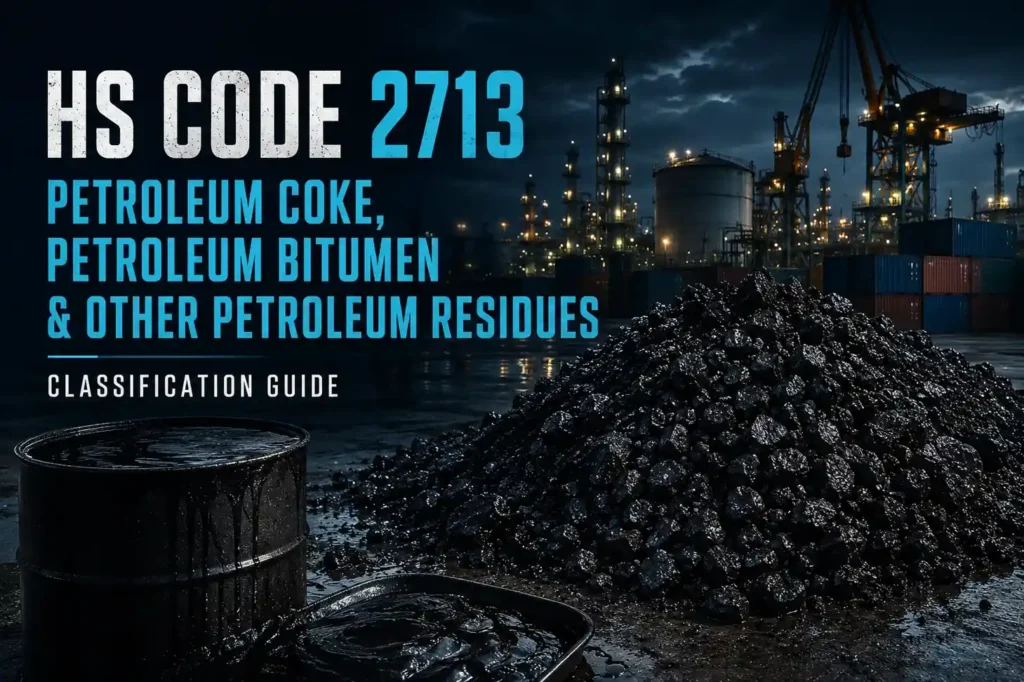
- 2713 — petroleum coke, petroleum bitumen and other petroleum residues;
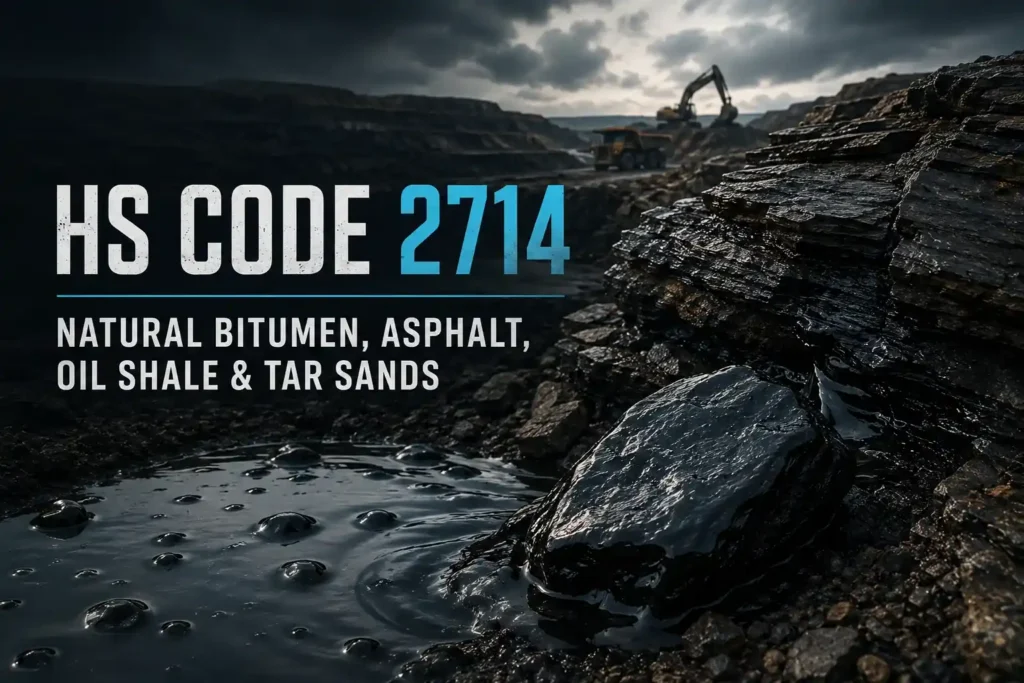
- 2714 — natural bitumen, natural asphalt, oil shale, tar sands, asphaltites and asphaltic rocks.
It is followed by:
- 2716 — electrical energy.
The position of 2715 within the tariff is useful because it highlights a recurring classification sequence:
raw or base bituminous material → prepared bituminous mixture → potentially a finished manufactured article.
For example:
- petroleum bitumen itself may be examined under 2713.20;
- natural bitumen itself may be examined under 2714;
- a qualifying mixture based on either material may be examined under 2715;
- a finished article made from asphalt or similar material may require consideration under 6807.
Legal text of heading 2715
Under HS 2022, heading 27.15 reads:
The wording contains three important legal elements.
1. The imported product must be a bituminous mixture
The heading is not simply a list of raw materials. It refers to mixtures based on the specified bituminous materials.
2. The mixture must be based on a material named in the heading
The legal heading identifies:
- natural asphalt;
- natural bitumen;
- petroleum bitumen;
- mineral tar;
- mineral tar pitch.
The technical file should therefore establish what the bituminous base or binder actually is.
3. Mastics and cut-backs are examples, not separate HS6 subdivisions
The words “bituminous mastics” and “cut-backs” appear as examples within the heading.
They do not create separate international six-digit subheadings.
International HS6 structure of heading 2715
The single international HS6 code under heading 2715.
Any additional tariff subdivisions must be checked in the current tariff of the destination country.
What does “based on” mean for HS 2715 classification?
The words “based on” are central to the heading.
The classification file should identify the material that forms the bituminous foundation, binder or principal basis of the mixture.
Typical supporting evidence includes:
- full formulation;
- ingredient percentages;
- type of bitumen or asphalt used;
- type of mineral tar or pitch used;
- solvent content;
- water content;
- fillers;
- fibres;
- polymers;
- surfactants or emulsifiers;
- other additives;
- production process.
A commercial label such as “road coating” or “waterproofing compound” does not identify the legal basis of the mixture.
Likewise, the fact that a product contains some bitumen does not by itself prove that the product is legally a bituminous mixture of heading 2715.
Composition percentages may be important evidence, but the legal analysis should still begin with the heading text, applicable Notes, the actual mixture and realistic competing headings.
Bituminous mastics under HS 2715
Bituminous mastics are expressly named as an example in heading 2715.
In commercial practice, such products may be used for:
- waterproofing;
- surface protection;
- joint or crack filling;
- roofing applications;
- corrosion protection;
- construction sealing;
- industrial protective applications.
Their composition can vary substantially.
Depending on the product, the formulation may include:
- bitumen or asphalt binder;
- mineral fillers;
- fibres;
- solvents;
- water;
- polymers;
- other performance additives.
The presence of the commercial word “mastic” is not enough by itself.
The product should be confirmed as an asphalt or other bituminous mastic.
The Chapter 32 boundary
Chapter 32 includes many types of:
- putties;
- caulking compounds;
- resin cements;
- mastics;
- surface preparations.
However, Chapter 32 Note 1(c) specifically excludes mastics of asphalt and other bituminous mastics and directs them to heading 2715.
A generic construction mastic should not be classified merely from the word “mastic”. First determine whether it is specifically an asphalt or bituminous mastic. If it is not, heading 3214 or another heading may require examination.
Cut-backs under HS 2715
Cut-backs are also expressly named in the legal text of heading 2715.
In general technical use, cut-back bitumen is produced by combining bitumen with a suitable volatile diluent or solvent to reduce viscosity and improve application at lower temperatures.
For customs purposes, the key point is that a qualifying cut-back is not simply unmodified petroleum bitumen.
It is a prepared mixture.
Useful evidence for a cut-back product
- bitumen type;
- solvent identity;
- solvent percentage;
- flash point;
- viscosity;
- distillation profile where available;
- production process;
- TDS;
- SDS;
- product specification;
- supplier formulation declaration.
The solvent content helps establish the physical and technical identity of the mixture, but classification should not be based on an invented universal solvent-percentage threshold.
Bitumen emulsions and similar preparations
Bitumen emulsions commonly contain:
- bitumen;
- water;
- an emulsifying agent;
- and sometimes stabilisers or other additives.
Such a product may have the character of a bituminous mixture based on petroleum bitumen and may therefore require analysis under 2715.
However, the correct classification should be confirmed from the exact composition and imported condition.
Verify the actual base, complete formulation, product function, processing, and any competing heading before declaration.
Road-surfacing, waterproofing and protective bituminous mixtures
Bituminous mixtures can be formulated for many different applications.
Supporting customs explanatory guidance in some jurisdictions describes products used for:
- waterproofing surfaces;
- protecting surfaces;
- corrosion-resistant coatings;
- electrical insulation;
- filling cracks;
- road surfacing;
- construction sealing.
These uses can support understanding of the commercial products encountered under heading 2715.
Nevertheless, intended use alone does not establish classification.
The key legal questions remain:
- is the product a bituminous mixture?
- what is its base material?
- what ingredients have been added?
- is it still a preparation, or has it become a manufactured article?
Detailed thresholds or examples published by another customs jurisdiction may help technical analysis, but the international HS legal text and the destination tariff remain the primary basis.
Critical classification boundaries for HS 2715
| Competing heading | Main classification question | Evidence to review |
|---|---|---|
| 2706 | Is the product mineral tar itself, or has it been formulated into a qualifying bituminous mixture? | Composition, processing history, added materials and product specification. |
| 2708 | Is the product mineral tar pitch itself or a mixture based on such pitch? | Feedstock, process records, formulation and imported condition. |
| 2713.20 | Is the shipment petroleum bitumen itself or a prepared mixture based on petroleum bitumen? | Formulation, solvents, water, fillers, additives and process history. |
| 2714 | Is the shipment natural bitumen or natural asphalt itself, or a prepared mixture based on it? | Geological origin, formulation, additives and imported physical form. |
| 3214 | Is the mastic specifically an asphalt or bituminous mastic, or a different type of caulking compound or mastic? | Binder chemistry, bituminous content, resin or polymer system, TDS and formulation. |
| 6807 | Is the product still a bituminous mixture, or has it become a finished article of asphalt or similar material? | Product form, manufacturing process, backing, reinforcement, dimensions and final article identity. |
2715 versus 2713.20 — Petroleum bitumen versus bituminous mixture
Petroleum bitumen itself is specifically provided for under 2713.20.
If petroleum bitumen is deliberately formulated with a solvent, filler, water, emulsifier or other components, the resulting product may instead require consideration under 2715.
The exact formulation matters.
“Is this the petroleum bitumen itself, or has it been formulated with other ingredients before shipment?”
2715 versus 2714 — Natural material versus prepared mixture
Heading 2714 covers natural bitumen and natural asphalt themselves, together with other natural materials named in that heading.
Heading 2715 covers qualifying mixtures based on natural asphalt or natural bitumen.
Therefore, the addition of other ingredients and the creation of a prepared product can move the analysis from 2714 to 2715.
2715 versus 3214 — Bituminous mastic versus other mastic
Heading 3214 covers many non-bituminous mastics, caulking compounds and related products.
But the legal Notes to Chapter 32 specifically remove asphalt mastics and other bituminous mastics from that Chapter and direct them to heading 2715.
The classification file should therefore identify the binder system, not merely the product name.
2715 versus 6807 — Mixture versus article
A drum, pail or bulk shipment of a qualifying bituminous mixture may be considered under 2715.
A finished roofing roll, sheet, tile or another manufactured article may instead require analysis under 6807 or another relevant heading.
The question is:
Are you importing the mixture, or are you importing an article manufactured from that mixture?
Technical evidence for classifying HS Code 2715
| Technical evidence | Why it matters |
|---|---|
| Exact product name | Helps distinguish raw bitumen, mastic, cut-back, emulsion, coating and finished articles. |
| Full formulation | One of the most important pieces of evidence for a mixture heading. |
| Ingredient percentages | Shows the relationship between bituminous base and other components. |
| Type of base material | Confirms whether the mixture is based on a material named in heading 2715. |
| Petroleum bitumen grade | Helps distinguish base bitumen from the prepared formulation. |
| Natural asphalt / natural bitumen information | Supports the identity of a naturally derived bituminous base. |
| Mineral tar or pitch information | Important where the mixture is based on tar or tar pitch. |
| Solvent identity | Particularly important for cut-backs and solvent-containing preparations. |
| Solvent content | Supports the technical identification of the formulation. |
| Water content | Important for emulsions and water-based bituminous mixtures. |
| Emulsifier | Helps identify bitumen emulsions and similar preparations. |
| Mineral fillers | Relevant for mastics, sealants and road-surfacing mixtures. |
| Fibres | May form part of certain bituminous mastics or protective preparations. |
| Polymers | Important when assessing polymer-modified formulations and competing headings. |
| Other additives | Can materially affect product identity and use. |
| Viscosity | Useful for differentiating raw bitumen from more fluid prepared products. |
| Flash point | Can support identification of solvent-containing cut-back products. |
| Density | Supports physical and technical characterisation. |
| Application method | Helps explain whether the product is used as coating, mastic, road treatment or another preparation. |
| Production process | Shows how the final mixture was created from its base materials. |
| TDS | Useful supporting evidence for product identity and properties. |
| SDS | Useful supporting evidence but not a legal classification rule. |
| CoA / laboratory data | May support formulation and physical-property verification. |
| Supplier formulation statement | Important when commercial documents do not disclose the complete composition. |
TDS, SDS, CoA, viscosity, solvent content, filler content and application data should be used to establish the actual product facts. They do not independently determine the HS code.
Step-by-step classification process for HS 2715
Identify the imported product precisely
Determine whether the shipment is raw bitumen, a mastic, cut-back, emulsion, coating, road mixture or finished article.
Confirm that it is a mixture
Identify all components added to the bituminous base.
Identify the base material
Determine whether it is based on natural asphalt, natural bitumen, petroleum bitumen, mineral tar or mineral tar pitch.
Obtain the complete formulation
Review bitumen, solvent, water, filler, fibre, polymer, emulsifier and other additive content.
Review the production process
Establish what was mixed, dispersed, diluted, emulsified or otherwise formulated before import.
Apply GRI 1
Start with the wording of heading 2715 and the applicable Section and Chapter Notes.
Test the 2713.20 boundary
Confirm whether the product is petroleum bitumen itself or a mixture based on petroleum bitumen.
Test the 2714 boundary
Confirm whether natural asphalt or natural bitumen remains unprepared or has become a mixture.
Test the Chapter 32 boundary
For mastics and sealants, determine whether the product is specifically bituminous or based on another binder system.
Test the finished-article boundary
Determine whether the shipment is still the mixture or a manufactured article.
Use 2715.00 after heading 2715 is established
Heading 2715 has one international HS6 code: 2715.00.
Verify the destination tariff
Confirm any additional digits required in Saudi Arabia, UAE, Qatar, Oman, Kuwait or Bahrain.
Need to classify a bituminous mixture?
JAMAREK helps structure customs classification analysis around the actual formulation, base material, technical evidence, competing headings and destination-country tariff requirements.
Practical HS Code 2715 classification scenarios
Scenario 1 — Petroleum bitumen without additives
The shipment consists solely of petroleum bitumen with no deliberate formulation.
Do not classify it under 2715 merely because it can later be used to manufacture bituminous mixtures.
2713.20 should be examined.
Scenario 2 — Petroleum bitumen diluted with solvent
Petroleum bitumen has been deliberately mixed with a volatile solvent to reduce viscosity.
This is consistent with the type of preparation commonly described as a cut-back.
2715.00 should be examined, subject to the complete facts.
Scenario 3 — Natural bitumen without formulation
The product is natural bitumen imported without additional ingredients.
The analysis remains under 2714, rather than automatically moving to 2715.
Scenario 4 — Natural bitumen with mineral filler
Natural bitumen is blended with mineral filler to form a prepared mastic.
This changes the analysis from natural bitumen itself to a prepared bituminous mixture.
2715.00 may be appropriate.
Scenario 5 — Bituminous crack-sealing mastic
The product is a formulated mastic whose binder is petroleum bitumen and which contains fillers and additives.
Because bituminous mastics are expressly referenced in heading 2715, 2715.00 should be examined.
Scenario 6 — Silicone construction sealant
The product is marketed as a “mastic” but its binder is silicone and it contains no qualifying bituminous base.
The word “mastic” does not make it a 2715 product.
Other headings, including 3214 where appropriate, should be examined.
Scenario 7 — Acrylic caulking compound
The formulation is acrylic-based rather than bituminous.
2715 should not be selected solely because the product fills cracks.
Scenario 8 — Bitumen emulsion
The product contains petroleum bitumen, water and an emulsifying agent.
The mixture may require consideration under 2715.00, but the complete formulation and any competing headings must be confirmed.
Scenario 9 — Polymer-modified bituminous coating
Petroleum bitumen is blended with polymer and other additives to form a protective coating.
The full formulation must be analysed.
If the imported goods retain the character of a qualifying bituminous mixture, 2715 may be relevant.
Scenario 10 — Mineral tar without formulation
The shipment is mineral tar itself.
Do not use 2715 simply because mineral tar is one of the possible base materials named in heading 2715.
The underlying mineral tar heading should be examined.
Scenario 11 — Mineral tar mixed with fillers
Mineral tar is intentionally combined with fillers to create a surface-protection preparation.
If it meets the legal description of a bituminous mixture based on mineral tar, 2715 may be relevant.
Scenario 12 — Mineral tar pitch itself
The imported product is pitch itself, without preparation into a mixture.
The appropriate pitch heading must be examined before 2715.
Scenario 13 — Mineral tar pitch mastic
Mineral tar pitch has been blended with fillers and other components into a prepared mastic.
Heading 2715 may be relevant because the product is now a mixture based on mineral tar pitch.
Scenario 14 — Waterproofing compound in pails
The product is a black paste sold for waterproofing.
The use and colour are insufficient.
Determine whether the binder is bitumen, asphalt, polymer, silicone or another material.
Only then can 2715 be assessed properly.
Scenario 15 — Bituminous anti-corrosion coating
Petroleum bitumen forms the base of a prepared protective coating containing fillers and additives.
Heading 2715 may be relevant, depending on the exact composition.
Scenario 16 — Ready-mixed bituminous road material
A prepared mixture contains bituminous binder and mineral aggregate for road construction.
The complete formulation and imported condition should be reviewed to determine whether 2715 describes the mixture.
Scenario 17 — Asphalt roofing roll
A bituminous mixture has already been incorporated into a manufactured roofing roll.
The imported good is now an article, not simply the mixture.
6807 should be examined.
Scenario 18 — Asphalt sheet
The material has been manufactured into a defined sheet or article.
Do not automatically classify it as bulk 2715 mixture.
The finished-article headings should be reviewed.
Scenario 19 — Supplier states “Asphalt Mastic”
The description suggests 2715 but is not sufficient on its own.
Confirm:
- the binder;
- the formulation;
- the presence of fillers or solvent;
- the product form.
Scenario 20 — Supplier states only “Road Bitumen”
This description may refer to petroleum bitumen itself rather than a mixture.
Confirm whether any other ingredients were added before shipment.
Scenario 21 — Bitumen mixed with rubber
Bitumen is mixed with rubber and inert fillers to create a prepared material.
The resulting product requires analysis as a formulation, not simply as petroleum bitumen.
Scenario 22 — Sulfonated asphalt preparation
Asphalt has undergone chemical treatment and the resulting imported product contains modified asphalt-derived material together with other constituents.
This type of product requires fact-specific analysis of the final mixture, including realistic competing headings.
Do not classify solely from the word “asphalt”.
Scenario 23 — Hot-applied bituminous mastic
A solid or semi-solid prepared product must be heated before application.
Physical state at room temperature does not by itself exclude heading 2715.
The formulation and bituminous base remain critical.
Scenario 24 — Bituminous mixture packed for retail
A qualifying bituminous mixture is packed in small retail containers.
Retail packaging alone does not automatically change the HS heading.
Classification remains based on the actual product and applicable legal provisions.
Common HS Code 2715 classification mistakes
1. Treating all petroleum bitumen as 2715
Petroleum bitumen itself is specifically provided for under 2713.20.
2. Treating all natural bitumen as 2715
Natural bitumen itself is associated with heading 2714.
3. Ignoring the word “mixtures” in the legal heading
Heading 2715 is not simply a list of raw bituminous materials.
4. Ignoring the legal base materials
The heading identifies natural asphalt, natural bitumen, petroleum bitumen, mineral tar and mineral tar pitch.
5. Treating every product called “mastic” as 2715
Non-bituminous mastics may fall elsewhere.
6. Ignoring Chapter 32 Note 1(c)
Asphalt mastics and other bituminous mastics are specifically excluded from Chapter 32 to heading 2715.
7. Assuming every waterproofing compound is 2715
Waterproofing products can use many different binder systems.
8. Assuming every black coating is bituminous
Colour does not prove composition.
9. Classifying only from intended use
Road, roofing or waterproofing use does not independently determine the heading.
10. Ignoring solvent content
Solvent information is highly relevant for cut-back products.
11. Ignoring water and emulsifiers
These can be important in identifying an emulsion-type preparation.
12. Ignoring fillers
Fillers can help establish that raw bitumen has become a prepared mastic or mixture.
13. Ignoring polymers
Polymer-modified products require review of the complete formulation.
14. Assuming all polymer-modified bitumen is automatically 2715
The actual product and competing headings must still be reviewed.
15. Using SDS as the final HS decision
SDS is technical evidence, not the legal classification rule.
16. Using TDS as the final HS decision
TDS supports product identification but does not replace GRI analysis.
17. Accepting the supplier HS code without verification
Supplier coding is supporting information, not a binding customs ruling.
18. Treating a finished asphalt article as bulk mixture
Finished articles may require consideration under 6807 or another heading.
19. Treating a cut-back as pure petroleum bitumen
Deliberate dilution creates a prepared mixture requiring separate analysis.
20. Inventing separate international HS6 codes for mastics and cut-backs
Heading 2715 has one international HS6 code: 2715.00.
21. Converting foreign explanatory thresholds into worldwide HS rules
National or regional explanatory guidance should not be presented as a universal legal threshold unless incorporated into the applicable tariff law.
22. Ignoring the production process
Knowing what was mixed or modified before import is often essential.
23. Failing to record rejected headings
A strong classification analysis should explain why realistic alternatives do not apply.
24. Stopping at HS6 without checking the destination tariff
Additional tariff digits must be verified in the destination country.
Building a defensible HS 2715 classification file
Depending on the product, a strong classification file may include:
- exact technical product name;
- commercial name;
- full formulation;
- ingredient percentages;
- type of bituminous base;
- petroleum bitumen grade;
- natural asphalt or natural bitumen information;
- mineral tar or pitch information;
- solvent type and percentage;
- water content;
- emulsifier type;
- mineral fillers;
- fibres;
- rubber;
- polymers;
- surfactants;
- other additives;
- viscosity;
- density;
- flash point;
- softening behaviour where relevant;
- application temperature;
- production process;
- mixing process;
- emulsification process where applicable;
- packaging;
- physical form at import;
- TDS;
- SDS;
- CoA;
- laboratory report;
- supplier formulation declaration;
- product photographs;
- GRI 1 analysis;
- relevant Section and Chapter Notes;
- comparison with 2706 where relevant;
- comparison with 2708 where relevant;
- comparison with 2713.20;
- comparison with 2714;
- comparison with 3214 where relevant;
- comparison with 6807 where relevant;
- rejected headings and reasons;
- destination-country detailed tariff.
1. What exactly is the bituminous base?
2. What other components have been added?
3. Is the imported product truly a mixture or only the base material itself?
4. Is it still a preparation, or has it become a finished article?
5. Which realistic competing headings have been tested and rejected?
HS Code 2715 in Saudi Arabia, UAE, Qatar, Oman, Kuwait and Bahrain
For customs classification in:
- Saudi Arabia;
- United Arab Emirates (UAE);
- Qatar;
- Oman;
- Kuwait;
- Bahrain,
the international classification foundation is:
2715.00 — Bituminous mixtures based on the materials specified in heading 2715.
The first six digits form the international HS code.
The destination tariff may add further digits for more detailed customs classification.
Always verify the current detailed tariff code required in Saudi Arabia, the United Arab Emirates, Qatar, Oman, Kuwait or Bahrain before declaration.
In addition to tariff classification, bituminous mixtures may be subject to separate regulatory requirements depending on:
- chemical composition;
- flammable solvent content;
- dangerous-goods status;
- industrial use;
- construction standards;
- environmental controls;
- transport requirements;
- destination-country import controls.
These requirements should be analysed separately from the HS classification itself.
HS 2028 and heading 2715
This guide is based on HS 2022.
The World Customs Organization has published the amendments for the next edition of the Harmonized System, scheduled to enter into force internationally on 1 January 2028.
Within Chapter 27, the published HS 2028 amendments modify the structure under heading 2710 for certain waste oils.
The published amendment document then proceeds to Chapter 28 without listing an amendment to heading 2715.
Accordingly, the currently published HS 2028 Recommendation does not list a change to the international heading or HS6 structure of 2715.
Classify goods under the tariff legally in force on the declaration date. Do not apply a future HS edition early merely because the amendments have already been published.
Frequently asked questions about HS Code 2715
What does HS Code 2715 cover?
What is the international HS6 code for heading 2715?
How many international HS6 codes are under 2715?
Are bituminous mastics specifically mentioned in heading 2715?
Are cut-backs specifically mentioned in heading 2715?
Is pure petroleum bitumen classified under 2715?
Is natural bitumen itself classified under 2715?
What is the main difference between 2714 and 2715?
What is the main difference between 2713.20 and 2715?
Does adding solvent to petroleum bitumen matter?
Does adding mineral filler to bitumen matter?
Can a bitumen emulsion fall under 2715?
Is every bitumen emulsion automatically 2715.00?
Is every waterproofing compound classified under 2715?
Is every mastic classified under 2715?
Why is Chapter 32 Note 1(c) important?
Can a silicone sealant be classified under 2715?
Can an acrylic mastic be classified under 2715?
Can a polymer-modified bituminous product fall under 2715?
Does the product's use for road construction prove 2715?
Does use for waterproofing prove 2715?
Can a finished asphalt roofing roll be classified under 2715?
What is the difference between a bituminous mixture and an asphalt article?
Can mineral tar-based mixtures fall under 2715?
Can mineral tar pitch-based mixtures fall under 2715?
Can SDS determine HS Code 2715?
Can TDS determine HS Code 2715?
What is the most important document for a 2715 classification?
Do Saudi Arabia, UAE, Qatar, Oman, Kuwait and Bahrain share the same international HS6 code?
Will heading 2715 change under HS 2028?
Classify the formulation — not just the word “bitumen”
Petroleum bitumen, natural bitumen, bituminous mastics, cut-backs, emulsions, sealants and finished asphalt products may be commercially related, but they do not automatically share the same HS heading. Reliable classification begins with the actual formulation and imported condition.
Conclusion
HS Code 2715 covers qualifying bituminous mixtures based on:
- natural asphalt;
- natural bitumen;
- petroleum bitumen;
- mineral tar;
- mineral tar pitch.
The heading expressly identifies bituminous mastics and cut-backs as examples.
Under HS 2022, there is only one international HS6 code:
2715.00.
The most important classification question is often whether the imported product is still the underlying bituminous material itself or whether it has become a prepared mixture.
Petroleum bitumen itself should be distinguished from mixtures under the boundary with 2713.20.
Natural asphalt and natural bitumen themselves should be distinguished from prepared mixtures under the boundary with 2714.
Bituminous mastics should also be distinguished from non-bituminous mastics, with Chapter 32 Note 1(c) providing an important legal rule for asphalt and other bituminous mastics.
Once a bituminous mixture has been manufactured into a finished article, headings such as 6807 may become relevant.
Full formulation, ingredient percentages, solvent content, water, emulsifiers, fillers, polymers, production process, TDS, SDS and laboratory data can provide important supporting evidence.
However, technical evidence does not replace the legal heading wording, applicable Section or Chapter Notes or the General Rules for Interpretation.
After determining the correct international HS6 classification, always verify the current detailed tariff and applicable import requirements in Saudi Arabia, the United Arab Emirates, Qatar, Oman, Kuwait and Bahrain.
Official & Supporting Sources
- World Customs Organization — HS 2022 Chapter 27
- World Customs Organization — General Rules for the Interpretation of the Harmonized System
- World Customs Organization — HS 2022 Chapter 32
- World Customs Organization — HS 2022 Chapter 68
- World Customs Organization — Official HS 2028 Amendments
- European Union — Combined Nomenclature Explanatory Notes for Heading 2715
This guide is provided for general educational and informational purposes only. Correct customs classification depends on the actual identity of the imported goods, complete formulation, base material, ingredient percentages, processing history, physical form, technical specifications, supporting documentation and the tariff legally in force on the relevant declaration date.
Commercial descriptions such as Bitumen, Asphalt, Bituminous Mastic, Cut-Back, Bitumen Emulsion, Asphalt Coating, Road Bitumen, Waterproofing Compound, Polymer Modified Bitumen, Crack Sealer or Roofing Compound should not be treated as complete customs classification conclusions without confirming their actual technical meaning.
TDS, SDS, CoA, formulation sheets, laboratory results, viscosity, solvent content, water content, filler content, polymer content and supplier statements are supporting evidence. They do not themselves create a binding HS classification.
Explanatory guidance, examples or technical thresholds published by a particular customs jurisdiction can be useful supporting material, but they should not automatically be presented as universal international HS legal rules in another jurisdiction.
Environmental, dangerous-goods, chemical, construction, industrial, transport, conformity and other regulatory requirements are separate matters and may require additional analysis.
Nothing in this article constitutes a binding customs ruling. Before applying any classification in Saudi Arabia, the United Arab Emirates, Qatar, Oman, Kuwait or Bahrain, verify the current detailed tariff, customs procedures and applicable regulatory requirements in the destination country.