

HS Code 2703: Peat (Including Peat Litter) Classification Guide
A practical guide to HS Code 2703 for peat, including peat litter, whether or not agglomerated, with classification guidance for Saudi Arabia, the United Arab Emirates (UAE), Qatar, Oman, Kuwait and Bahrain.
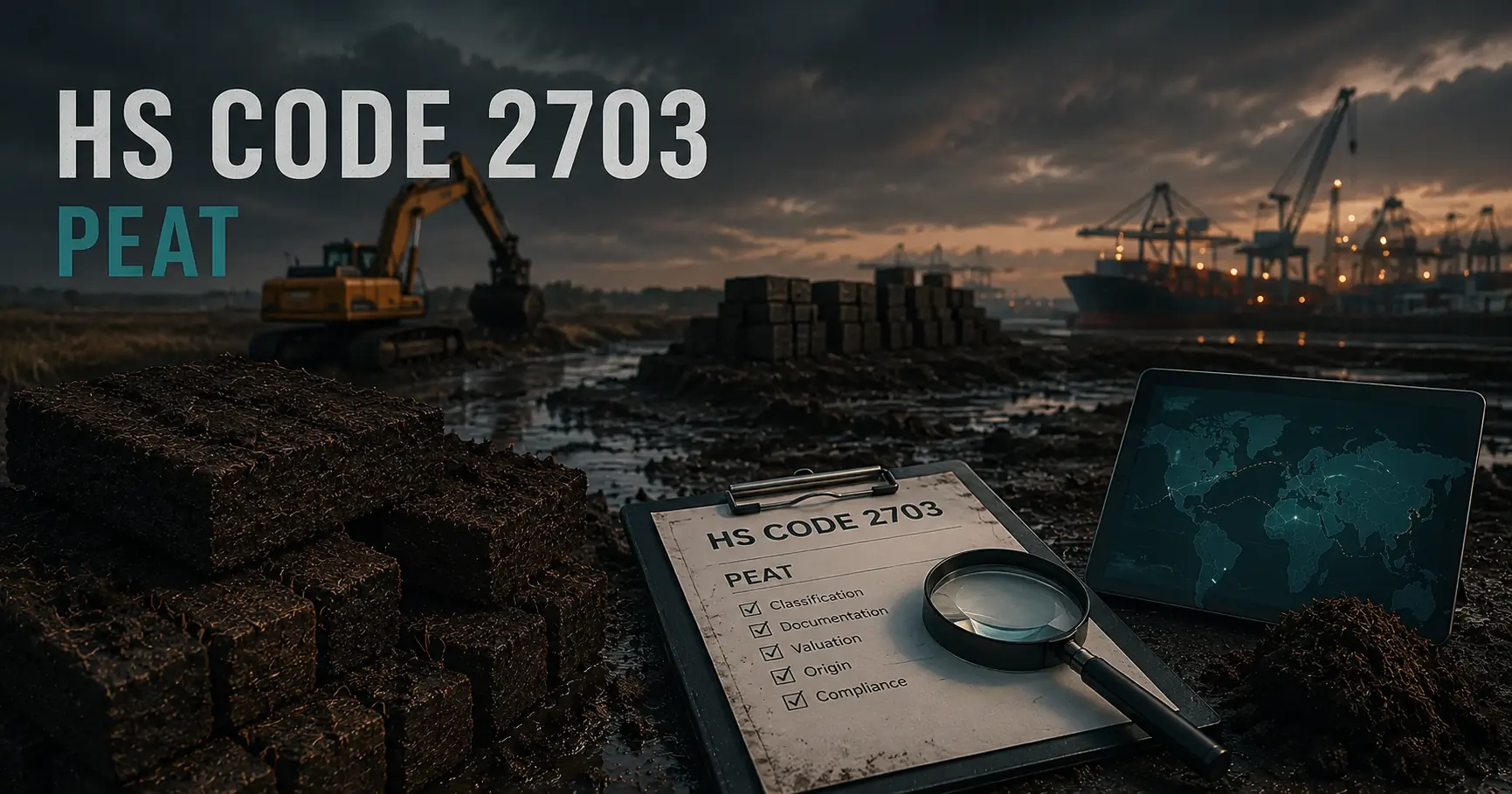
HS Code 2703 covers peat, including peat litter, whether or not agglomerated. Unlike several neighbouring headings in Chapter 27, Heading 2703 is unusually compact: the four-digit heading leads to a single international six-digit subheading, 2703.00.
That simple structure does not mean every product containing peat can automatically be classified under 2703. The classifier still needs to establish what the goods actually are. A shipment may be described commercially as peat, peat moss, horticultural peat, peat substrate, peat blocks, peat briquettes, growing media or soil conditioner. Those expressions can describe very different products, ranging from peat in a relatively straightforward form to complex formulations containing fertilizers, mineral components, coir, perlite, wetting agents or other additives.
The legal wording therefore provides the starting point, not the end of the analysis. The key question is whether the goods presented to customs remain accurately described by Heading 2703: peat, including peat litter, whether or not agglomerated.
Where HS Code 2703 Sits in Chapter 27
Heading 2703 belongs to Chapter 27 of the Harmonized System, covering mineral fuels, mineral oils and products of their distillation, bituminous substances and mineral waxes. For broader chapter context, see the HS Code Chapter 27 guide .
The official HS 2022 sequence places 2703 between Heading 2702 for lignite and Heading 2704 for coke and semi-coke of coal, lignite or peat. This placement is useful because it highlights several classification boundaries that can matter in practice. Peat itself belongs in 2703. Lignite has its own heading in 2702. If peat is processed into coke or semi-coke, Heading 2704 becomes relevant. Tar distilled from peat is addressed in 2706, while peat wax is specifically named within 2712.
Those neighbouring provisions reinforce an important customs principle: the origin of a product does not permanently determine its HS heading. A product that started as peat can move to a different heading if processing creates another commodity described elsewhere in the nomenclature.
HS 2703 Classification Structure
International HS Structure
Peat (including peat litter), whether or not agglomerated.
Peat (including peat litter), whether or not agglomerated.
The heading and the six-digit subheading have the same substantive scope. This is different from Heading 2702, where the international level separates non-agglomerated lignite from agglomerated lignite. For peat, the HS 2022 nomenclature does not create separate six-digit categories based on agglomeration.
This matters for both classification and content planning. A product may be loose peat, compressed peat, peat blocks or another agglomerated form and still remain within 2703.00, provided that the finished goods remain peat and no other legal provision describes them more appropriately.
There is no international 2703.10 versus 2703.20 structure under HS 2022. The international subheading is 2703.00.
What Does “Including Peat Litter” Mean for Classification?
The wording of Heading 2703 specifically includes peat litter. That inclusion is legally significant because it confirms that peat presented in a litter form is not excluded merely because of the way it is marketed or used.
In practice, a classifier should still verify the actual material. The phrase “litter” on a bag or invoice is not enough by itself. If the product is peat litter, the heading expressly includes it. If it is a formulated litter product containing peat together with substantial quantities of other materials, fragrances, absorbents or functional ingredients, the complete composition and legal description of the finished product should be reviewed.
The same principle applies to products sold for horticulture. The HS wording identifies peat as a material; it does not state that only peat used as fuel belongs in Chapter 27. A commercial end use such as horticulture, soil improvement or bedding does not by itself remove genuine peat from 2703.
Agglomerated Peat: Why Physical Form Usually Does Not Change 2703
Heading 2703 says “whether or not agglomerated.” This is one of the most useful pieces of legal wording in the classification analysis because it directly answers a common question.
Peat can be processed into compressed blocks, briquette-like forms, pellets, plugs or other consolidated shapes for transport, handling, storage or use. The fact that particles have been compressed or formed does not automatically move genuine peat outside Heading 2703.
The correct analysis is therefore different from the analysis used for lignite under 2702. With lignite, agglomeration determines which of two international six-digit subheadings applies. With peat, agglomerated and non-agglomerated forms remain together under 2703.00.
Compression is not the same as formulation
A compressed block made essentially from peat is not necessarily the same classification problem as a manufactured growing medium that contains peat plus several other ingredients. Compression changes the physical presentation. Formulation can change the composition and potentially the legal identity of the product.
This distinction is especially important for horticultural goods. A manufacturer may compress peat principally to reduce freight volume or change its physical presentation. Another manufacturer may combine peat with coir, perlite, mineral nutrients, fertilizer, lime, wetting agents or other substances to create a multi-component growing medium.
Both products may be marketed using the word “peat”, but the commercial description does not determine the tariff result. The finished goods must be evaluated under the heading terms, relevant legal Notes and the General Rules for Interpretation. For mixtures, GRI 2(b) and, where necessary, GRI 3 may become relevant.
Horticultural Peat, Peat Moss and Growing Media
Many searches for HS Code 2703 come from businesses trading horticultural materials rather than energy products. Terms such as peat moss, horticultural peat, potting peat, peat substrate and growing media are common in commercial documentation.
Those terms should be treated carefully. “Peat moss” is widely used commercially, but the customs analysis must still identify the actual goods. If the shipment consists of peat, including material processed into a form still accurately described as peat, Heading 2703 is the natural provision to evaluate. If the product is a formulated mixture, classification should be based on the finished formulation rather than on the presence of peat alone.
Useful questions for horticultural products
- Is the product essentially peat, or is it a multi-component growing medium?
- Are coir, bark, perlite, vermiculite, sand or mineral components added?
- Does the product contain fertilizer or nutrient additives?
- Has lime or another pH-adjusting material been incorporated?
- Are wetting agents, polymers or other functional additives present?
- Is the material loose, compressed or formed into plugs or blocks?
- What percentage of the finished product is peat?
- How does the manufacturer describe the production process and finished product?
These questions are evidence-gathering tools, not automatic tariff tests. HS 2022 does not prescribe a special percentage of peat, moisture content, pH, electrical conductivity or organic-matter threshold in the legal wording of 2703. The information helps determine what the product really is and whether another heading needs to be considered.
The presence of coir, perlite, fertilizer, lime, wetting agents, minerals or other materials does not automatically determine whether the finished product remains classified in Heading 2703 or should be classified elsewhere.
Classification begins under GRI 1 with the terms of the headings and any relevant Section or Chapter Notes. Where the goods consist of peat mixed or combined with other materials, GRI 2(b) may also need to be considered.
If, after applying those provisions, the finished goods are prima facie classifiable under two or more headings, the analysis may proceed under GRI 3 before classification at the subheading level under GRI 6.
Composition percentages, pH, moisture, fertilizer content and other technical data establish the facts about the product. They do not, by themselves, create an automatic HS 2703 threshold.
No Special Numerical Threshold in the Chapter 27 Notes
The Chapter 27 Subheading Notes contain precise technical thresholds for certain other goods. For example, anthracite under 2701.11 and bituminous coal under 2701.12 are defined using volatile-matter and calorific-value criteria. Light oils under 2710.12 are defined using a distillation test.
There is no comparable numerical definition in the Chapter 27 Notes for Heading 2703. The legal text does not say that peat must contain a specified percentage of moisture, organic matter, fibre or ash, nor does it establish a calorific-value threshold for 2703.
Technical Data and Documents to Review
Peat classification is often easier than classification of petroleum preparations, but technical documentation still matters when the commercial name is broad or when the goods have been formulated, compressed or mixed.
| Information | Why It Matters |
|---|---|
| Full product description | Establishes whether the goods are peat, peat litter, peat blocks, a growing medium or another prepared product. |
| Composition | Shows whether peat is the material itself or only one component of a mixture. |
| Physical form | Confirms whether the material is loose, milled, compressed, pelletised, blocked or otherwise agglomerated. |
| Added materials | Identifies coir, perlite, fertilizer, lime, minerals, wetting agents or other components that may change the classification analysis. |
| Production process | Helps distinguish simple cutting, drying, milling or compression from manufacturing that creates a different prepared product. |
| Moisture / organic matter | Can support technical identification of the material, but these values are not stated as dedicated legal thresholds in Heading 2703. |
| pH / electrical conductivity | Common horticultural specifications that help identify a formulated substrate, but are not by themselves HS 2703 legal tests. |
| Intended use | Provides context for horticulture, bedding, soil conditioning or other uses, but use alone does not determine the heading. |
| Packaging and labels | Can reveal whether the manufacturer presents the goods as pure peat or a formulated commercial preparation. |
Useful supporting documents
- commercial invoice;
- packing list;
- technical data sheet (TDS);
- certificate of analysis (COA), where available;
- full composition statement;
- product label and packaging photographs;
- manufacturing or blending description;
- horticultural specification sheet;
- moisture, organic-matter, pH or EC data where relevant to identity;
- supplier statement confirming whether additives are present.
The goal is not to collect every document on every shipment. The goal is to answer the legal classification questions with enough evidence to support the conclusion.
HS 2703 vs Similar Chapter 27 Products
| Heading | Product | Key Distinction |
|---|---|---|
| 2702 | Lignite | Lignite has its own heading and two six-digit subheadings. Peat should not be classified as lignite merely because both are carbonaceous materials. |
| 2703 | Peat, including peat litter | The subject of this guide. Agglomerated and non-agglomerated peat remain within the same international subheading 2703.00. |
| 2704 | Coke and semi-coke of peat | Further processing can produce coke or semi-coke, which is specifically covered by 2704 rather than remaining under 2703. |
| 2706 | Tar distilled from peat | Tar obtained by distillation from peat is specifically named in 2706. |
| 2712 | Peat wax | Peat wax is specifically included with mineral waxes under 2712, not under 2703 merely because it originates from peat. |
2703 vs 2702 — Peat or Lignite?
Peat and lignite can be associated in the geological progression of carbonaceous materials, but the HS treats them as different commodities. The classifier should therefore avoid using a broad term such as “brown organic fuel” or “low-rank coal material” as a substitute for product identification.
Supplier specifications, geological description, physical appearance, fibre structure, moisture, ash and other technical information can help establish whether the goods are peat or lignite. The important legal point is that 2702 and 2703 are separate headings; classification should follow the actual material presented.
See also our HS Code 2701 coal classification guide for the neighbouring coal heading.
2703 vs 2704 — Peat or Peat Coke?
The fact that a product originated from peat does not mean it stays in 2703 after substantial processing. Heading 2704 expressly covers coke and semi-coke of peat. If a thermal or carbonisation process produces a coke-like material, the finished product should be evaluated as presented rather than classified according to the original feedstock.
2703 vs 2712 — Peat or Peat Wax?
Peat wax is specifically named in Heading 2712. A wax extracted or obtained from peat should not be returned to 2703 merely because peat is its source. This illustrates why classification must be based on the goods presented and the applicable heading terms and legal Notes, rather than only on the raw material from which the finished product originated.
How to Evaluate a Product for HS Code 2703
Knowing that peat is covered by Heading 2703 is only the starting point. The classification review should first establish what the imported or exported goods actually are, then apply the legal heading wording and the General Rules for Interpretation.
Identify the Actual Goods
Establish whether the product presented to customs is peat, peat litter, compressed peat, a peat-based growing medium or another prepared product. Do not rely only on a broad invoice description such as “peat moss”, “substrate” or “growing medium”.
Compare the Goods With the Heading Terms Under GRI 1
Heading 2703 expressly covers peat, including peat litter, whether or not agglomerated. Classification begins with that legal wording together with any relevant Section or Chapter Notes.
Review the Physical Form
Determine whether the peat is loose, milled, compressed, blocked, pelletised or otherwise agglomerated. Agglomeration alone does not remove genuine peat from Heading 2703 because the heading expressly covers peat whether or not agglomerated.
Determine Whether the Product Is a Mixture
Review whether peat is the material itself or only one component of a product containing coir, perlite, fertilizer, lime, minerals, wetting agents or other substances.
Consider GRI 2(b) Where Relevant
Where the goods consist of peat mixed or combined with other materials, GRI 2(b) may need to be considered. The presence of additional materials does not create an automatic percentage rule for remaining in or leaving Heading 2703.
Consider Competing Headings and GRI 3 Where Necessary
If application of GRI 2(b), or another aspect of the product, leaves the goods prima facie classifiable under two or more headings, apply the principles of GRI 3 as required. Technical composition helps establish the facts, but the tariff decision follows the legal Rules.
Apply GRI 6 at the Subheading Level
Once Heading 2703 has been established, the international six-digit classification is 2703.00. HS 2022 does not create separate international subheadings for agglomerated and non-agglomerated peat.
Verify the Destination Tariff
After confirming the international HS classification, verify the current detailed tariff and applicable customs or regulatory requirements in Saudi Arabia, the United Arab Emirates (UAE), Qatar, Oman, Kuwait or Bahrain.
Need to Classify a Peat or Growing-Media Product?
Knowing that peat falls under Heading 2703 does not automatically determine the classification of a formulated product. JAMAREK reviews the actual product description, composition, physical form and supporting documents to help identify the appropriate classification for the goods presented.
Practical HS 2703 Classification Scenarios
Scenario 1 — Loose horticultural peat
A supplier ships loose peat in large bales for horticultural use. The technical sheet identifies peat as the material and does not list fertilizer, coir, perlite or other formulation components. The commercial use is horticulture, but the goods remain peat. Heading 2703 is therefore the appropriate international provision to evaluate.
Scenario 2 — Compressed peat blocks
Peat is compressed into dense blocks to reduce transport volume. Water is added by the customer before use. If the goods remain peat and the processing is essentially agglomeration or compression, the wording “whether or not agglomerated” is directly relevant. The product does not need a separate international six-digit code merely because it is compressed.
Scenario 3 — Peat-based multi-component substrate
A finished growing medium contains peat together with coir, perlite, fertilizer and a wetting agent. The invoice calls it “peat substrate.”
In this case, the classifier should not stop at the word “peat”. The finished product should first be evaluated under the heading terms and relevant legal Notes in accordance with GRI 1. Because the goods consist of peat mixed or combined with other materials, GRI 2(b) may also need to be considered.
If, after applying those provisions, the goods remain prima facie classifiable under two or more headings, the analysis may proceed under GRI 3 before applying GRI 6 at the subheading level. The percentages of peat, coir, perlite, fertilizer or other ingredients can help establish the technical facts, but they do not by themselves create an automatic rule that determines whether Heading 2703 applies.
Scenario 4 — Product described as peat coke
A manufacturer thermally processes peat and sells the resulting carbonaceous material as peat semi-coke. Heading 2704 specifically refers to coke and semi-coke of peat, so the finished material should not automatically remain under 2703.
Scenario 5 — Peat wax
A product is obtained from peat but is commercially and technically a wax. Heading 2712 expressly names peat wax. The source material therefore does not control the final classification.
Common HS Code 2703 Classification Mistakes
1. Assuming every “peat-based” product is peat
A product can contain peat without being legally described simply as peat. The more complex the formulation, the more important it becomes to review the complete composition.
2. Treating compressed peat as a different HS6 category
HS 2022 does not divide 2703.00 into agglomerated and non-agglomerated subheadings. The heading expressly covers both.
3. Creating unofficial moisture or pH thresholds
Technical values can be useful evidence, especially for horticultural goods, but the legal notes do not create a dedicated moisture, pH, EC or calorific-value threshold for 2703.
4. Classifying only by use
Horticultural use does not automatically move peat outside Chapter 27, just as use as a soil conditioner does not by itself prove that a formulated product belongs in 2703. The goods must be classified by their actual identity and applicable legal wording.
5. Ignoring processing into another named product
Peat coke, peat tar and peat wax are examples where processing can create products specifically addressed elsewhere in Chapter 27.
6. Copying a supplier code without checking the product version
A supplier may sell pure peat, amended peat and multi-component substrates under similar brand names. The code used for one version should not automatically be copied to another.
7. Confusing the international six-digit level with the destination tariff line
2703.00 is the international HS subheading. The customs declaration may require a more detailed tariff line under the tariff currently applied in the destination market.
Building a Defensible Peat Classification File
A strong internal classification record for peat does not need to be complicated. It should simply show why the goods are accurately described as peat and why realistic alternatives were rejected.
- record the supplier and commercial product name;
- retain the full composition or a statement that the material is peat;
- record whether the goods are loose or agglomerated;
- identify any additives or blending components;
- retain product photographs and packaging where useful;
- note the manufacturing or compression process;
- record the selected heading and six-digit subheading;
- explain any comparison with lignite, peat coke, peat tar or peat wax;
- retain technical sheets or certificates used in the decision;
- verify the destination tariff line separately.
This approach becomes particularly valuable when a business imports several horticultural grades from the same supplier. A clear classification record can distinguish pure compressed peat from amended peat or a finished growing medium instead of applying one code to an entire product family.
HS Code 2703 in Saudi Arabia, UAE, Qatar, Oman, Kuwait and Bahrain
Saudi Arabia, the United Arab Emirates (UAE), Qatar, Oman, Kuwait and Bahrain operate within the GCC customs framework. The international Harmonized System classification provides the common starting point, while the detailed tariff line and operational customs requirements should be checked in the actual destination market.
For educational content, JAMAREK stops at the internationally harmonized level. For peat, that means Heading 2703 and international subheading 2703.00. We do not publish one destination country's extended tariff code as if it automatically applied to every shipment across all six Gulf states.
In Arabic tariff terminology used in Saudi customs data, peat may appear under the term “خنور”. This is why an Arabic-language importer may search for “خنور,” while another reader may know the same material as “الخُثّ” or by the English term peat.
Identify the material → confirm whether the goods are peat or a formulation → apply the relevant heading terms and legal Notes → consider GRI 2(b) and GRI 3 where required → apply GRI 6 after the heading has been established → verify the current destination tariff and customs requirements in Saudi Arabia, UAE, Qatar, Oman, Kuwait or Bahrain.
Why HS 2703 Is Important for Horticultural Importers
Peat is widely traded in compressed and bulk formats, and its customs description can become unclear when marketing terminology focuses on plant growth rather than the material itself. Importers may receive invoices describing “professional substrate,” “peat moss,” “seedling medium,” “nursery media,” “peat bale” or “compressed growing block.”
For a customs team, the first task is to translate those marketing expressions into product facts. Is the bale actually peat? Is it amended with fertilizer? Is the block a compressed peat material or a composite substrate? Does the technical sheet show multiple mineral or organic components?
Asking these questions before shipment helps prevent two opposite errors: placing a complex prepared growing medium under 2703 merely because it contains peat, or moving genuine compressed peat outside 2703 merely because it is sold for horticultural use.
Future Update: HS 2028
This guide is based on HS 2022, the current international nomenclature in 2026. The World Customs Organization has published the HS 2028 amendments, which will enter into force on 1 January 2028.
The official published amendment document contains a Chapter 27 change to the waste-oil structure under Heading 2710. It deletes 2710.91 and introduces 2710.92 and 2710.93. The published amendment set does not identify a specific amendment to Heading 2703 or international subheading 2703.00.
That does not mean businesses should ignore the 2028 transition. Once HS 2028 becomes effective, transactions should be checked against the nomenclature and tariff actually implemented by the destination customs administration. Future correlation tables and updated Explanatory Notes can also affect how businesses document classification decisions.
Frequently Asked Questions About HS Code 2703
What is HS Code 2703?
What is the six-digit HS code for peat?
Does compressed or agglomerated peat stay under 2703?
Does HS 2703 include peat litter?
Is peat moss classified under 2703?
If a growing medium contains peat, is it automatically classified under 2703?
Is there a minimum percentage of peat required for HS Code 2703?
Is there a moisture threshold for HS 2703?
Is there a calorific-value threshold for peat under 2703?
What is the difference between peat and lignite for HS classification?
Where is peat coke classified?
Where is peat wax classified?
Does the same international HS code apply across the six GCC states?
Classify the Actual Peat Product — Not Just the Marketing Name
Pure peat, compressed peat and formulated growing media can look commercially similar while raising different customs questions. Use JAMAREK to review the actual composition, physical form and supporting information for the goods.
Final Takeaway
HS Code 2703 is a concise heading with an important practical message: peat, including peat litter, is covered whether or not it is agglomerated. At the international six-digit level, the structure remains equally simple: 2703.00.
The main classification challenge is therefore not choosing between multiple 2703 subheadings. It is deciding whether the finished goods are actually peat. That question becomes especially important for horticultural products marketed as peat moss, substrates, growing media or compressed blocks.
A reliable review should confirm the material, composition, additives, processing and physical form; begin with the heading terms and relevant Notes under GRI 1; consider GRI 2(b) and GRI 3 where a mixture or competing headings make them relevant; apply GRI 6 at the subheading level; and keep technical values in their proper role as evidence rather than inventing thresholds that the HS does not contain.
After establishing 2703.00 at the international level, verify the detailed tariff and customs requirements that apply in the destination market — Saudi Arabia, United Arab Emirates, Qatar, Oman, Kuwait or Bahrain.
For peat classification, identify the finished goods first. The word “peat” on a label is useful evidence, but the composition and legal description of the product determine the classification.
Official Sources
This guide is provided for general educational and informational purposes only. Correct HS classification depends on the characteristics of the actual goods, the legally applicable nomenclature, supporting technical documentation and the customs requirements in force at the time of import or export.
The examples in this article are not binding customs rulings. For transactions involving Saudi Arabia, the United Arab Emirates (UAE), Qatar, Oman, Kuwait or Bahrain, verify the current tariff and requirements applicable in the destination market before completing the customs declaration.