

HS Code 2704: Coke, Semi-Coke and Retort Carbon Classification Guide
A practical guide to HS Code 2704 for coke and semi-coke of coal, lignite or peat, whether or not agglomerated, together with retort carbon, with classification guidance for Saudi Arabia, the United Arab Emirates (UAE), Qatar, Oman, Kuwait and Bahrain.
HS Code 2704 covers coke and semi-coke of coal, lignite or peat, whether or not agglomerated, as well as retort carbon. At the international six-digit level, the entire heading sits under a single subheading: 2704.00.
The structure looks simple, but real classification questions can still be difficult because the commercial word coke is used for several carbon-rich products made from different feedstocks. Coal coke, lignite coke, peat coke and petroleum coke can all be dark carbonaceous solids, but the Harmonized System does not place them all in the same heading. Heading 2704 is tied to coke and semi-coke made from coal, lignite or peat. Petroleum coke is separately named in Heading 2713.
The classifier therefore needs more than a black, porous appearance or a supplier description that simply says “coke.” Feedstock, manufacturing process and finished-product identity are central to a defensible decision. A product made by carbonising coal may point naturally toward 2704; a product obtained as a petroleum refining residue raises a different question under 2713.
Where HS Code 2704 Sits in Chapter 27
Heading 2704 is part of Chapter 27 of the Harmonized System. The chapter covers mineral fuels, mineral oils and products of their distillation, bituminous substances and mineral waxes. For chapter-level context, see the HS Code Chapter 27 guide.
The neighbouring headings show the processing progression clearly. Heading 2701 covers coal; Heading 2702 covers lignite; Heading 2703 covers peat. Heading 2704 then covers coke and semi-coke made from those three named materials, together with retort carbon. In other words, 2704 is not a catch-all heading for every carbon-rich solid. It is a specific processed-product heading.
The distinction becomes especially important where documentation still refers heavily to the original material. A shipment described as “carbonised lignite” or “coked peat” should be classified according to the goods as presented, not automatically according to the starting feedstock heading.
HS 2704 Classification Structure
International HS Structure
Coke and semi-coke of coal, of lignite or of peat, whether or not agglomerated; retort carbon.
The same international scope as Heading 2704.
HS 2022 does not create separate international six-digit subheadings for coal coke, lignite coke, peat coke, semi-coke, agglomerated coke or retort carbon. All are grouped within 2704.00 when they satisfy the heading wording.
2704.00 is a real international HS6 code, but its scope is the same as Heading 2704. A separate long-form article for 2704.00 would substantially duplicate this heading guide.
Coke vs Semi-Coke: What Matters for HS Classification?
Coke is generally produced by heating a carbonaceous feedstock in a controlled process with limited oxygen so that volatile components are driven off and a carbon-rich solid remains. Semi-coke is also a carbonised product, but commercial and technical use of the term can reflect a different degree of carbonisation or different process conditions.
For HS classification, the key legal point is that Heading 2704 expressly covers both coke and semi-coke. The heading therefore does not require the classifier to force every shipment into one universal technical definition of “fully coked” before considering 2704. It does, however, require confidence that the finished material is properly described as coke or semi-coke of one of the named feedstocks.
Technical information such as volatile matter, fixed carbon, ash, sulfur, moisture, bulk density and size distribution may help identify the commercial grade and support the product description. However, the Chapter 27 legal and subheading notes do not state a special numerical volatile-matter, carbon, sulfur or calorific-value threshold that defines Heading 2704 itself.
Common commercial coke descriptions
Commercial documentation may use expressions such as metallurgical coke, blast-furnace coke, foundry coke, nut coke, coke breeze, coke fines, industrial coke, semi-coke or char. These terms are useful starting points, but they are not substitutes for the legal classification analysis.
For example, size terms such as “breeze,” “fines” or “nut” often describe particle size rather than a different chemical identity. A small-size coke product can still raise the same heading question if it remains coke of coal, lignite or peat. By contrast, the broad term “char” is particularly ambiguous and may be used for products made from wood, biomass, coal or other feedstocks.
Coal, Lignite and Peat: Why Feedstock Matters
Coke and semi-coke of coal
Coal is the most familiar feedstock associated with coke production. Heading 2701 covers coal itself, while 2704 covers coke and semi-coke of coal. A classification file should therefore establish that the goods presented are a processed coke product rather than the original coal feedstock.
See also the HS Code 2701 coal classification guide.
Coke and semi-coke of lignite
Lignite has its own raw-material heading, 2702. If lignite is carbonised or otherwise processed into a product properly described as coke or semi-coke of lignite, Heading 2704 becomes relevant. The starting material does not keep the finished product in 2702.
See the HS Code 2702 lignite classification guide.
Coke and semi-coke of peat
Peat itself is classified under Heading 2703. Heading 2704 expressly includes coke and semi-coke of peat. This is another clear example of processing changing the relevant heading while remaining inside Chapter 27.
See the HS Code 2703 peat classification guide.
Agglomerated Coke and Semi-Coke
Heading 2704 contains the phrase “whether or not agglomerated.” That wording means coke or semi-coke is not excluded merely because it has been compacted, briquetted or otherwise agglomerated.
Physical form should still be documented. Agglomeration can involve pressure, binders or other processing steps, and a classifier should understand what has been done to the product. But the presence of agglomeration alone does not create a separate international six-digit subheading under 2704.
A practical distinction is needed between agglomerating the coke material itself and manufacturing a different composite article or preparation. If substantial additional materials or functions are introduced, the complete finished product should be reviewed rather than relying only on the coke component.
Retort Carbon Under HS Code 2704
Retort carbon is specifically named in the legal wording of Heading 2704. This matters because it is not introduced merely as an example of coke; it is separately listed after the semicolon in the heading text.
In practice, documentation for a product described as retort carbon should show enough information to establish that identity. Useful evidence can include the manufacturing process, feed material, technical specification, intended industrial function, physical form and supplier description.
The term should not be confused with every form of industrial carbon. Carbon products appear in many other HS headings depending on their origin, treatment and form. A supplier description that says only “carbon” is therefore too broad to support 2704 without additional facts.
HS 2704 vs Similar Carbonaceous Products
| Heading | Product | Key Distinction |
|---|---|---|
| 2701 | Coal | Raw coal and certain coal solid fuels belong in 2701; coke and semi-coke of coal are separately named in 2704. |
| 2702 | Lignite | Lignite itself is 2702; coke or semi-coke made from lignite is expressly covered by 2704. |
| 2703 | Peat | Peat itself is 2703; coke or semi-coke of peat is expressly covered by 2704. |
| 2704 | Coke / semi-coke / retort carbon | The subject of this guide: coke and semi-coke of coal, lignite or peat, whether or not agglomerated, plus retort carbon. |
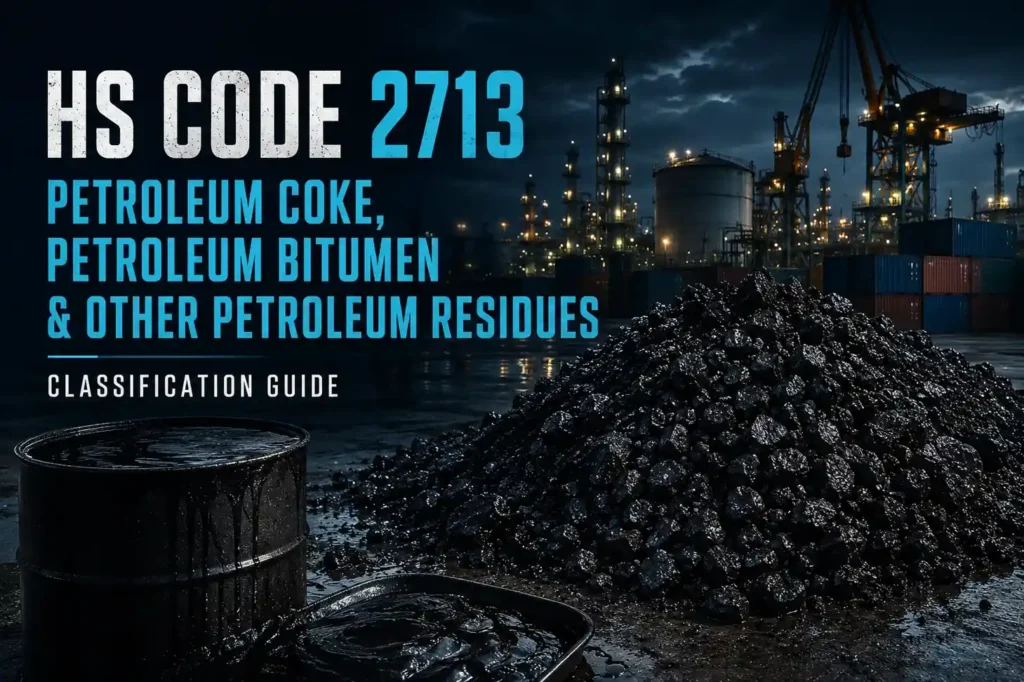
| 2713 | Petroleum coke | Petroleum coke is specifically classified under 2713, including separate international subheadings for not calcined and calcined petroleum coke. |
| 4402 | Wood charcoal | Wood charcoal, including shell or nut charcoal, is separately classified in Chapter 44, not 2704. |
2704 vs 2713 — Coke or Petroleum Coke?
This is one of the most important boundaries for commercial classification. The word “coke” appears in both product families, but the feedstock and production route differ. Petroleum coke is expressly named in Heading 2713, where HS 2022 distinguishes petroleum coke that is not calcined under 2713.11 from calcined petroleum coke under 2713.12.
Therefore, calcined petroleum coke is not classified in 2704 merely because it is coke. If documentation refers to petroleum refining, petcoke, green petroleum coke, calcined petroleum coke or another petroleum-residue origin, Heading 2713 should be evaluated.
2704 vs 4402 — Coke or Wood Charcoal?
Wood charcoal is not brought into 2704 simply because it is a carbonised solid. WCO Heading 4402 separately covers wood charcoal, including shell or nut charcoal, whether or not agglomerated. Feedstock identity therefore matters: carbonised wood and carbonised coal are not interchangeable for HS purposes.
Why “char” is not enough
The commercial term “char” can be used very loosely. A product described as char may come from coal, biomass, wood, agricultural residues or another feedstock. Before choosing 2704, obtain enough technical information to identify what the material actually is and how it was produced.
Technical Data and Documents to Review
Heading 2704 does not have a complicated international subheading split, but technical data is still valuable because it helps prove the identity and origin of the finished material.
| Information | Why It Matters |
|---|---|
| Feedstock | Confirms whether the product was made from coal, lignite, peat, petroleum feedstock, wood or another material. |
| Manufacturing process | Shows whether the material is a carbonised coke/semi-coke product, a petroleum residue, charcoal or another carbon product. |
| Commercial grade | Terms such as metallurgical coke, foundry coke, semi-coke or coke breeze provide context but must be linked to actual product facts. |
| Fixed carbon / volatile matter | Useful for commercial identity and quality evidence; not stated as dedicated legal thresholds for Heading 2704 in the Chapter 27 Notes. |
| Ash and sulfur | Can distinguish grades and support product identification, especially in metallurgical or industrial trade. |
| Moisture | Useful for specification and shipment condition but not a stand-alone statutory test for 2704. |
| Particle size | Helps explain terms such as lump coke, nut coke, breeze or fines. |
| Agglomeration / binder | Confirms whether the product has been briquetted or compacted and whether substantial added materials are present. |
| TDS / COA / SDS | Can show origin, composition, process, physical properties and product identity. |
| Production-flow statement | Especially useful when distinguishing coal coke from petroleum coke or wood-derived charcoal. |
Documents worth retaining
- commercial invoice and packing list;
- technical data sheet (TDS);
- certificate of analysis (COA);
- safety data sheet (SDS), where relevant;
- supplier statement identifying the feedstock;
- manufacturing or carbonisation process description;
- product photographs and packaging labels;
- particle-size or grading specification;
- fixed carbon, volatile matter, ash, sulfur and moisture data where available;
- documentation showing whether the product is agglomerated and whether a binder is used.
No Dedicated Numerical Threshold Defines HS 2704
It is easy to overcomplicate coke classification by copying specifications from steelmaking, laboratory standards or commercial purchase contracts and treating them as if they were HS legal tests. A blast-furnace coke contract may specify minimum strength, maximum ash or a particular sulfur limit, but those buyer specifications do not automatically become tariff thresholds.
The current Chapter 27 legal and subheading notes do not state a special percentage of fixed carbon, volatile matter, ash, sulfur or moisture that determines whether Heading 2704 applies. Technical values remain useful evidence, but the legal analysis begins with the heading wording, relevant notes and the actual identity of the goods.
How to Classify a Product Under HS Code 2704
Identify the Finished Product
Determine whether the goods are coke, semi-coke, retort carbon or another carbonaceous material. Do not stop at a broad description such as “carbon” or “char.”
Confirm the Feedstock
Establish whether the coke or semi-coke was produced from coal, lignite or peat. If the feedstock is petroleum or wood, compare the appropriate alternative headings.
Review the Processing Route
Understand the carbonisation or coking process and confirm whether processing created the finished product described in 2704.
Check Agglomeration
Record whether the goods are loose, lump, fines, briquetted or otherwise agglomerated. Agglomeration itself remains expressly allowed by the heading.
Compare Realistic Alternatives
Where relevant, compare raw coal 2701, lignite 2702, peat 2703, petroleum coke 2713 and wood charcoal 4402.
Apply GRI 1
Use the wording of Heading 2704 together with the relevant Section and Chapter Notes to determine whether the goods are legally described by the heading.
Apply GRI 6
At the international level, Heading 2704 has one six-digit subheading, 2704.00.
Verify the Destination Tariff
After establishing the international HS classification, check the current detailed tariff line and customs or regulatory requirements in the actual GCC destination market.
Need to Classify Coke, Semi-Coke or an Industrial Carbon Product?
A supplier description such as “coke,” “semi-coke,” “char” or “carbon” may not identify the correct heading. Use JAMAREK to analyse the actual feedstock, production process, product form and supporting technical documents.
Practical HS 2704 Classification Scenarios
Scenario 1 — Metallurgical coke made from coal
A shipment is documented as metallurgical coke produced from coking coal. The TDS identifies coal as the feedstock and provides fixed-carbon, ash, sulfur and size specifications. The goods are a finished coke product rather than raw coal. Heading 2704 is the natural international provision to evaluate.
Scenario 2 — Coke breeze
The product consists of small particles and fines generated from coal coke and is sold as coke breeze. Particle size alone does not automatically create a different international HS6. If the material remains coke of coal, the legal wording of 2704 should be evaluated.
Scenario 3 — Semi-coke made from lignite
Lignite is subjected to a carbonisation process and the resulting product is commercially and technically described as semi-coke. Because 2704 expressly includes semi-coke of lignite, the finished product should not remain in the raw-lignite heading merely because lignite was the feedstock.
Scenario 4 — Coke produced from peat
Peat is processed into a carbon-rich coke product. Heading 2704 expressly includes coke and semi-coke of peat. The raw peat heading 2703 therefore does not automatically continue to apply after the processing changes the product identity.
Scenario 5 — Calcined petroleum coke
A refinery-related product is described as calcined petroleum coke. Despite the word “coke,” the correct comparison is Heading 2713, which specifically includes petroleum coke and distinguishes calcined from not-calcined petroleum coke at the international six-digit level.
Scenario 6 — Wood charcoal briquettes
Carbonised wood is formed into briquettes. Although it is a dark agglomerated carbon fuel, wood charcoal is separately covered by Heading 4402. It should not be classified in 2704 simply because it resembles coke.
Scenario 7 — Product called only “industrial carbon”
An invoice provides no feedstock or process information. The appearance is black and porous, but that is insufficient to distinguish coal coke, petroleum coke, charcoal or another carbon material. Classification should be held open until enough technical evidence is obtained.
Common HS Code 2704 Classification Mistakes
1. Treating every coke product as 2704
Petroleum coke has its own heading under 2713. The word “coke” alone is not enough.
2. Keeping processed coke under the raw feedstock heading
Coal, lignite and peat have their own headings, but coke and semi-coke made from them are expressly described in 2704.
3. Confusing wood charcoal with coke
Wood charcoal is separately covered by 4402. Feedstock identity must be established.
4. Using commercial quality specifications as legal thresholds
Metallurgical contracts often specify carbon, ash, sulfur, moisture, strength or size. These are important commercial parameters, but they are not automatically statutory HS 2704 thresholds.
5. Assuming agglomeration changes the international code
The heading expressly says “whether or not agglomerated,” and there is only one international six-digit subheading, 2704.00.
6. Relying on colour or porosity
Many carbonaceous products are black and porous. Visual appearance alone is not enough to establish feedstock or production route.
7. Accepting “char” as a complete description
“Char” can describe products from coal, biomass, wood and other materials. Obtain feedstock and process data.
8. Copying a supplier's extended tariff code
The supplier may be using a national extension from a different jurisdiction or a code for a different grade. Confirm the international HS basis for the actual goods.
Building a Defensible Classification Record
A strong internal classification file should show the logic that connects the actual goods to 2704, not merely record the number.
- record the exact commercial product name;
- identify coal, lignite or peat as feedstock where applicable;
- record the coking or carbonisation process;
- state whether the finished product is coke, semi-coke or retort carbon;
- retain relevant TDS, COA and SDS documents;
- record physical form and agglomeration;
- retain size, carbon, volatile matter, ash, sulfur and moisture data where useful;
- document why 2713 petroleum coke does or does not apply;
- document why 4402 wood charcoal does or does not apply where relevant;
- record the international classification as 2704 / 2704.00 when supported;
- verify the detailed destination tariff separately.
HS Code 2704 in Saudi Arabia, UAE, Qatar, Oman, Kuwait and Bahrain
Saudi Arabia, the United Arab Emirates (UAE), Qatar, Oman, Kuwait and Bahrain operate within the GCC customs framework. The international HS heading and six-digit subheading provide the common classification starting point, while the detailed tariff line and operational requirements should be checked in the actual destination country. The GCC has applied a common external tariff and a Common Customs Law as part of its customs union framework.
JAMAREK educational content stops at the internationally harmonized level. For this topic, that means Heading 2704 and HS6 2704.00. We do not present one country's detailed extension as if it were automatically the declaration code for all six GCC states.
Identify the finished carbon product → confirm the feedstock → distinguish coke from petroleum coke or charcoal → apply 2704 / 2704.00 where supported → verify the current detailed tariff and requirements in Saudi Arabia, UAE, Qatar, Oman, Kuwait or Bahrain.
Future Update: HS 2028
This guide is based on HS 2022, the current international nomenclature in 2026. The World Customs Organization has published the HS 2028 amendments, which enter into force on 1 January 2028.
The official HS 2028 amendment document does not identify a specific amendment to Heading 2704 or subheading 2704.00. The Chapter 27 amendment published in that document concerns the waste-oil structure under Heading 2710.
That is a future transition, not a current 2026 rule. After HS 2028 takes effect, businesses should re-check the final nomenclature, correlation tables, updated WCO material and the tariff actually implemented by the destination customs authority.
Frequently Asked Questions About HS Code 2704
What is HS Code 2704?
What is the six-digit international HS code for Heading 2704?
Does 2704 include coke made from coal?
Does 2704 include coke made from lignite?
Does 2704 include coke made from peat?
Does agglomerated coke stay under 2704?
Is petroleum coke classified under 2704?
Is calcined petroleum coke HS 2704?
Is wood charcoal classified under 2704?
Is there a fixed-carbon percentage required for 2704?
Is there a volatile-matter threshold for coke under 2704?
What is retort carbon?
Does the same international HS6 foundation apply across the six GCC states?
Classify the Carbon Product by Feedstock and Process
Coal coke, lignite semi-coke, petroleum coke and wood charcoal can look similar but belong to different tariff provisions. Use JAMAREK to review the product facts before choosing the code.
Final Takeaway
HS Code 2704 covers a specific family of processed carbon products: coke and semi-coke of coal, lignite or peat, whether or not agglomerated, together with retort carbon. The international six-digit subheading is 2704.00.
The most important classification discipline is to identify the feedstock and production route. Coke produced from coal, lignite or peat raises 2704. Petroleum coke belongs to 2713. Wood charcoal belongs to 4402. A broad commercial name such as “coke,” “char” or “carbon” should not override those legal distinctions.
Technical specifications such as fixed carbon, volatile matter, ash, sulfur, moisture and size can provide strong evidence about the product grade and identity, but they should not be converted into invented HS 2704 legal thresholds. Apply the heading wording under GRI 1, confirm the single international subheading under GRI 6, and then verify the detailed tariff and requirements in the actual GCC destination market.
Official Sources
This guide is provided for general educational and informational purposes only. Correct HS classification depends on the characteristics of the actual goods, the legally applicable nomenclature, supporting technical documentation and the customs requirements in force at the time of import or export.
The examples in this article are not binding customs rulings. For transactions involving Saudi Arabia, the United Arab Emirates (UAE), Qatar, Oman, Kuwait or Bahrain, verify the current tariff and requirements applicable in the destination market before completing the customs declaration.