

HS Code 2707: High-Temperature Coal Tar Distillation Products Classification Guide
A practical classification guide to HS Code 2707 for oils and other products obtained from the distillation of high-temperature coal tar, as well as qualifying similar products with predominantly aromatic constituents, for businesses trading with Saudi Arabia, the United Arab Emirates (UAE), Qatar, Oman, Kuwait and Bahrain.
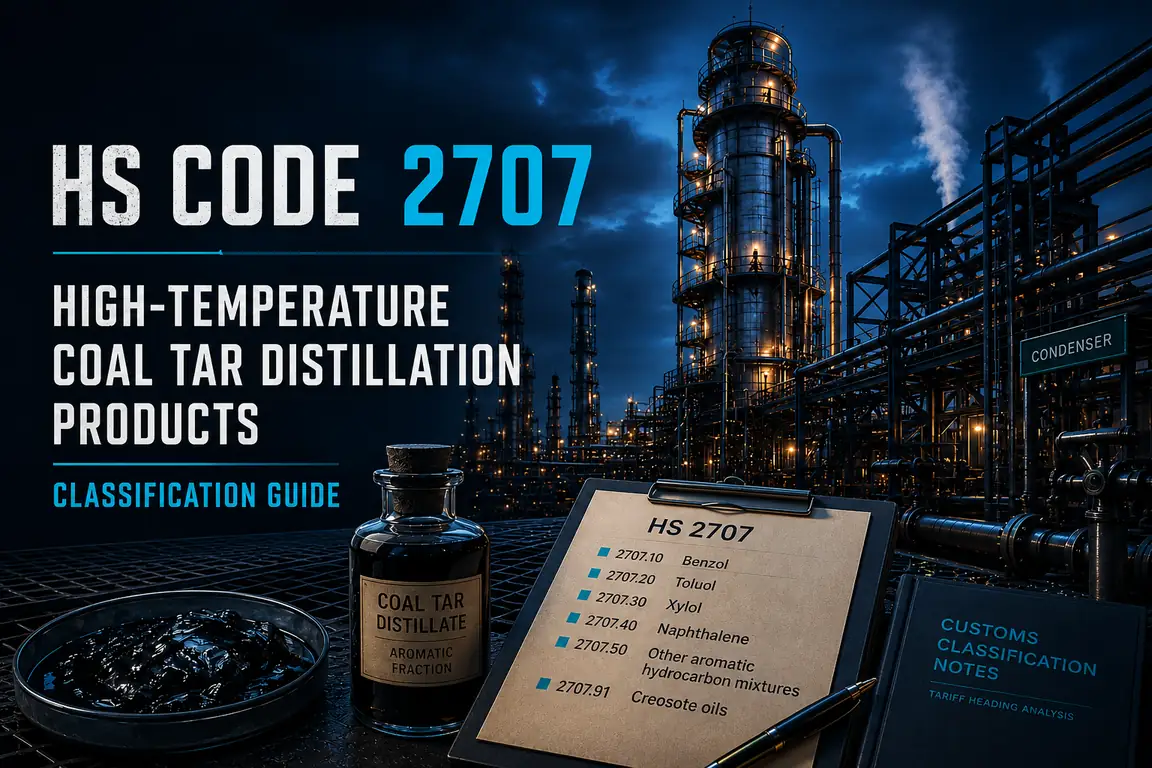
HS Code 2707 covers oils and other products obtained from the distillation of high-temperature coal tar, together with qualifying similar products where the aromatic portion predominates by weight over the non-aromatic portion.
This heading is substantially more technical than a simple product-name classification. A shipment described as “benzene,” “toluene,” “xylene,” “aromatic oil,” “coal-tar distillate,” “creosote oil” or “aromatic hydrocarbon mixture” cannot safely be assigned to Heading 2707 from its invoice description alone.
Classification may depend on several different legal and technical questions: whether the product is actually derived from the distillation of high-temperature coal tar, whether it qualifies as a similar aromatic-rich product, whether it is a mixture rather than a separately chemically defined compound, the percentage by weight of specific constituents, and—in the case of subheading 2707.50— its distillation behaviour at 250°C.
This creates important boundaries between Heading 2707 and Heading 2706 for mineral tar itself, Heading 2708 for pitch and pitch coke, Heading 2710 for certain petroleum and similar oils, Chapter 29 for separately chemically defined organic compounds, and Heading 3807 for wood-derived creosote and related products.
For importers, exporters, customs teams and trade compliance professionals dealing with Saudi Arabia, the United Arab Emirates (UAE), Qatar, Oman, Kuwait and Bahrain, a defensible classification file should therefore establish the actual identity and composition of the product before selecting the applicable HS subheading.
Where HS Code 2707 sits within Chapter 27
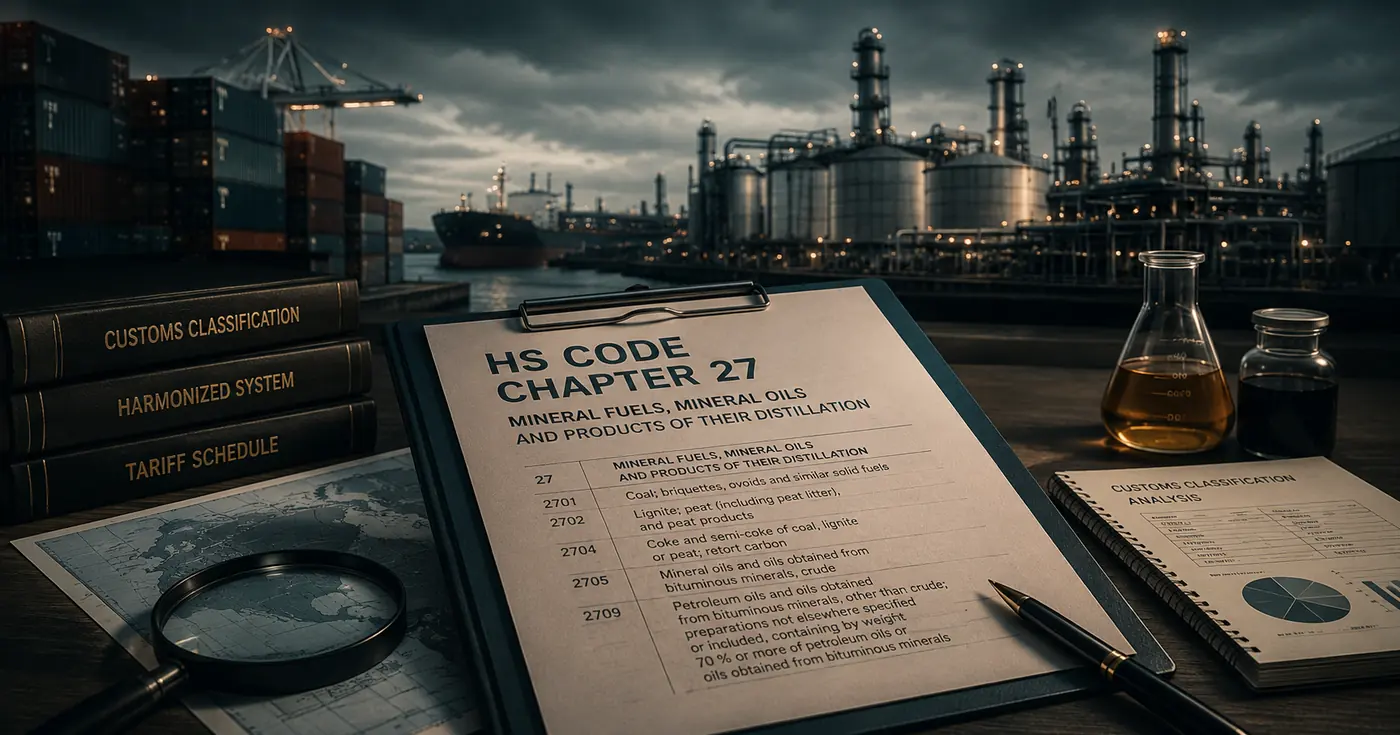
Heading 2707 forms part of Chapter 27 of the Harmonized System, covering mineral fuels, mineral oils and products of their distillation, bituminous substances and mineral waxes.
For the broader chapter structure, see the HS Code Chapter 27 Classification Guide .
Within the sequence of Chapter 27, Heading 2707 is positioned between the tariff treatment of mineral tar itself and the treatment of certain later-stage products derived from mineral tar.
- Heading 2706 concerns tar distilled from coal, lignite or peat and other mineral tars within its legal scope.
- Heading 2707 concerns qualifying oils and other products of high-temperature coal-tar distillation and qualifying similar aromatic-rich products.
- Heading 2708 concerns pitch and pitch coke obtained from coal tar or other mineral tars.
This sequence is useful in practice because the same industrial value chain may begin with coal or coke production, generate coal tar, separate various distillation fractions and ultimately produce oils, aromatic-rich mixtures, pitch, pitch coke or isolated chemical compounds.
A product's historical origin therefore does not permanently determine its tariff classification.
Customs classification applies to the goods actually presented at the border.
HS Code 2707 structure
Unlike Heading 2706, which has only one international six-digit subheading, Heading 2707 contains several separate HS6 classifications.
International six-digit subheadings under Heading 2707
Subject to the special Chapter 27 Subheading Note discussed below.
Subject to the special Chapter 27 Subheading Note discussed below.
Subject to the special Chapter 27 Subheading Note discussed below.
Subject to the special Chapter 27 Subheading Note discussed below.
The subheading includes a specific distillation threshold at 250°C.
The existence of several HS6 subheadings makes Heading 2707 particularly important from a classification perspective.
Determining the four-digit heading is not necessarily the end of the analysis. Once Heading 2707 is established, GRI 6 requires the relevant subheading terms and Subheading Notes to be applied when determining the international six-digit classification.
A commercial product called “benzene,” “toluene,” “xylene” or “naphthalene” does not automatically belong in 2707.10, 2707.20, 2707.30 or 2707.40. Chapter 27 excludes separately chemically defined organic compounds, subject to limited exceptions unrelated to these four products. The Chapter 29 boundary must therefore be checked.
The aromatic constituent test in Heading 2707
One of the defining legal features of Heading 2707 is the treatment of certain similar products.
In addition to products obtained from the distillation of high-temperature coal tar, the heading also includes qualifying similar products where, by weight, the aromatic constituents exceed the non-aromatic constituents.
This is an important legal distinction.
The heading does not simply refer to any oil containing aromatic hydrocarbons. Nor does the presence of benzene, toluene, xylenes or other aromatic substances automatically establish Heading 2707.
When the “similar products” part of the heading is relevant, the relationship between the total aromatic and non-aromatic fractions may become critical.
What does “aromatic constituents exceed non-aromatic constituents” mean?
The comparison in the heading is made by weight.
A laboratory composition report or another technically reliable analysis may therefore be necessary where this criterion is central to the classification.
For example, a report showing 72% aromatic constituents and 28% non-aromatic constituents may support one part of the legal analysis.
However, that percentage by itself should not be treated as a complete classification decision.
The goods must still be evaluated against the full heading text, relevant Chapter Notes, competing headings and the applicable GRI.
Why Heading 2710 also matters
Chapter 27 contains an important contrasting rule in relation to Heading 2710.
For purposes of that heading, certain similar oils can fall within its scope where the non-aromatic constituents predominate by weight over the aromatic constituents.
This makes the aromatic/non-aromatic relationship particularly useful when analysing the boundary between certain products potentially associated with Heading 2707 and oils potentially associated with Heading 2710.
“Aromatic > non-aromatic = 2707” and “non-aromatic > aromatic = 2710” are both oversimplifications. Each heading has additional legal terms that must also be satisfied.
Benzol, toluol, xylol and naphthalene under HS 2707
Chapter 27 contains a specific Subheading Note for 2707.10, 2707.20, 2707.30 and 2707.40.
For these subheadings, the corresponding named product must contain more than 50% by weight of benzene, toluene, xylenes or naphthalene, respectively.
This threshold is extremely important because the HS wording is not simply referring to any mixture in which one of these substances is detectable.
2707.10 — Benzol (benzene)
For purposes of subheading 2707.10, the product must contain more than 50% by weight of benzene.
A mixture containing 52% benzene may therefore raise a genuine 2707.10 question if the goods are otherwise within Heading 2707.
But that is not the same as saying: “benzene = 2707.10.”
Separately chemically defined benzene is specifically described in Chapter 29 under Heading 29.02.
The classifier must therefore distinguish an HS 2707 product meeting the relevant Subheading Note from a separately chemically defined organic compound that is excluded from Chapter 27.
2707.20 — Toluol (toluene)
The corresponding threshold for 2707.20 is more than 50% by weight of toluene.
As with benzene, the percentage threshold must be considered together with the Chapter 27 legal scope.
Separately chemically defined toluene is described in Heading 29.02, so a product specification stating “99.9% toluene” should not simply be treated as a 2707.20 product without reviewing the Chapter Notes.
2707.30 — Xylol (xylenes)
For 2707.30, the product must contain more than 50% by weight of xylenes.
Chapter 29 separately provides classifications for individual xylene isomers and mixed xylene isomers within Heading 29.02.
The actual composition and nature of the goods therefore matter.
2707.40 — Naphthalene
For 2707.40, the product must contain more than 50% by weight of naphthalene.
Again, the Subheading Note must not be read in isolation from Chapter 27 Note 1(a), which excludes separately chemically defined organic compounds from the Chapter, except for the specific methane and propane exception in Heading 2711.
Understanding HS Code 2707.50
Subheading 2707.50 has one of the most technical descriptions within Heading 2707.
It applies to other aromatic hydrocarbon mixtures that satisfy a defined distillation condition: 65% or more by volume, including losses, must distil at 250°C using the ISO 3405 method, which the HS nomenclature identifies as equivalent to ASTM D86.
Why a distillation curve matters
Unlike classifications that can often be evaluated from composition alone, 2707.50 introduces an explicit distillation-performance requirement.
A technical data sheet may contain a boiling range, but that does not necessarily provide the precise result required by the HS subheading.
Where 2707.50 is a serious classification candidate, the most useful evidence may include:
- an actual distillation report;
- the test method used;
- the percentage distilled at 250°C;
- confirmation that losses are included where required;
- composition of the aromatic hydrocarbon mixture;
- and supporting laboratory or supplier documentation.
Example: 68% distilled at 250°C
Assume an aromatic hydrocarbon mixture is otherwise within Heading 2707, and a valid ISO 3405 test shows that 68% by volume, including losses, distils at 250°C.
That result supports the specific distillation criterion in 2707.50.
The full subheading analysis must still confirm that the product is properly considered an “other aromatic hydrocarbon mixture” within the heading and is not more appropriately classified under another preceding subheading.
Example: 61% distilled at 250°C
If the corresponding result is only 61% by volume, the explicit 65% threshold for 2707.50 is not met.
That does not automatically determine which other subheading applies. The classifier must continue the analysis against the remaining subheadings and actual product characteristics.
Do not replace the legal 2707.50 criterion with a supplier's general boiling-point statement or an unrelated laboratory method. The HS text specifically identifies ISO 3405 and notes its equivalence to ASTM D86.
Creosote oils — HS Code 2707.91
Subheading 2707.91 specifically covers creosote oils within Heading 2707.
This creates a particularly important terminology problem because the word “creosote” can also appear in connection with wood-derived products.
Coal-tar creosote oils vs wood creosote
Heading 3807 separately covers wood tar, wood tar oils and wood creosote, together with other specified wood- and vegetable-derived products.
Therefore, a customs declaration should not select 2707.91 simply because the invoice says “creosote.”
The product source must be established.
Useful evidence may include:
- feedstock;
- manufacturing process;
- supplier product specification;
- SDS identification;
- TDS;
- composition;
- and a supplier declaration clarifying whether the product is coal-tar derived or wood-derived.
Important classification boundaries for HS 2707
2706 vs 2707 — Tar itself or a distillation product?
Heading 2706 covers qualifying mineral tar itself, including certain processing states expressly allowed by that heading.
Heading 2707 moves the analysis toward oils and other products of high-temperature coal-tar distillation and qualifying similar aromatic-rich products.
A key practical question is therefore:
Has the material remained mineral tar, or has distillation produced a separate oil, fraction or other product?
2707 vs 2708 — Distillation product or pitch?
Heading 2708 specifically addresses pitch and pitch coke obtained from coal tar or other mineral tars.
If the goods are the heavy pitch residue remaining after relevant processing, retaining them in 2707 merely because the production chain involved coal-tar distillation may be incorrect.
2707 vs 2710 — Aromatic-rich or non-aromatic-rich similar oil?
The relationship between aromatic and non-aromatic constituents can be especially useful when reviewing this boundary.
Heading 2707 expressly addresses qualifying similar products where aromatic constituents predominate by weight.
Chapter 27 Note 2, in the context of Heading 2710, describes qualifying similar oils where non-aromatic constituents predominate by weight.
However, neither ratio should be used without examining all other legal requirements of the respective heading.
2707 vs Chapter 29 — Mixture or separately chemically defined compound?
This is one of the most important boundaries in the entire article.
Chapter 27 Note 1(a) excludes separately chemically defined organic compounds, except pure methane and propane classified in Heading 2711.
Chapter 29, in contrast, generally covers separately chemically defined organic compounds, subject to its own Notes.
For example, Chapter 29 specifically provides for:
- benzene;
- toluene;
- individual xylene isomers;
- mixed xylene isomers;
- and other cyclic hydrocarbons within Heading 29.02.
Therefore, a certificate of analysis showing an essentially isolated chemical substance deserves very different treatment from a complex coal-tar-derived mixture containing more than 50% of that component.
2707.91 vs 3807 — Creosote oil or wood creosote?
The commercial word “creosote” cannot resolve this boundary.
Heading 3807 expressly identifies wood creosote and other wood-tar products.
Source, process and product identity are therefore essential.
| Heading | General classification context | Key question |
|---|---|---|
| 2706 | Qualifying mineral tar itself. | Is the material still mineral tar rather than a separated distillation product? |
| 2707 | High-temperature coal-tar distillation products and qualifying similar aromatic-rich products. | Do the goods satisfy the legal scope of Heading 2707? |
| 2708 | Pitch and pitch coke from coal tar or other mineral tars. | Has the product become pitch or pitch coke? |
| 2710 | Petroleum oils, oils from bituminous minerals and qualifying similar oils and preparations within its terms. | Does the product instead satisfy Heading 2710, including the applicable Chapter Note? |
| Chapter 29 | Separately chemically defined organic compounds and other products within Chapter 29. | Is the product actually an isolated chemically defined compound rather than an HS 2707 mixture or distillation product? |
| 3807 | Wood tar, wood tar oils, wood creosote and specified related products. | Is the product wood-derived rather than the relevant coal-tar/mineral-tar product? |
Technical information to review for HS Code 2707
Heading 2707 is a good example of why customs classification often requires more than a commercial invoice and SDS.
Different subheadings test different facts.
| Information or document | Why it can matter |
|---|---|
| Exact product name | Provides the starting description, but terms such as aromatic oil, coal-tar distillate, benzol, solvent naphtha, creosote or xylene mixture require technical verification. |
| Feedstock / source | Helps establish whether the goods originate from high-temperature coal tar, another relevant process, petroleum, wood or another source. |
| Manufacturing process | Can establish whether the product is actually a distillation product of high-temperature coal tar and identify its stage in the processing chain. |
| Distillation fraction | Helps identify whether the product is a separated fraction rather than tar itself, and may assist in distinguishing 2706, 2707 and downstream products. |
| Aromatic / non-aromatic split | Particularly important where the “similar products” part of Heading 2707 is relied upon or where Heading 2710 is a possible competing classification. |
| Benzene wt.% | Relevant to the more-than-50%-by-weight test for 2707.10. |
| Toluene wt.% | Relevant to the more-than-50%-by-weight test for 2707.20. |
| Total xylenes wt.% | Relevant to the more-than-50%-by-weight test for 2707.30. |
| Naphthalene wt.% | Relevant to the more-than-50%-by-weight test for 2707.40. |
| Distillation curve | Critical when 2707.50 is being considered. |
| ISO 3405 / ASTM D86 result | Helps establish whether the explicit 65%-by-volume-at-250°C condition for 2707.50 is satisfied. |
| Certificate of Analysis (CoA) | May provide the quantitative composition necessary to distinguish mixtures from highly purified or chemically defined products. |
| TDS | Can provide boiling range, composition, physical properties, manufacturing description and commercial product identity. |
| SDS | Can support identification, composition and hazard information. It is supporting evidence, not the legal classification rule. |
| Supplier technical declaration | Useful when standard documents do not clearly state feedstock, manufacturing route, composition or whether the product is a mixture. |
| Purity specification | Particularly important where Chapter 29 may apply because the goods could be a separately chemically defined organic compound. |
| Physical state and presentation | Helps establish the identity of the goods as actually imported or exported. |
| End use | May provide useful context but should generally not replace the legal and technical classification analysis. |
How to evaluate a product for HS Code 2707
Identify the actual goods
Establish what is physically being imported or exported. Avoid relying on broad descriptions such as “aromatic oil,” “coal-tar product” or “industrial solvent.”
Identify the source and manufacturing route
Determine whether the product results from the distillation of high-temperature coal tar or is being evaluated as a similar product.
Check whether the goods are still tar
If the material remains mineral tar rather than a separated oil or product of distillation, Heading 2706 may need to be evaluated.
Check the Chapter 27 exclusion for separate chemical compounds
If the product is a separately chemically defined organic compound, investigate Chapter 29 before relying on Heading 2707.
Evaluate the aromatic/non-aromatic relationship
Where the “similar products” part of Heading 2707 is relevant, determine whether aromatic constituents exceed non-aromatic constituents by weight.
Check 2707.10–2707.40
Review the weight percentage of benzene, toluene, xylenes or naphthalene against the Chapter 27 Subheading Note.
Check the more-than-50% threshold
For the four named subheadings, confirm whether the named constituent exceeds 50% by weight.
Evaluate 2707.50 where relevant
For other aromatic hydrocarbon mixtures, review the specified ISO 3405 / ASTM D86 distillation result at 250°C.
Evaluate creosote oils
If the product is described as creosote oil, confirm its source and determine whether 2707.91 or the wood-derived products of 3807 are relevant.
Check for pitch or pitch coke
If processing has produced pitch or pitch coke, evaluate Heading 2708.
Evaluate Heading 2710 where appropriate
If the goods are petroleum or similar oils potentially satisfying Heading 2710, review the heading and Chapter 27 Note 2 carefully.
Apply GRI 1
Determine the four-digit classification from the terms of the headings and relevant Section and Chapter Notes.
Apply GRI 6
Once Heading 2707 is established, compare the subheadings at the same level and apply the relevant Subheading Notes.
Verify the destination tariff
After establishing the international HS6 classification, check the current detailed tariff and declaration requirements in Saudi Arabia, the UAE, Qatar, Oman, Kuwait or Bahrain.
Need help classifying an aromatic or coal-tar product?
Use JAMAREK to review product identity, composition, technical documentation and competing tariff headings before selecting the final classification.
Practical HS 2707 classification scenarios
Scenario 1 — Coal-tar distillate containing 58% benzene
A product is documented as a high-temperature coal-tar distillation product. Laboratory data show 58% benzene by weight, with the balance consisting of other components.
The product exceeds the Chapter 27 Subheading Note threshold associated with 2707.10.
Before confirming 2707.10, the classifier should still confirm that the product remains within Chapter 27 and is not instead a separately chemically defined benzene product falling within Chapter 29.
Scenario 2 — High-purity benzene
The product specification describes essentially pure benzene as an isolated chemical substance.
It would be unsafe to select 2707.10 simply because benzene clearly exceeds 50% by weight.
Chapter 27 Note 1(a) and Heading 29.02 must first be considered.
Scenario 3 — Coal-tar product containing 47% benzene
A coal-tar-derived mixture contains 47% benzene by weight.
It does not satisfy the more-than-50% criterion used for 2707.10.
The classifier must continue through the other subheadings and the characteristics of the actual product.
Scenario 4 — Toluene-rich coal-tar fraction
A documented Heading 2707 product contains 63% toluene by weight.
This raises 2707.20 as a strong candidate, subject to the Chapter 27 exclusion for separately chemically defined compounds and the complete subheading analysis.
Scenario 5 — Xylene-rich aromatic mixture
A complex aromatic mixture contains 57% total xylenes by weight and is otherwise shown to fall within Heading 2707.
The more-than-50% test makes 2707.30 relevant.
The file should still document why the goods are an HS 2707 product rather than a separately chemically defined Chapter 29 product.
Scenario 6 — Naphthalene-rich distillation product
A high-temperature coal-tar distillation fraction contains 72% naphthalene by weight.
2707.40 becomes relevant under the Chapter 27 Subheading Note, provided the Chapter-level classification remains correct.
Scenario 7 — Aromatic mixture with 68% distilled at 250°C
An aromatic hydrocarbon mixture is otherwise within Heading 2707. Testing under ISO 3405 shows that 68% by volume, including losses, distils at 250°C.
This satisfies the explicit numerical distillation condition contained in 2707.50.
The classifier must still ensure that an earlier, more specifically described subheading does not apply.
Scenario 8 — Aromatic mixture with 62% distilled at 250°C
The same type of product produces a result of 62% by volume at 250°C.
The 65% threshold for 2707.50 is not met.
This does not automatically mean 2707.99 applies. The full remaining subheading analysis must still be completed.
Scenario 9 — Supplier only provides a boiling range
The TDS states “boiling range 170–260°C” but provides no ISO 3405 / ASTM D86 result showing how much volume distils at 250°C.
That information alone may be insufficient to establish the specific 2707.50 test.
Additional technical evidence should be requested.
Scenario 10 — Coal-tar creosote oil
Supplier documents identify the goods as a creosote oil obtained in a coal-tar processing chain.
2707.91 is a relevant subheading for evaluation, subject to confirmation of the product's actual technical identity.
Scenario 11 — Wood creosote
The product is described as creosote, but the manufacturing information confirms that it is derived from wood.
Heading 3807 should be evaluated instead of assuming 2707.91.
Scenario 12 — Heavy residue identified as pitch
A heavy product remaining after processing of coal tar is technically identified as pitch.
Heading 2708 is a more relevant candidate than 2707.
Scenario 13 — Product with 75% non-aromatic constituents
A similar oil contains 75% non-aromatic constituents and 25% aromatic constituents by weight.
The “similar products” condition in Heading 2707 is not satisfied on the basis of the aromatic predominance test.
If the goods otherwise resemble petroleum or similar oils, Heading 2710 and its Chapter Note should be reviewed.
Scenario 14 — Supplier code copied from another country
A supplier lists “2707.20” on the invoice, but no composition report, manufacturing data or information on the product's chemical identity is supplied.
The supplier code should be treated as a data point, not as proof of classification.
The importer should obtain the technical evidence necessary to independently support the classification.
Common HS 2707 classification mistakes
1. Assuming every coal-tar derivative belongs in 2707
Coal-tar origin alone does not determine the final HS heading.
2. Assuming benzene always means 2707.10
Separately chemically defined benzene requires review under Chapter 29.
3. Ignoring the more-than-50% rule
The Chapter 27 Subheading Note establishes a specific threshold for 2707.10 through 2707.40.
4. Treating exactly 50% as “more than 50%”
The legal test is more than 50% by weight. Exactly 50% does not satisfy a “more than 50%” threshold.
5. Adding benzene, toluene and xylenes together for the named subheading test
Each named subheading has its own specified constituent. The test for 2707.10 concerns benzene; 2707.20 concerns toluene; 2707.30 concerns xylenes; and 2707.40 concerns naphthalene.
6. Using volume percentage instead of weight percentage for 2707.10–2707.40
The Chapter 27 Subheading Note uses percentage by weight.
7. Using weight percentage for the 2707.50 distillation test
The 2707.50 threshold is expressed by volume, including losses.
8. Ignoring the 250°C test temperature
A result at a different temperature does not automatically establish the specific 2707.50 condition.
9. Treating any boiling-range statement as an ISO 3405 result
A general TDS boiling range and the tariff's specified distillation test are not necessarily the same evidence.
10. Assuming “aromatic-rich” automatically means 2707
The complete heading wording and other legal provisions still apply.
11. Ignoring Heading 2710
Certain petroleum and similar oils may require analysis under Heading 2710, including the Chapter 27 Note concerning non-aromatic predominance.
12. Ignoring Chapter 29
This can lead to major classification errors for high-purity benzene, toluene, xylenes and other isolated chemicals.
13. Confusing coal-tar creosote with wood creosote
Heading 3807 expressly covers wood creosote.
14. Keeping pitch under 2707
Pitch and pitch coke obtained from coal tar or other mineral tars are specifically addressed by Heading 2708.
15. Treating the SDS as the classification decision
The SDS is supporting evidence. It does not replace the HS legal framework.
16. Copying the supplier's HS code without checking the product specification
Suppliers may use a different national tariff, an outdated code, or a classification based on different specifications.
17. Stopping at the four-digit heading
Heading 2707 contains several materially different international six-digit subheadings.
18. Stopping at HS6 without checking the destination tariff
The international six-digit classification is only one stage of a complete import or export classification process.
Building a defensible HS 2707 classification file
Because Heading 2707 contains quantitative composition tests and an explicit distillation criterion, a strong classification file should document more than the final code.
- Record the exact commercial product name.
- Identify the feedstock and manufacturing source.
- Document whether the product results from high-temperature coal-tar distillation.
- Determine whether the product is a mixture or a separately chemically defined compound.
- Obtain a Certificate of Analysis where composition is material.
- Record the total aromatic and non-aromatic fractions when relevant.
- Record benzene percentage by weight where 2707.10 is being evaluated.
- Record toluene percentage by weight where 2707.20 is being evaluated.
- Record total xylenes percentage by weight where 2707.30 is being evaluated.
- Record naphthalene percentage by weight where 2707.40 is being evaluated.
- Document why the more-than-50% test is or is not satisfied.
- For 2707.50, obtain the appropriate distillation result at 250°C.
- Document the test method used.
- Keep the TDS.
- Keep the SDS.
- Request a supplier technical declaration when standard documents are insufficient.
- Evaluate Heading 2706 if the material may still be mineral tar.
- Evaluate Heading 2708 if pitch or pitch coke may apply.
- Evaluate Heading 2710 where petroleum or similar oils may apply.
- Evaluate Chapter 29 where the product may be a separate chemical compound.
- Evaluate Heading 3807 where wood-derived creosote is possible.
- Document the application of GRI 1.
- Document the application of GRI 6 to the selected subheading.
- Record why plausible competing headings were rejected.
- Verify the current detailed tariff for the actual destination country.
HS Code 2707 in Saudi Arabia, UAE, Qatar, Oman, Kuwait and Bahrain
The international Harmonized System provides a common six-digit classification foundation for goods traded with Saudi Arabia, the United Arab Emirates (UAE), Qatar, Oman, Kuwait and Bahrain.
For Heading 2707, that common international structure includes:
- 2707.10;
- 2707.20;
- 2707.30;
- 2707.40;
- 2707.50;
- 2707.91;
- 2707.99.
However, the international HS6 code should not be confused with the complete detailed tariff code required for a customs declaration in the destination market.
Detailed tariff extensions, procedural requirements, customs systems and regulatory obligations should be verified for the actual country of import.
Businesses should therefore confirm the current detailed tariff and applicable customs requirements before filing in Saudi Arabia, the UAE, Qatar, Oman, Kuwait or Bahrain.
Identify the actual goods → establish feedstock and process → determine mixture vs separate chemical → analyse aromatic/non-aromatic composition → check the named 50% thresholds → test 2707.50 where relevant → review 2706, 2708, 2710, Chapter 29 and 3807 → apply GRI 1 → apply GRI 6 → verify the destination country's current detailed tariff.
Future update: HS 2028
This guide is based on HS 2022, the international Harmonized System edition applicable in 2026.
The World Customs Organization has adopted amendments for HS 2028, scheduled to enter into force on 1 January 2028.
The official recommendation accepted pursuant to the 26 June 2025 WCO Recommendation lists a Chapter 27 amendment concerning subheading 2710.91.
That subheading is to be deleted and replaced through the creation of new subheadings 2710.92 and 2710.93.
The published official amendment recommendation does not list an amendment to Heading 2707.
Businesses should nevertheless review the final HS 2028 nomenclature, correlation tables and destination-country implementation before using the new structure after it takes effect.
Frequently asked questions about HS Code 2707
What does HS Code 2707 cover?
What are the international six-digit subheadings under HS 2707?
Is benzene always classified under 2707.10?
What percentage of benzene is required for 2707.10?
What percentage of toluene is required for 2707.20?
What percentage of xylenes is required for 2707.30?
What percentage of naphthalene is required for 2707.40?
Does exactly 50% benzene satisfy the 2707.10 threshold?
What is the main test for HS 2707.50?
Can a general boiling range prove 2707.50?
What if only 60% distils at 250°C?
What does “aromatic constituents exceed non-aromatic constituents” mean?
Does every aromatic hydrocarbon mixture fall under 2707?
What is the difference between HS 2706 and HS 2707?
What is the difference between HS 2707 and HS 2708?
Why is Heading 2710 relevant to HS 2707?
Why is Chapter 29 important when classifying benzene or toluene?
Is creosote oil classified under 2707.91?
Is wood creosote classified under 2707.91?
Is SDS enough to classify a product under HS 2707?
Is a TDS enough to confirm 2707.50?
Should I use my supplier's HS code?
Do Saudi Arabia, UAE, Qatar, Oman, Kuwait and Bahrain use the same HS6 basis?
Should JAMAREK create separate articles for every 2707 HS6 code now?
Classify complex aromatic products with better evidence
Use JAMAREK to analyse product composition, technical documents, competing headings and classification logic before filing a customs declaration.
Final takeaway
HS Code 2707 is not simply a heading for “coal-tar chemicals” or “aromatic products.”
Its legal scope begins with oils and other products obtained from the distillation of high-temperature coal tar and extends to qualifying similar products where aromatic constituents exceed non-aromatic constituents by weight.
Once Heading 2707 is established, the six-digit classification can require additional quantitative analysis.
Subheadings 2707.10, 2707.20, 2707.30 and 2707.40 are linked to a Chapter 27 Subheading Note requiring more than 50% by weight of benzene, toluene, xylenes or naphthalene respectively.
Subheading 2707.50 uses a different type of test: at least 65% by volume, including losses, must distil at 250°C according to the specified method.
Creosote oils have their own subheading at 2707.91, but wood creosote presents an important boundary with Heading 3807.
Another major boundary exists with Chapter 29. A product containing a high percentage of benzene, toluene or another aromatic compound is not automatically an HS 2707 product if it is actually a separately chemically defined organic compound.
Similarly, mineral tar itself may remain in Heading 2706, pitch and pitch coke may fall in Heading 2708, and certain petroleum or similar oils may require evaluation under Heading 2710.
This is why a defensible HS 2707 classification may require a combination of TDS, SDS, Certificate of Analysis, aromatic/non-aromatic composition, named constituent percentages, manufacturing information and an appropriate distillation report.
These documents establish the facts. They do not replace the legal classification framework.
For imports or exports involving Saudi Arabia, the United Arab Emirates (UAE), Qatar, Oman, Kuwait and Bahrain, the international HS6 classification should then be followed by verification of the current detailed tariff and applicable declaration requirements in the actual destination market.
Official Sources
- World Customs Organization — HS 2022 Chapter 27
- World Customs Organization — General Rules for the Interpretation of the Harmonized System
- World Customs Organization — HS 2022 Chapter 29
- World Customs Organization — HS 2022 Chapter 38
- GCC Secretariat — Customs Digital Library
- World Customs Organization — HS 2028 Amendments
- World Customs Organization — Official HS 2028 Amendment Recommendation
This guide is provided for general educational and informational purposes only. Correct customs classification depends on the actual identity of the goods, their composition, source, manufacturing process, technical characteristics, purity, distillation behaviour, presentation, supporting documentation and the tariff in force at the time of import or export.
Technical documents such as TDS, SDS, Certificates of Analysis, laboratory reports, distillation data, manufacturing information and supplier declarations may provide important evidence, but they do not replace the legal wording of the tariff, applicable Section or Chapter Notes, Subheading Notes or the General Rules for Interpretation.
Nothing in this article constitutes a binding customs ruling. Before using any classification in Saudi Arabia, the United Arab Emirates, Qatar, Oman, Kuwait or Bahrain, verify the current detailed tariff, customs requirements and any applicable regulatory obligations in the destination country.