HS Code 2706: Tar Distilled from Coal, Lignite or Peat Classification Guide
A practical HS Code 2706 guide covering tar distilled from coal, lignite or peat and other mineral tars, with classification guidance for Saudi Arabia, the United Arab Emirates (UAE), Qatar, Oman, Kuwait and Bahrain.
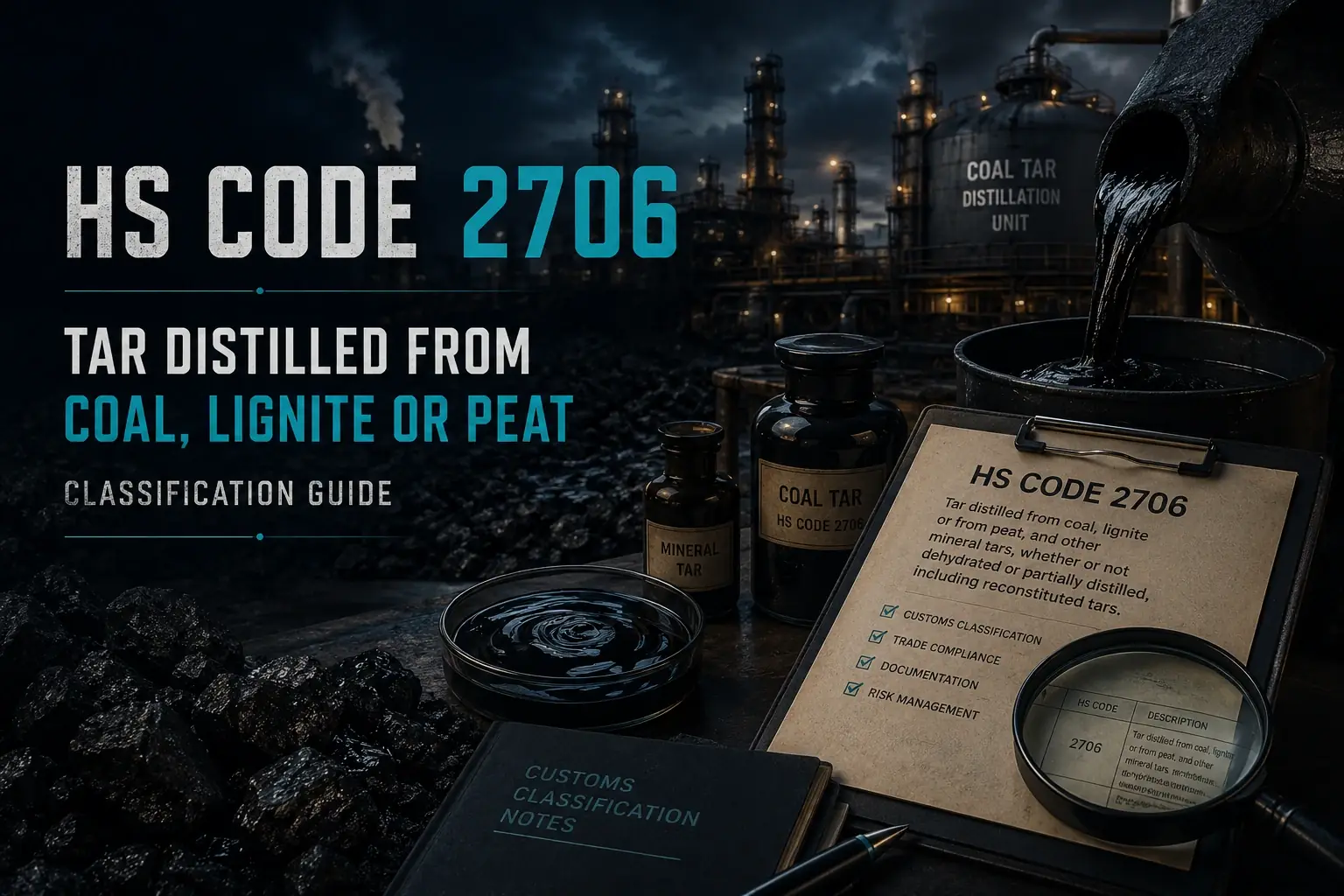
HS Code 2706 covers tar distilled from coal, from lignite or from peat, and other mineral tars, whether or not dehydrated or partially distilled, including reconstituted tars. At the international six-digit level, the heading is classified under 2706.00.
Heading 2706 may appear straightforward because its legal description is relatively compact. In practice, however, an important customs boundary exists between mineral tar itself and the products, residues, fractions, pitches, mixtures and preparations that may be obtained from or made with tar.
A product can originate from coal, lignite, peat or another mineral source and still require classification outside Heading 2706 if the goods, as presented for import or export, have become a product more specifically described elsewhere in the tariff.
This is why a commercial description such as “coal tar”, “tar product”, “mineral tar”, “tar oil” or “tar mixture” should not automatically be converted into HS Code 2706.
For businesses importing into or exporting from Saudi Arabia, the United Arab Emirates (UAE), Qatar, Oman, Kuwait and Bahrain, the classification review should establish exactly what the goods are, how they were produced, their processing stage and whether another heading describes the imported product more specifically.
Where HS Code 2706 Sits in Chapter 27
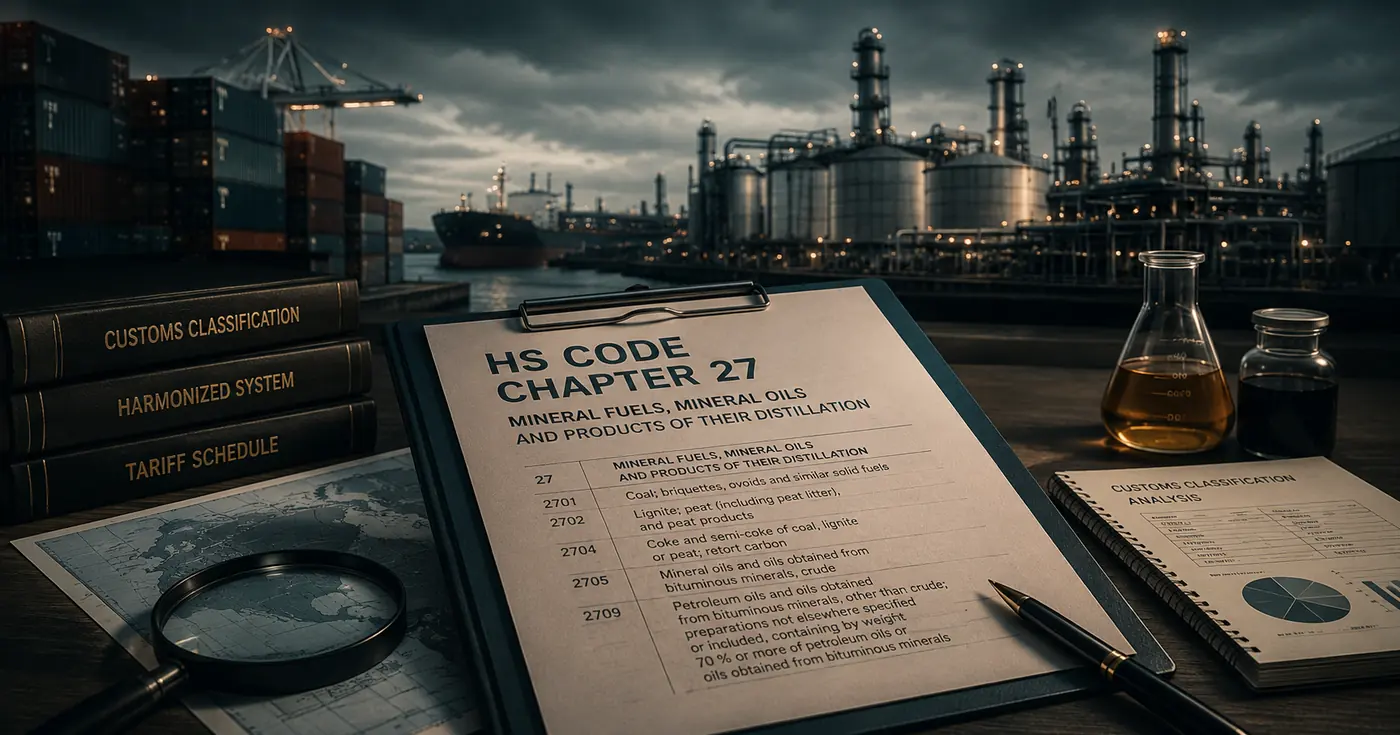
HS Code 2706 forms part of Chapter 27, which covers mineral fuels, mineral oils and products of their distillation, bituminous substances and mineral waxes.
For the wider chapter structure, see our Chapter 27 guide .
The headings surrounding 2706 are particularly useful when analysing the processing chain of coal, mineral tar and related products.
- Heading 2705 covers coal gas, water gas, producer gas and similar gases within its legal scope.
- Heading 2706 covers the mineral tars described by its wording.
- Heading 2707 covers oils and other products of the distillation of high temperature coal tar, together with certain similar aromatic products.
- Heading 2708 covers pitch and pitch coke obtained from coal tar or from other mineral tars.
Other headings later in Chapter 27 can also become relevant. Petroleum bitumen is specifically addressed under Heading 2713, natural bitumen and natural asphalt under Heading 2714, and certain bituminous mixtures based on mineral tar or mineral tar pitch under Heading 2715.
The legal analysis therefore does not ask simply: “Did this product originate from tar?”
It asks: “What is the product being imported or exported now, and which heading legally describes that product?”
HS Code 2706 Structure
Four-Digit Heading and Six-Digit Level
Tar distilled from coal, from lignite or from peat, and other mineral tars, whether or not dehydrated or partially distilled, including reconstituted tars.
The international six-digit subheading corresponding to Heading 2706.
Heading 2706 corresponds to a single international six-digit subheading: 2706.00.
There is no separate international HS6 division within this heading for coal tar, lignite tar, peat tar, dehydrated tar, partially distilled tar or reconstituted tar.
Once the goods are legally classified within Heading 2706, the international six-digit result is therefore 2706.00.
Because Heading 2706 corresponds to one international HS6 subheading, a separate long-form guide dedicated only to 2706.00 would substantially duplicate the international classification scope discussed in this article.
What Mineral Tars Can Fall Under HS Code 2706?
The legal wording expressly refers to tar distilled from:
- coal;
- lignite;
- peat; and
- other mineral tars.
This wording means the heading is not limited only to products commercially called “coal tar”.
At the same time, the words “other mineral tars” should not be interpreted as an unlimited category for every substance that looks dark, viscous, bituminous or tar-like.
The goods still need to be properly identified as a mineral tar within the legal context of the heading.
Coal Tar
Coal tar can arise in industrial processes involving the thermal treatment or carbonisation of coal.
For customs classification, however, the production origin is only part of the analysis. The product being traded must still be identified.
If the shipment is actually a tar, Heading 2706 may apply. If further processing has produced a more specific oil, aromatic product, pitch, pitch coke or formulated preparation, another heading may need to be considered.
Lignite Tar
Tar distilled from lignite is expressly named in Heading 2706. Therefore, the fact that the feedstock is lignite rather than coal does not by itself prevent classification under the heading.
As with coal tar, the relevant question remains whether the goods being imported or exported retain the identity of tar within the scope of Heading 2706.
Peat Tar
Tar distilled from peat is also expressly included in the legal wording.
Businesses should therefore avoid assuming that Heading 2706 is exclusively a coal-product heading.
Other Mineral Tars
The heading also includes other mineral tars. Where this part of the heading is relied upon, the technical file should clearly identify the source, production process and actual nature of the material.
A vague commercial expression such as “industrial tar” does not establish that the goods are a mineral tar.
Dehydrated, Partially Distilled and Reconstituted Tars
One of the most important features of the Heading 2706 wording is that it expressly contemplates certain processing of the tar.
Dehydrated Tar
Heading 2706 states that the covered mineral tars remain within the heading whether or not dehydrated.
Therefore, removing water from an otherwise qualifying mineral tar does not automatically move the product outside Heading 2706.
Water content can still be useful technical information, but dehydration alone should not be treated as a legal exclusion from the heading.
Partially Distilled Tar
The heading also covers the relevant mineral tars whether or not partially distilled.
This creates an important distinction. A partially distilled tar may remain within Heading 2706, while a specific product obtained through further distillation may be described by another heading.
The customs review should therefore determine what the traded material has become. The phrase “partially distilled” on a supplier document is useful evidence, but it is not a substitute for establishing the actual identity of the goods.
Reconstituted Tars
The legal text also expressly includes reconstituted tars.
For classification purposes, that wording should be applied carefully. It confirms that a qualifying product does not necessarily have to be presented exactly as it first emerged from the original production operation.
However, the heading wording should not be extended beyond what it says. If a supplier describes a product as “reconstituted tar”, the classification file should contain enough technical information to confirm that the goods are genuinely a tar within Heading 2706 rather than a formulated preparation or another product classified elsewhere.
The expressions “dehydrated”, “partially distilled” and “reconstituted” should not be treated as automatic classification shortcuts. The goods must still satisfy the legal scope of Heading 2706.
What HS Code 2706 Does Not Cover
The Heading 2706 text does not contain an express exclusion phrase equivalent to the petroleum-gas exclusion found in Heading 2705.
Nevertheless, significant classification boundaries arise from other headings and from the Chapter Notes.
High Temperature Coal Tar Distillation Products — Heading 2707
Heading 2707 covers oils and other products of the distillation of high temperature coal tar.
It also covers certain similar products where the weight of the aromatic constituents exceeds that of the non-aromatic constituents.
This heading is highly relevant when a product no longer represents tar itself but is instead a more specific oil, fraction or other product resulting from the relevant distillation process.
The fact that the product originated from coal tar does not automatically keep it in Heading 2706.
Pitch and Pitch Coke — Heading 2708
Heading 2708 covers pitch and pitch coke obtained from coal tar or from other mineral tars.
This is one of the clearest boundaries for Heading 2706.
If the imported goods are actually identified as pitch or pitch coke, the classification analysis should evaluate Heading 2708 rather than classify the material under 2706 merely because its source was mineral tar.
Petroleum Bitumen — Heading 2713
Petroleum-derived products should not be confused automatically with mineral tar products.
Heading 2713 covers petroleum coke, petroleum bitumen and other residues of petroleum oils or oils obtained from bituminous minerals.
In particular, petroleum bitumen is specifically classified under the tariff structure of Heading 2713.
Therefore, a black viscous product described commercially as “bitumen”, “asphalt binder” or “tar” should not be assigned to 2706 until the actual technical identity and source have been established.
Natural Bitumen and Natural Asphalt — Heading 2714
Heading 2714 covers natural bitumen and asphalt, bituminous or oil shale and tar sands, asphaltites and asphaltic rocks.
These natural materials are legally distinct from the mineral tars covered by Heading 2706.
Bituminous Mixtures — Heading 2715
Heading 2715 is particularly important for formulated products.
It covers bituminous mixtures based on natural asphalt, natural bitumen, petroleum bitumen, mineral tar or mineral tar pitch.
The heading wording provides examples such as bituminous mastics and cut-backs.
This means that a product containing or based on mineral tar does not automatically remain classified in Heading 2706. If the goods are actually a bituminous mixture or preparation described by Heading 2715, that heading must be evaluated.
Wood Tar and Certain Vegetable-Origin Products — Heading 3807
Heading 2706 deals with mineral tars.
Wood tar is specifically addressed elsewhere in the Harmonized System. Heading 3807 covers wood tar, wood tar oils, wood creosote, wood naphtha, vegetable pitch and certain related preparations.
This provides an important source-based boundary: a product should not be placed in Heading 2706 merely because it is commercially described as “tar”.
If the product is wood tar rather than mineral tar, Heading 3807 should be evaluated.
Separate Chemically Defined Organic Compounds
Chapter 27 Note 1(a) excludes separate chemically defined organic compounds from Chapter 27, except for pure methane and pure propane, which remain in Heading 2711.
This can become relevant where processing or separation produces an identifiable chemical compound rather than a complex tar product.
In that situation, the product should not be retained in Heading 2706 simply because the compound was originally obtained from tar. The applicable classification outside Chapter 27 must be determined from the identity of the compound and the relevant tariff provisions.
HS Code 2706 vs Related Headings
One of the most useful ways to analyse Heading 2706 is to compare it with neighbouring or competing tariff provisions.
| Heading | General Classification Boundary | Key Question |
|---|---|---|
| 2706 | Tar distilled from coal, lignite or peat, and other mineral tars, including the processing states expressly permitted by the heading. | Is the product still a mineral tar within the legal wording? |
| 2707 | Oils and other products of the distillation of high temperature coal tar and qualifying similar products. | Has processing produced a more specific distillation product rather than tar itself? |
| 2708 | Pitch and pitch coke obtained from coal tar or other mineral tars. | Are the goods actually pitch or pitch coke? |
| 2713 | Petroleum coke, petroleum bitumen and other specified petroleum-oil residues. | Is the product petroleum bitumen or another petroleum-derived residue rather than mineral tar? |
| 2714 | Natural bitumen, natural asphalt, tar sands and other natural bituminous materials. | Is the product naturally occurring bituminous material rather than distilled mineral tar? |
| 2715 | Bituminous mixtures based on natural asphalt, bitumen, petroleum bitumen, mineral tar or mineral tar pitch. | Has the tar become part of a formulated bituminous mixture? |
| 3807 | Wood tar, wood tar oils, wood creosote, wood naphtha, vegetable pitch and related preparations. | Is the tar derived from wood or another covered non-mineral source? |
This comparison illustrates why classification should not be made from appearance alone.
Several products in these headings may be dark, viscous, carbon-rich or commercially described using similar terminology. The legal distinction comes from product identity, source, processing stage and the terms of the relevant headings.
Why Production Stage and Composition Can Matter
Classification under GRI 1 begins with the terms of the headings and the relevant Section and Chapter Notes.
Technical data do not replace those legal rules.
Instead, technical evidence helps establish what the goods actually are so that the tariff wording can be applied correctly.
For Heading 2706, production-stage information can be especially useful because the same industrial value chain can produce:
- tar;
- partially distilled tar;
- specific tar distillation products;
- pitch;
- pitch coke;
- chemical compounds;
- bituminous mixtures; and
- other downstream products.
The tariff result can change as the technical identity of the traded product changes.
Composition can also become relevant when comparing a product with Heading 2707, because the legal description of that heading refers, in part, to the relationship between aromatic and non-aromatic constituents for certain similar products.
Similarly, physical characteristics can help identify whether the product is technically described as tar, pitch or another material. These characteristics should be treated as evidence, not as invented legal thresholds unless the applicable tariff provision actually provides such a threshold.
Technical Information to Review for HS Code 2706
There is no single universal document list that, by itself, proves classification under Heading 2706.
The information required depends on what needs to be established about the actual product and the competing tariff headings.
| Data or Document | How It Can Support the Classification Review |
|---|---|
| Exact product name | Provides the commercial starting point. Descriptions such as coal tar, mineral tar, tar oil, pitch, bitumen or tar mixture can indicate very different classification issues. The name alone is not conclusive. |
| Feedstock or source | Can help establish whether the tar is associated with coal, lignite, peat, another mineral source, petroleum or wood. This is especially useful when distinguishing Heading 2706 from petroleum-based products or wood tar of Heading 3807. |
| Manufacturing process | Can establish how the product was generated and whether it originated as tar from a relevant mineral process. |
| Distillation history | Helps determine whether the goods remain tar, are only partially distilled, or have become a more specific product of distillation potentially classified under Heading 2707. |
| Water or moisture information | Can describe the condition of the goods. Heading 2706 expressly permits qualifying tars whether or not dehydrated, so water removal alone does not determine classification. |
| Composition / analysis data | May help establish product identity, identify major components, distinguish complex tar products from separate chemical compounds, and evaluate alternative headings where composition is relevant. |
| TDS / technical specification | May provide information about product type, source, physical characteristics, composition, processing and intended application. |
| SDS | May provide useful product-identification, composition and hazard information. It should be treated as supporting technical evidence, not as a customs classification ruling. |
| Supplier technical declaration | Can clarify whether the goods are tar, partially distilled tar, reconstituted tar, pitch, bitumen, tar oil or another downstream product where standard documents are unclear. |
| Process-flow description | Can show where the imported product sits within the production chain and whether additional processing has changed its technical identity. |
| Physical characteristics | Information such as physical state, viscosity, softening behaviour or other relevant characteristics can help describe and identify the product. Such data should not be treated as universal legal thresholds unless supported by the applicable tariff rule. |
| Formulation information | Particularly important where the goods may be a mixture or preparation rather than tar itself, including products potentially falling under Heading 2715. |
| End use | Can provide commercial and technical context, but normally should not be used as the sole basis for classification under Heading 2706. |
In many real classification files, the most useful documents will be a combination of the TDS, SDS, composition or laboratory data, supplier technical statement and a description of the production process.
Where the available documents use vague terms such as “tar derivative”, “industrial tar” or “coal tar product”, additional technical information should be obtained before confirming Heading 2706.
How to Evaluate Goods for HS Code 2706
Identify the Traded Product
Establish what is physically being imported or exported. Do not classify the shipment only from a broad invoice description such as “tar”, “coal tar product” or “bituminous material”.
Identify the Source or Feedstock
Determine whether the product is associated with coal, lignite, peat, another mineral source, petroleum, wood or another feedstock. This can immediately identify important tariff boundaries.
Determine Whether the Goods Are Actually Mineral Tar
Review the technical description and product characteristics to determine whether the material remains a mineral tar covered by the wording of Heading 2706.
Review the Processing Stage
Determine whether the goods are untreated tar, dehydrated tar, partially distilled tar, reconstituted tar or a more advanced downstream product.
Evaluate Heading 2707
If the goods are a specific oil or another product from the distillation of high temperature coal tar, or another product potentially falling within the legal wording of 2707, that heading should be evaluated.
Evaluate Pitch and Pitch Coke
If the goods are actually pitch or pitch coke obtained from coal tar or other mineral tar, Heading 2708 should be considered.
Check for Bitumen, Natural Asphalt or Bituminous Mixtures
Review Headings 2713, 2714 and 2715 where the goods may instead be petroleum bitumen, natural bituminous material or a formulated bituminous mixture.
Check Whether the Product Is Wood Tar
Where the product is derived from wood rather than a mineral source, Heading 3807 should be evaluated.
Review the Chapter Notes
Consider the relevant legal Notes, including Chapter 27 Note 1(a) where a separate chemically defined organic compound may be involved.
Apply GRI 1
Determine classification according to the terms of the headings and any relevant Section or Chapter Notes. Continue to the other General Rules only where required.
Apply GRI 6 at the Subheading Level
If the goods are classified in Heading 2706, the international six-digit result is 2706.00.
Verify the Destination Tariff
After establishing the international HS classification, verify the current detailed tariff and applicable operational requirements in Saudi Arabia, the UAE, Qatar, Oman, Kuwait or Bahrain.
Need Help Classifying Mineral Tar Products?
Use JAMAREK to analyse the available product identity, source, processing stage, composition and supporting technical documents before selecting the HS code.
Practical HS Code 2706 Classification Scenarios
Scenario 1 — Coal Tar Supported by Technical Documentation
A supplier describes the traded product as coal tar generated during a coal-processing operation.
The technical specification and process information support that identity. The goods are not described as a separate distillation oil, pitch, pitch coke or formulated bituminous preparation.
In this situation, Heading 2706 is the natural heading to evaluate, subject to the complete facts and applicable legal Notes.
Scenario 2 — Dehydrated Coal Tar
An importer receives a product described as dehydrated coal tar.
The removal of water does not automatically move the goods out of Heading 2706 because the legal wording expressly covers qualifying mineral tars whether or not dehydrated.
The remaining classification question is whether the goods are still properly identified as mineral tar.
Scenario 3 — Partially Distilled Mineral Tar
Technical documents show that mineral tar has undergone partial distillation, but the traded material remains identified as tar rather than a separated tar oil or another specific product.
Heading 2706 remains relevant because its wording expressly includes qualifying tars whether or not partially distilled.
Scenario 4 — Coal Tar Distillation Oil
A supplier describes the goods as an oil fraction obtained from high temperature coal tar.
The product should not automatically be classified under 2706 merely because coal tar was the original material.
Heading 2707 should be evaluated using the actual product identity, composition and applicable tariff wording.
Scenario 5 — Coal Tar Pitch
The imported material is commercially and technically identified as coal tar pitch.
Heading 2708 should be evaluated because pitch obtained from coal tar or other mineral tars is specifically addressed there.
Scenario 6 — Petroleum Bitumen Sold as “Tar”
An invoice describes the goods informally as “road tar”, but the technical documents identify the material as petroleum bitumen.
The informal commercial word “tar” does not determine classification.
Heading 2713, including the tariff provision for petroleum bitumen, should instead be evaluated.
Scenario 7 — Natural Asphalt
A shipment consists of natural asphalt extracted from a natural deposit.
The goods should not be classified in Heading 2706 merely because the material is dark and bituminous. Heading 2714 is the relevant heading to evaluate.
Scenario 8 — Mineral-Tar-Based Bituminous Mastic
A supplier provides a formulated bituminous mastic based on mineral tar.
The product is no longer simply tar. Because Heading 2715 specifically covers certain bituminous mixtures based on mineral tar or mineral tar pitch, that heading should be evaluated.
Scenario 9 — Wood Tar
A product is described as tar obtained from wood processing.
Heading 2706 should not be selected merely because the word “tar” appears in the product name.
Wood tar is specifically addressed under Heading 3807, which should be evaluated instead.
Scenario 10 — “Reconstituted Tar” With Insufficient Information
The invoice says only “reconstituted tar”. No source information, production description, formulation data or technical specification is available.
The heading wording does include reconstituted tars, but the commercial description alone does not prove that the goods satisfy Heading 2706.
Additional technical information should be obtained before confirming the customs classification.
Scenario 11 — Separate Chemical Product Isolated from Tar
A downstream operation separates and supplies a specific chemically defined organic compound.
The product should not remain under Heading 2706 solely because it originated from tar.
Chapter 27 Note 1(a) must be considered, and the appropriate classification for the actual chemical product should be determined outside Chapter 27 where required.
Common HS Code 2706 Classification Mistakes
1. Treating Every Dark Tar-Like Material as HS 2706
Appearance is not a legal tariff criterion. Petroleum bitumen, natural asphalt, pitch, wood tar and formulated bituminous preparations may all be dark materials but fall under different headings.
2. Relying Only on the Word “Tar”
The term “tar” may be used loosely in commercial documents. The technical identity and source should be verified.
3. Assuming Coal-Tar Origin Permanently Determines the Code
Downstream products may move into Heading 2707, Heading 2708 or another tariff provision depending on their actual identity.
4. Treating Dehydration as an Automatic Exclusion
Heading 2706 expressly includes qualifying mineral tars whether or not dehydrated.
5. Treating Partial Distillation as an Automatic Exclusion
Heading 2706 also expressly includes qualifying tars whether or not partially distilled.
The real issue is whether the material still remains tar or has become another identifiable product.
6. Ignoring Heading 2707
A specific high-temperature coal-tar distillation product should not remain in 2706 merely because it originated from coal tar.
7. Ignoring Pitch and Pitch Coke
Pitch and pitch coke obtained from coal tar or mineral tar are specifically addressed under Heading 2708.
8. Confusing Petroleum Bitumen With Mineral Tar
Petroleum bitumen has its own tariff treatment within Heading 2713. Product source and technical identity should be confirmed.
9. Ignoring Bituminous Mixtures of Heading 2715
A formulated mixture based on mineral tar is not necessarily classified as mineral tar itself.
10. Classifying Wood Tar as Mineral Tar
Wood tar is specifically covered in Heading 3807, not Heading 2706.
11. Treating TDS or SDS as the Legal Classification Rule
TDS, SDS, laboratory results and supplier information can provide valuable evidence, but customs classification is legally determined according to the tariff wording, relevant legal Notes and the General Rules for Interpretation.
12. Ignoring Chapter 27 Note 1(a)
The Chapter Note becomes important where a separate chemically defined organic compound may have been produced or isolated.
13. Copying a Supplier HS Code Without Verification
A supplier code may reflect another jurisdiction, another tariff version, another product specification or a domestic extension beyond the international six-digit level.
14. Stopping at 2706.00 Without Checking the Destination Tariff
The international six-digit classification provides the common HS starting point.
The current detailed tariff and operational requirements should still be verified for the actual destination market.
Building a Defensible HS 2706 Classification File
- Record the exact commercial product name.
- Identify whether the goods are tar, tar oil, pitch, bitumen, a mixture or another downstream product.
- Identify the feedstock or source, including whether it is coal, lignite, peat, another mineral source, petroleum or wood.
- Obtain a clear technical description of the manufacturing process.
- Document the distillation stage where relevant.
- Determine whether the goods are dehydrated or partially distilled where this is relevant to the technical description.
- If the supplier uses the expression “reconstituted tar”, obtain enough information to establish what the imported product actually is.
- Retain the TDS or technical specification where available.
- Retain the SDS where available.
- Obtain composition or laboratory data where needed to distinguish competing headings.
- Obtain a supplier technical declaration when the standard documents are insufficient.
- Review whether Heading 2707 applies to a more specific coal-tar distillation product.
- Review whether Heading 2708 applies to pitch or pitch coke.
- Review Headings 2713 and 2714 where bitumen or natural bituminous materials may be involved.
- Review Heading 2715 where the goods are a bituminous mixture based on mineral tar or mineral tar pitch.
- Review Heading 3807 where the goods are wood tar.
- Check whether Chapter 27 Note 1(a) affects the classification.
- Document why Heading 2706 applies or why it was rejected.
- Record 2706.00 where classification in Heading 2706 is legally supported.
- Verify the current destination-country tariff separately.
HS Code 2706 in Saudi Arabia, UAE, Qatar, Oman, Kuwait and Bahrain
The international Harmonized System provides the common six-digit classification foundation used when evaluating goods for Saudi Arabia, the United Arab Emirates (UAE), Qatar, Oman, Kuwait and Bahrain.
This JAMAREK guide therefore focuses on the internationally harmonized classification level: Heading 2706 and international subheading 2706.00.
Detailed tariff extensions, declaration requirements and operational procedures should not be assumed to be identical in every destination market.
Before completing a customs declaration, importers and exporters should verify the current detailed tariff and any applicable customs or regulatory requirements in the actual destination country.
Identify the goods → identify the source → determine whether the product is actually mineral tar → review its processing stage → evaluate 2707, 2708, 2713, 2714, 2715 or 3807 where relevant → review the Chapter Notes → apply the General Rules for Interpretation → use 2706.00 where Heading 2706 is legally supported → verify the current destination-country tariff and requirements.
Future Update: HS 2028
This guide is based on HS 2022, which remains the international HS edition in force in 2026.
The World Customs Organization has adopted the HS 2028 amendments, and the HS 2028 edition will enter into force on 1 January 2028.
In the WCO's official Recommendation containing the amendments accepted on 26 June 2025 for entry into force on 1 January 2028, the listed amendment to Chapter 27 concerns subheading 2710.91.
That subheading is deleted and new subheadings 2710.92 and 2710.93 are introduced.
The official Recommendation does not list an amendment to Heading 2706.
Businesses should nevertheless review the final HS 2028 nomenclature, correlation material and destination-country implementation before using the tariff structure after the new edition enters into force.
Frequently Asked Questions About HS Code 2706
What does HS Code 2706 cover?
What is the international HS6 code under Heading 2706?
Does Heading 2706 cover coal tar?
Does HS Code 2706 include lignite tar?
Does HS Code 2706 include peat tar?
Can dehydrated coal tar remain under Heading 2706?
Can partially distilled tar remain under Heading 2706?
Does Heading 2706 include reconstituted tars?
What is the difference between HS 2706 and HS 2707?
Is coal tar pitch classified under HS 2706?
Is petroleum bitumen classified under HS 2706?
Are natural asphalt and natural bitumen classified under HS 2706?
Can a mineral-tar-based mixture fall under Heading 2715?
Is wood tar classified under HS 2706?
Are TDS and SDS mandatory documents for HS Code 2706?
Why is the production process important for HS 2706?
Is composition alone enough to determine HS Code 2706?
Can end use determine whether a product belongs in HS 2706?
Is “tar product” enough as an invoice description?
Does the same international HS6 foundation apply across the six Gulf markets?
Do we need a separate article for HS Code 2706.00?
Classify Mineral Tar Products With More Confidence
Use JAMAREK to review available product information, source, processing stage, technical characteristics and classification logic before submitting the customs declaration.
Final Takeaway
HS Code 2706 is a focused customs heading for tar distilled from coal, lignite or peat and other mineral tars within its legal scope.
The heading expressly recognises that qualifying tars may be dehydrated, partially distilled or reconstituted.
That does not mean every product derived from tar remains in Heading 2706.
Oils and other products of high temperature coal-tar distillation may require analysis under Heading 2707. Pitch and pitch coke are addressed under Heading 2708. Petroleum bitumen can fall within Heading 2713, natural bituminous materials under Heading 2714, and qualifying bituminous mixtures under Heading 2715.
Wood tar provides another important boundary because it is specifically addressed under Heading 3807 rather than Heading 2706.
The legal classification analysis begins with the heading texts, relevant Section and Chapter Notes and the General Rules for Interpretation.
Technical documents such as TDS, SDS, composition data, manufacturing information, distillation-stage information and supplier declarations are used to establish what the goods actually are so those legal provisions can be applied correctly.
If the goods fall within Heading 2706, the international six-digit classification is 2706.00.
For businesses operating in Saudi Arabia, the United Arab Emirates (UAE), Qatar, Oman, Kuwait and Bahrain, a defensible classification file should explain both why Heading 2706 applies and why the relevant alternative headings were rejected.
Official Sources
- World Customs Organization — HS 2022 Chapter 27
- World Customs Organization — General Rules for the Interpretation of the Harmonized System
- World Customs Organization — HS 2022 Chapter 38
- GCC Secretariat — Customs Digital Library
- World Customs Organization — HS 2028 Amendments
- World Customs Organization — Official HS 2028 Amendment Recommendation
This guide is provided for general educational and informational purposes only. Correct customs classification depends on the actual product identity, source, technical characteristics, composition, processing stage, presentation, supporting documentation and the applicable customs nomenclature in force at the time of import or export.
Technical documents such as TDS, SDS, specifications, composition or laboratory data, manufacturing information and supplier declarations may provide useful evidence, but they do not replace the legal terms of the tariff, applicable Section or Chapter Notes, or the General Rules for Interpretation.
Nothing in this article is a binding customs ruling. Before using any code in Saudi Arabia, the United Arab Emirates, Qatar, Oman, Kuwait or Bahrain, verify the current destination-country tariff, applicable customs requirements and any relevant regulatory requirements.