HS Code 2705: Coal Gas, Water Gas, Producer Gas and Similar Gases Classification Guide
A practical HS Code 2705 guide covering coal gas, water gas, producer gas and similar gases, with classification guidance for Saudi Arabia, the United Arab Emirates (UAE), Qatar, Oman, Kuwait and Bahrain.
HS Code 2705 covers coal gas, water gas, producer gas and similar gases, other than petroleum gases and other gaseous hydrocarbons. At the international six-digit level, the heading is classified under 2705.00.
Although Heading 2705 has a relatively short legal description, an important customs boundary sits inside that wording. Not every industrial gas belongs in 2705. Not every fuel gas belongs in 2705. And not every gaseous product used in manufacturing, energy production or chemical operations belongs in 2705.
The heading is specifically directed to coal gas, water gas, producer gas and gases that fall within the scope of the phrase “similar gases”.
For businesses importing into or exporting from Saudi Arabia, the United Arab Emirates (UAE), Qatar, Oman, Kuwait and Bahrain, understanding that boundary is important before applying a detailed tariff code.
If the goods are petroleum gases or other gaseous hydrocarbons, the wording of Heading 2705 expressly excludes them. The appropriate alternative classification must then be determined from the actual identity and presentation of the product, together with the applicable Section Notes, Chapter Notes and heading texts.
Where HS Code 2705 Sits in Chapter 27
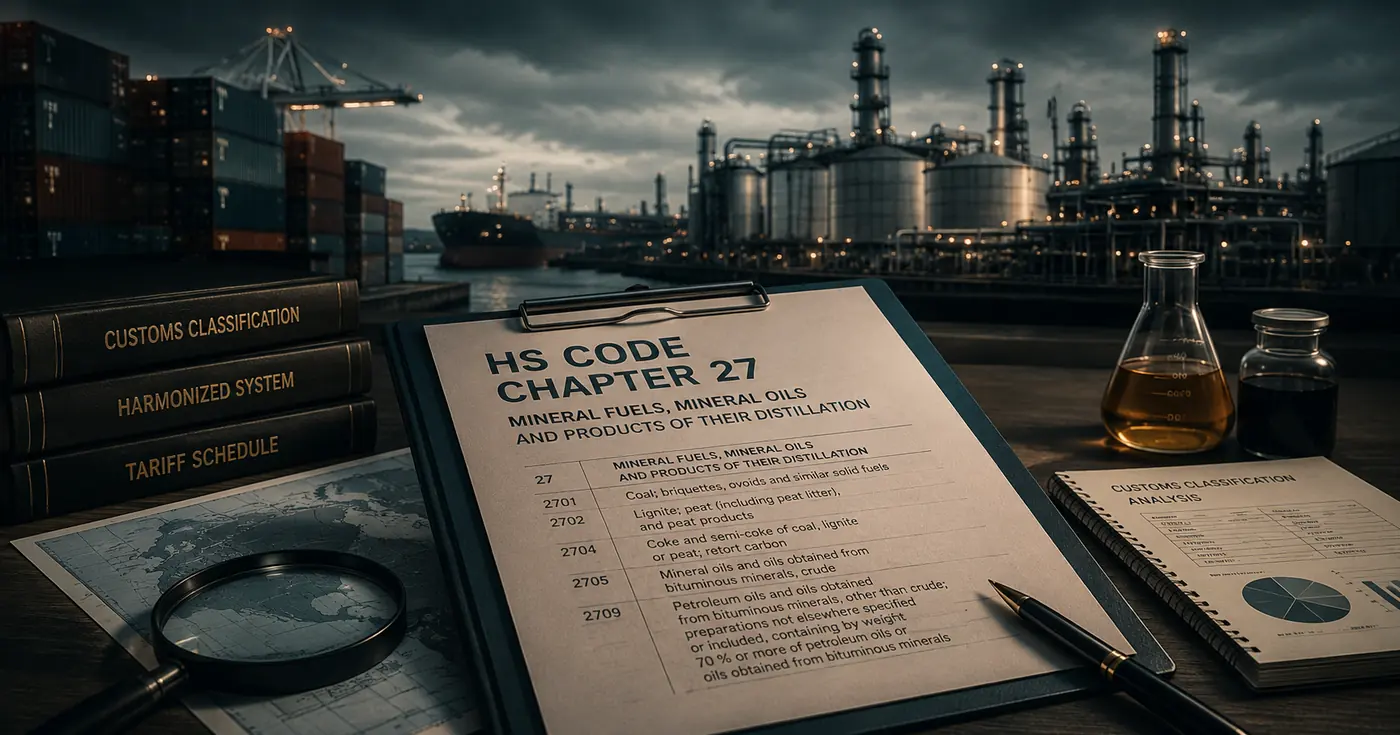
HS Code 2705 is part of Chapter 27, which covers mineral fuels, mineral oils and products of their distillation, bituminous substances and mineral waxes. For the wider structure of the chapter, see our Chapter 27 guide .
The nearby headings help put 2705 into context. Heading 2701 covers coal. Heading 2704 covers coke and semi-coke. Heading 2705 then covers the gases described by its legal wording. Heading 2706 moves to coal tar and similar mineral tars.
In practical classification work, the surrounding chapter structure is useful, but the legal analysis begins with the terms of the heading and the relevant Section and Chapter Notes.
HS Code 2705 Structure
Four-Digit Heading and Six-Digit Level
Coal gas, water gas, producer gas and similar gases, other than petroleum gases and other gaseous hydrocarbons.
The international six-digit subheading corresponding to Heading 2705.
At the international HS level, 2705.00 is the six-digit subheading under Heading 2705.
There is therefore no separate international six-digit split between coal gas, water gas, producer gas and similar gases within Heading 2705. Once the goods are properly classified in the heading, the international six-digit result is 2705.00.
Because Heading 2705 corresponds to a single international HS6 subheading, a separate long-form guide for 2705.00 would substantially duplicate the international classification scope covered here.
What Are Coal Gas, Water Gas and Producer Gas?
Coal Gas
Coal gas generally refers to a manufactured gas associated with the thermal treatment or carbonisation of coal.
For customs classification, however, the commercial name alone should not be treated as conclusive. The actual technical identity of the traded product and the supporting documentation should be reviewed before Heading 2705 is selected.
Water Gas
Water gas is generally associated with a manufactured gas produced through the reaction of steam with hot carbonaceous material.
The resulting product may contain gases such as carbon monoxide and hydrogen. For classification purposes, the relevant question is whether the actual traded product is properly identified as water gas within the scope of Heading 2705, rather than another separately classified product.
Producer Gas
Producer gas is generally associated with gas-generation processes involving carbonaceous material and a controlled supply of air, sometimes together with steam, to produce a combustible gas mixture.
For tariff purposes, the technical identity of the product remains more important than a broad description such as “industrial gas” or “fuel gas”.
In practical classification work, the identity of coal gas, water gas or producer gas can be supported by information about the product composition, production route, feedstock and technical documentation.
End use may provide useful context, but a gas does not enter Heading 2705 merely because it is used as fuel or because it is used inside an industrial facility.
What Does “Similar Gases” Mean?
The phrase “similar gases” means that Heading 2705 is not limited only to the three gases expressly named in the heading.
At the same time, the phrase should not be treated as a general residual category for every gas mixture that does not immediately fit somewhere else.
Any reliance on the words “similar gases” should be supported by the actual characteristics and identity of the goods and evaluated in the context of the heading wording and relevant legal Notes.
Useful technical questions can include:
- What is the actual identity of the traded gas?
- What is its composition?
- How is it produced?
- What feedstock or process inputs are used?
- Is it comparable in nature to the gases specifically described in Heading 2705?
- Is it a petroleum gas or another gaseous hydrocarbon expressly excluded by the heading?
- Do the technical documents support the proposed classification?
If the information is insufficient, the classification file should be strengthened with relevant technical evidence, which may include composition data, process information, technical datasheets, safety data sheets or supplier declarations.
What HS Code 2705 Does Not Cover
The wording of Heading 2705 contains an express exclusion: petroleum gases and other gaseous hydrocarbons.
This exclusion is important. A product should not be classified under 2705 merely because it is commercially described as an industrial gas, process gas or fuel gas.
Where the goods are petroleum gases or other gaseous hydrocarbons, Heading 2705 does not apply. The appropriate alternative classification depends on the actual chemical identity, composition, physical state and presentation of the goods, together with the relevant legal Notes and heading texts.
Heading 2711 covers petroleum gases and other gaseous hydrocarbons and should be evaluated where relevant. However, Chapter 27 Note 1(a) must also be considered. That Note excludes separate chemically defined organic compounds from Chapter 27, except for pure methane and pure propane, which remain classified in Heading 2711.
This means that a separately identified gaseous hydrocarbon should not automatically be assigned to Heading 2711 solely because it is a gas. The product's purity, identity, composition and presentation must be considered together with the applicable Chapter Notes.
Why Composition and Production Information Can Matter
A commercial product name alone is often insufficient to establish whether Heading 2705 applies.
Classification under GRI 1 begins with the terms of the headings and any relevant Section or Chapter Notes. Technical information is then used to establish what the goods actually are so those legal provisions can be applied correctly.
Information about the composition may help determine whether the product is a manufactured gas mixture or whether it is instead a petroleum gas, another gaseous hydrocarbon or a separately chemically defined compound.
Information about the production route and feedstock may also help confirm whether a commercial description such as coal gas, water gas or producer gas accurately reflects the traded product.
These facts are supporting evidence. They do not replace the legal wording of the Harmonized System.
Technical Information to Review for HS Code 2705
There is no single universal document list that, by itself, establishes classification under Heading 2705. The documents needed will depend on the information required to establish the identity and characteristics of the particular product.
| Data or Document | How It Can Support the Classification Review |
|---|---|
| Product name | Provides the commercial starting point and may indicate whether the goods are described as coal gas, water gas, producer gas or another type of gas. The name alone is not conclusive. |
| Manufacturing process | Can help establish how the gas is generated and whether the production route supports the technical identity stated by the supplier. |
| Feedstock | May provide supporting evidence about the production route and help explain the origin and nature of the resulting gas. Feedstock alone does not determine the HS classification. |
| Composition | Can help distinguish the product from petroleum gases, other gaseous hydrocarbons or separately chemically defined compounds that may require classification elsewhere. |
| TDS / specification sheet | May provide useful information about product identity, technical characteristics, composition, specifications and intended application. |
| SDS | May provide useful product-identification and composition information, including chemical names, ingredients or concentration ranges where disclosed. It should be treated as supporting technical evidence rather than a customs ruling. |
| Supplier declaration | Can help confirm technical facts that are not clear from the invoice, TDS or SDS, such as production route, feedstock or product identity. |
| Process-flow description | Can be useful where understanding how the gas is generated is necessary to establish its technical identity. |
| Physical state and presentation | Can be relevant when comparing the goods with alternative headings and subheadings, particularly where the tariff structure distinguishes liquefied products from products in the gaseous state. |
| End use | Can provide commercial and technical context, but should not be treated as the sole basis for classification under Heading 2705. |
Depending on the product, useful evidence may include a technical datasheet, safety data sheet, composition or analysis data, supplier declaration and a description of the manufacturing process.
If the available documentation does not establish the identity of the gas with sufficient clarity, additional technical information should be obtained before confirming the proposed customs classification.
How to Evaluate Goods for HS Code 2705
Identify the Traded Product
Establish what is actually being imported or exported, rather than relying only on a broad invoice description such as “gas”, “industrial gas” or “fuel gas”.
Review the Technical Identity
Determine whether the available information supports identification of the goods as coal gas, water gas, producer gas or another gas potentially within the scope of Heading 2705.
Review Composition and Production Information
Where relevant, review composition, production route, feedstock and supporting technical documents to establish the actual characteristics of the product.
Apply the Express Exclusion
Determine whether the goods are petroleum gases or other gaseous hydrocarbons. If they are, Heading 2705 expressly excludes them.
Review the Chapter Notes
Consider the relevant legal Notes, including Chapter 27 Note 1(a) where a separately chemically defined organic compound may be involved.
Apply GRI 1
Determine classification according to the terms of the headings and any relevant Section or Chapter Notes. Continue to the other General Rules only where required by GRI 1.
Apply GRI 6 at the Subheading Level
If the goods are classified in Heading 2705, the international six-digit result is 2705.00.
Verify the Destination Tariff
After establishing the international HS classification, verify the current detailed tariff and applicable operational requirements in Saudi Arabia, the UAE, Qatar, Oman, Kuwait or Bahrain.
Need Help Classifying Industrial Gas Products?
Use JAMAREK to analyse the available product identity, composition, manufacturing information and supporting documents before selecting the HS code.
Practical HS Code 2705 Classification Scenarios
Scenario 1 — Product Documented as Coal Gas
A supplier provides a gas product described in the technical documentation as coal gas generated through a coal-processing operation.
The available documentation supports that technical identity and does not indicate that the traded product is instead a petroleum gas or another gaseous hydrocarbon excluded by the heading. In this situation, Heading 2705 is the natural heading to evaluate.
Scenario 2 — Producer Gas Generated in an Industrial System
The product is identified as producer gas, and the process information and technical documentation support that identity.
Heading 2705 is therefore relevant for classification analysis, subject to the complete facts and applicable legal Notes.
Scenario 3 — Water Gas Used as a Process Fuel
The goods are technically identified as water gas and are supplied for use as fuel within an industrial process.
The use as fuel is not, by itself, what places the product in Heading 2705. The important issue is whether the actual identity of the goods falls within the wording of the heading.
Scenario 4 — LPG Used as an Industrial Fuel
An importer considers Heading 2705 because LPG is used as fuel inside an industrial facility.
That reasoning is not sufficient. Petroleum gases are expressly excluded from Heading 2705. Heading 2711 and its applicable subheadings should instead be evaluated together with the relevant Chapter Notes and the actual composition and presentation of the product.
Scenario 5 — Pure Methane Sold as a Separate Product
The goods are presented as pure methane rather than coal gas, water gas, producer gas or a similar gas under Heading 2705.
Chapter 27 Note 1(a) specifically provides that pure methane remains classified in Heading 2711. This is therefore a clear example of why the Chapter Notes must be read together with the heading wording.
Scenario 6 — Separately Chemically Defined Gaseous Hydrocarbon
A product is supplied as a separately chemically defined organic compound.
It should not automatically be assigned to Heading 2711 merely because it is a gaseous hydrocarbon. Chapter 27 Note 1(a) excludes separately chemically defined organic compounds from Chapter 27, other than pure methane and pure propane. The appropriate alternative classification must therefore be determined from the actual chemical identity and applicable tariff provisions.
Scenario 7 — “Industrial Gas Mixture” With No Technical Detail
The commercial invoice says only “Industrial Gas Mixture”. No composition data, process information, technical specification or supplier declaration is available.
That description is not enough to establish that Heading 2705 applies. The appropriate action is to obtain the technical information needed to identify the goods rather than selecting the code from the invoice wording alone.
Common HS Code 2705 Classification Mistakes
1. Treating 2705 as a General Gas Heading
Heading 2705 is not a general heading for all gases. Its scope is defined by its specific legal wording.
2. Ignoring the Petroleum Gas and Gaseous Hydrocarbon Exclusion
Petroleum gases and other gaseous hydrocarbons are expressly excluded from Heading 2705.
3. Relying Only on End Use
A gas used in a furnace, refinery, chemical plant, manufacturing facility or power system does not automatically belong in Heading 2705.
4. Accepting a Vague Invoice Description
Descriptions such as “Gas”, “Industrial Gas”, “Process Gas” or “Fuel Gas” may be too broad to establish the legal identity of the goods.
5. Treating Technical Documents as the Legal Classification Rule
TDS, SDS, composition data and supplier information can provide important technical evidence, but classification is legally determined according to the HS heading texts, relevant Notes and the General Rules for Interpretation.
6. Ignoring the Chapter Notes
Chapter 27 Note 1(a) is particularly important where the product may be a separately chemically defined organic compound.
7. Automatically Sending Every Gaseous Hydrocarbon to Heading 2711
Heading 2711 is important when evaluating petroleum gases and other gaseous hydrocarbons, but the Chapter Notes must still be applied. Separately chemically defined organic compounds are generally excluded from Chapter 27, except for pure methane and pure propane.
8. Copying a Supplier HS Code Without Verification
A supplier may be using a domestic tariff extension, an older tariff version or a classification based on a different product presentation or jurisdiction.
9. Stopping at 2705.00 Without Checking the Destination Tariff
The international HS6 classification is the common starting point. The current detailed tariff and any relevant customs or regulatory requirements must still be verified for the actual destination market.
Building a Defensible HS 2705 Classification File
- Record the exact commercial product name.
- Obtain a clear technical description of the goods.
- Identify the actual composition where relevant.
- Document the manufacturing or gas-generation process where it helps establish product identity.
- Identify the feedstock where it provides useful supporting evidence.
- Retain the TDS or specification sheet where available.
- Retain the SDS where available.
- Obtain additional supplier technical information where the existing documents are insufficient.
- Check whether the product is a petroleum gas or another gaseous hydrocarbon.
- Check whether Chapter 27 Note 1(a) affects the classification.
- Document why Heading 2705 applies or why it was rejected.
- Record 2705.00 where classification in Heading 2705 is supported.
- Verify the current destination-country tariff separately.
HS Code 2705 in Saudi Arabia, UAE, Qatar, Oman, Kuwait and Bahrain
The international Harmonized System provides the common six-digit classification foundation used when evaluating goods for Saudi Arabia, the United Arab Emirates (UAE), Qatar, Oman, Kuwait and Bahrain.
For this reason, this JAMAREK educational guide focuses on the internationally harmonized classification level: Heading 2705 and international subheading 2705.00.
Detailed tariff extensions and operational requirements should not be assumed to apply identically in every destination market.
Before completing a customs declaration, importers and exporters should verify the current detailed tariff and any applicable customs or regulatory requirements in the actual destination country.
Identify the product → review its technical identity and composition → review production information where relevant → apply the Heading 2705 exclusion → review the applicable Chapter Notes → apply the General Rules for Interpretation → use 2705.00 where Heading 2705 is legally supported → verify the current destination-country tariff and requirements.
Future Update: HS 2028
This guide is based on HS 2022, which remains the international HS edition in force in 2026.
The World Customs Organization has adopted the HS 2028 amendments, and the HS 2028 edition will enter into force on 1 January 2028.
In the WCO's official Recommendation containing the amendments accepted on 26 June 2025 for entry into force on 1 January 2028, the listed amendment to Chapter 27 concerns subheading 2710.91 and the creation of new subheadings 2710.92 and 2710.93. The Recommendation does not list an amendment to Heading 2705.
Businesses should nevertheless review the final HS 2028 nomenclature, correlation material and destination-country implementation before using the tariff structure after the new edition enters into force.
Frequently Asked Questions About HS Code 2705
What does HS Code 2705 cover?
What is the international HS6 code under Heading 2705?
Does HS Code 2705 cover all industrial gases?
Does HS Code 2705 include petroleum gases?
Does HS Code 2705 include other gaseous hydrocarbons?
Are all gaseous hydrocarbons classified under Heading 2711?
Is pure methane classified in Heading 2711?
Is producer gas classified under 2705?
Is water gas classified under 2705?
Are TDS and SDS mandatory documents for HS Code 2705?
What technical information can be useful for an HS 2705 review?
Why can the manufacturing process be relevant?
Is “Industrial Gas” enough as an invoice description?
Does the same international HS6 foundation apply across the six Gulf markets?
Do we need a separate article for HS Code 2705.00?
Classify Industrial Gas Products With More Confidence
Use JAMAREK to review available product information, technical characteristics, composition and classification logic before submitting the customs declaration.
Final Takeaway
HS Code 2705 is a focused customs heading, not a general category for every industrial gas or gaseous fuel.
It covers coal gas, water gas, producer gas and similar gases, while expressly excluding petroleum gases and other gaseous hydrocarbons.
The legal classification analysis begins with the heading wording, relevant Section and Chapter Notes and the General Rules for Interpretation. Technical documents and product data are used to establish what the goods actually are so those legal provisions can be applied correctly.
If the goods fall within Heading 2705, the international six-digit classification is 2705.00.
If the goods are petroleum gases or other gaseous hydrocarbons, Heading 2705 itself directs the analysis elsewhere. Heading 2711 may be relevant, but Chapter 27 Note 1(a) must also be considered, particularly where a separately chemically defined organic compound is involved.
For businesses operating in Saudi Arabia, the United Arab Emirates (UAE), Qatar, Oman, Kuwait and Bahrain, a defensible classification file should contain sufficient technical and commercial evidence to identify the goods, rather than relying only on a short invoice description or an unverified supplier HS code.
Official Sources
This guide is provided for general educational and informational purposes only. Correct customs classification depends on the actual product identity, technical characteristics, composition, presentation, supporting documentation and the applicable customs nomenclature in force at the time of import or export.
Technical documents such as TDS, SDS, specifications, composition data and supplier declarations may provide useful evidence, but they do not replace the legal terms of the tariff, applicable Section or Chapter Notes, or the General Rules for Interpretation.
Nothing in this article is a binding customs ruling. Before using any code in Saudi Arabia, the United Arab Emirates, Qatar, Oman, Kuwait or Bahrain, verify the current destination-country tariff, applicable customs requirements and any relevant regulatory requirements.