

HS Code Chapter 27: Mineral Fuels, Mineral Oils and Products of Their Distillation
A practical guide to HS Code Chapter 27 covering mineral fuels, petroleum oils, natural gas, coal, petroleum coke, bitumen and mineral waxes, with classification guidance for trade involving Saudi Arabia, the United Arab Emirates (UAE), Qatar, Oman, Kuwait and Bahrain.
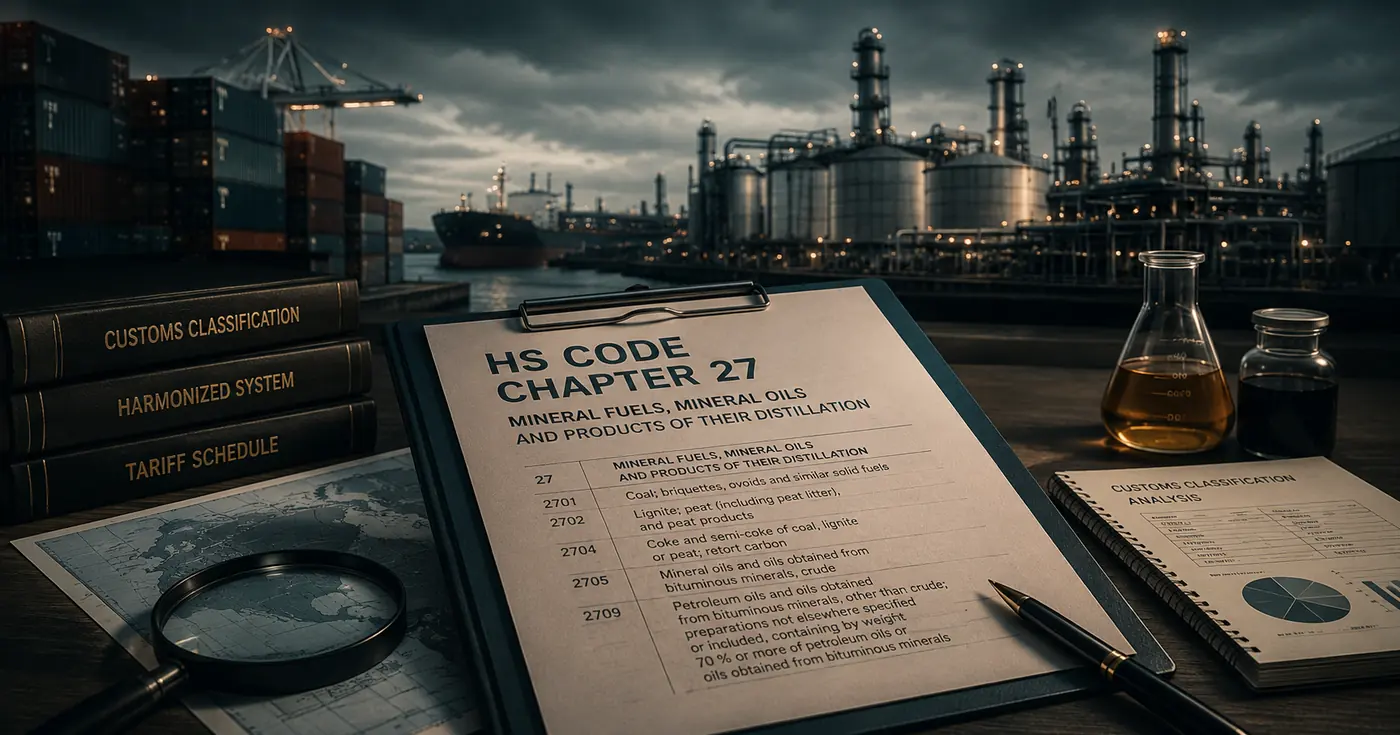
HS Code Chapter 27 covers one of the most commercially important categories in international trade: mineral fuels, mineral oils, petroleum products, coal, petroleum gases, bituminous substances, mineral waxes and electrical energy.
Businesses involved in oil and gas, petrochemicals, industrial manufacturing, power generation, transportation, construction and energy trading regularly encounter products that may fall within Chapter 27 of the Harmonized System.
Identifying the chapter, however, is only the first stage of customs classification. Products described commercially as oil, fuel, gas, lubricant or petroleum product do not automatically receive the same HS code.
The correct classification can depend on factors such as chemical composition, petroleum content, processing method, physical state, distillation characteristics, additives and whether another HS heading describes the product more specifically.
What Products Fall Under HS Chapter 27?
The official scope of Chapter 27 covers mineral fuels, mineral oils and products of their distillation, bituminous substances and mineral waxes.
In practical trade terms, the chapter brings together several major commodity groups.
Solid Mineral Fuels
- Coal
- Anthracite
- Bituminous coal
- Lignite
- Peat
- Coke and semi-coke
Petroleum Products
- Crude petroleum oils
- Refined petroleum oils
- Light oils
- Certain petroleum preparations
- Waste oils
- Petroleum residues
Petroleum Gases
- Liquefied natural gas
- Natural gas in gaseous state
- Propane
- Butanes
- Other gaseous hydrocarbons
Other Chapter 27 Products
- Petroleum coke
- Petroleum bitumen
- Natural asphalt
- Paraffin wax
- Petroleum jelly
- Electrical energy
This list is useful for understanding the general scope of the chapter, but it should not be used as a shortcut for determining the final HS code of a particular product.
For example, two materials both sold as “industrial oil” can be classified differently if one is primarily a petroleum oil and the other is a formulated chemical preparation with additives that bring it within another heading.
Understanding the 2-, 4- and 6-Digit HS Structure
The Harmonized System is hierarchical. Classification begins with a broad chapter and becomes progressively more specific through headings and subheadings.
Example Using Chapter 27
Mineral fuels, mineral oils and related products.
Petroleum gases and other gaseous hydrocarbons.
Natural gas, liquefied.
Under the international Harmonized System, headings are identified by four digits, while six-digit codes identify the international subheading level.
This distinction is important for trade involving Saudi Arabia, the United Arab Emirates (UAE), Qatar, Oman, Kuwait and Bahrain because the international six-digit classification can be extended by the applicable destination tariff for customs declaration purposes.
HS Chapter 27 Headings: 2701–2716
HS Code Chapter 27 is divided into headings covering different mineral fuels, petroleum products, gases and related materials. Understanding these four-digit headings is essential before moving to the six-digit subheading level.
Coal
Heading 2701 covers coal and certain solid fuels manufactured from coal. International subheadings distinguish anthracite, bituminous coal, other coal and briquettes or similar manufactured solid fuels.
Technical characteristics can matter. For example, the international subheading notes contain specific criteria used to define anthracite and bituminous coal.
Lignite
Heading 2702 covers lignite, whether or not agglomerated, excluding jet. The international structure distinguishes lignite that is not agglomerated from agglomerated lignite.
Peat
Heading 2703 covers peat, including peat litter, whether or not agglomerated.
Coke and Semi-Coke
Heading 2704 covers coke and semi-coke of coal, lignite or peat, whether or not agglomerated, as well as retort carbon.
Coal Gas and Similar Gases
Heading 2705 covers coal gas, water gas, producer gas and similar gases, other than petroleum gases and other gaseous hydrocarbons.
The word “gas” alone is therefore not enough to determine classification. The origin and composition of the gaseous product should be understood.
Mineral Tars
Heading 2706 covers tar distilled from coal, lignite or peat and other mineral tars, including qualifying dehydrated, partially distilled and reconstituted tars.
Coal Tar Distillation Products
Heading 2707 covers oils and other products resulting from the distillation of high-temperature coal tar, together with certain similar products where aromatic constituents predominate over non-aromatic constituents.
Some international subheadings within 2707 are linked to the percentage by weight of particular substances such as benzene, toluene, xylenes or naphthalene.
Pitch and Pitch Coke
Heading 2708 covers pitch and pitch coke obtained from coal tar or other mineral tars.
Crude Petroleum Oils
Heading 2709 covers petroleum oils and oils obtained from bituminous minerals in their crude state.
One of the major classification boundaries within Chapter 27 is the distinction between crude petroleum products classified in heading 2709 and petroleum oils or preparations classified within heading 2710.
Relevant questions can include whether refining has taken place, whether the product has been blended and whether another process has changed the nature of the original material.
HS 2710 — Petroleum Oils and Preparations
Heading 2710 is one of the most important and technically demanding headings within Chapter 27.
It covers petroleum oils and oils obtained from bituminous minerals, other than crude oils, together with certain preparations not elsewhere specified or included where qualifying petroleum oils make up at least 70% by weight and are the basic constituents of the preparation.
Chapter Note 2 also explains that the references in heading 2710 to petroleum oils and oils obtained from bituminous minerals can include similar oils and oils consisting mainly of mixed unsaturated hydrocarbons obtained by any process, provided that the weight of the non-aromatic constituents exceeds that of the aromatic constituents.
Heading 2710 also contains specific provisions for products containing biodiesel and for waste oils. For Chapter 27 purposes, waste oils include qualifying used oils no longer fit for use as primary products, certain sludge oils from petroleum-oil storage tanks, and qualifying oil emulsions or mixtures with water such as those arising from spills, tank washing or cutting-oil operations.
Why Petroleum Percentage Matters
The 70% threshold is an important part of the legal wording for certain preparations, but classification should never be performed using percentage alone.
The full nature of the finished product must still be reviewed. A formulated preparation may potentially be described by another heading even though petroleum-derived materials are present.
Light Oils and Preparations
The international subheading notes provide a technical definition for light oils and preparations under subheading 2710.12.
The definition uses a distillation criterion: 90% or more by volume, including losses, must distil at 210°C according to the specified ISO method, which is equivalent to ASTM D 86.
This demonstrates why technical data can directly determine customs classification. An invoice that merely describes the goods as “petroleum oil” or “industrial oil” may not provide enough information.
HS 2711 — Petroleum Gases and Other Gaseous Hydrocarbons
Heading 2711 covers petroleum gases and other gaseous hydrocarbons. Classification at the international subheading level can depend on both the identity of the hydrocarbon and whether the product is liquefied or presented in gaseous state.
The six-digit structure includes categories for:
- Liquefied natural gas
- Liquefied propane
- Liquefied butanes
- Liquefied ethylene, propylene, butylene and butadiene
- Other liquefied petroleum gases and gaseous hydrocarbons
- Natural gas in gaseous state
- Other gaseous hydrocarbons in gaseous state
LPG Is a Commercial Description
“LPG” is a common commercial expression for liquefied petroleum gas, but it is not always sufficient to establish the exact six-digit HS code.
A shipment may consist principally of propane, butane or another qualifying mixture. The actual composition should therefore be reviewed before selecting the international subheading.
Petroleum Jelly and Mineral Waxes
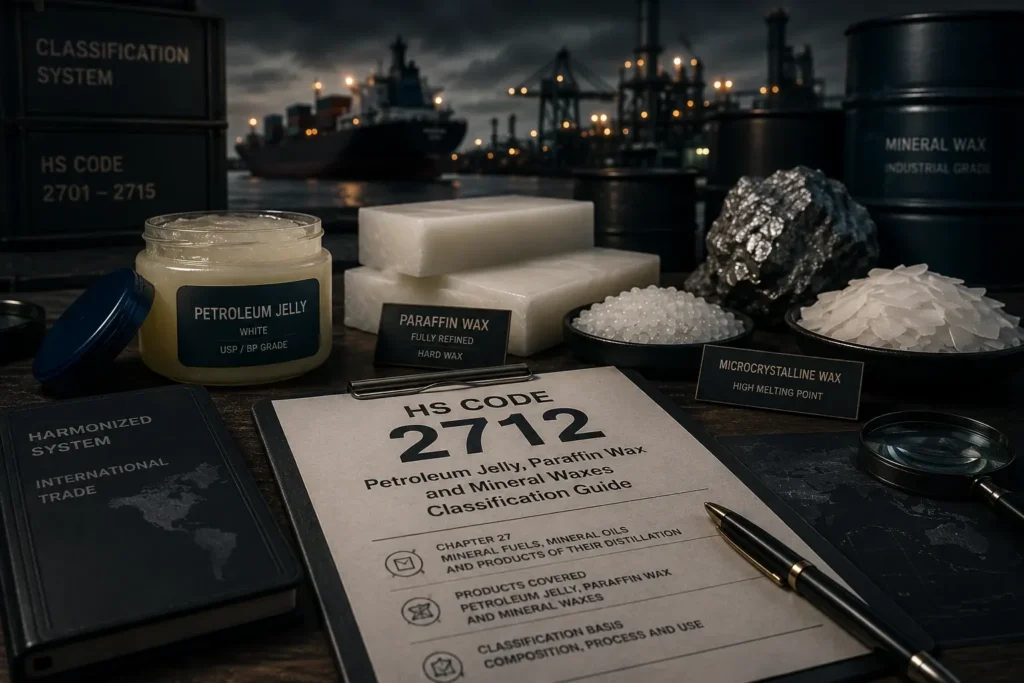
Heading 2712 covers petroleum jelly, paraffin wax, microcrystalline petroleum wax, slack wax, ozokerite, lignite wax, peat wax and other qualifying mineral waxes and similar products.
Product use alone should not determine classification. A wax used in candles, cosmetics, coatings or packaging still needs to be classified according to its actual characteristics.
Petroleum Coke, Petroleum Bitumen and Residues
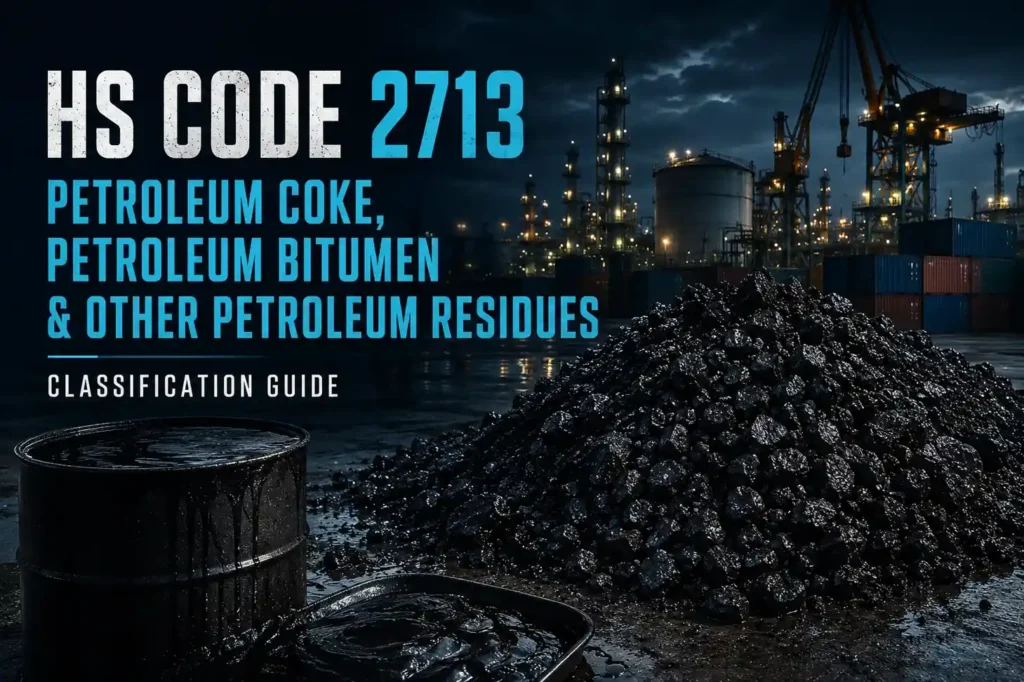
Heading 2713 covers petroleum coke, petroleum bitumen and certain other residues of petroleum oils or oils obtained from bituminous minerals.
At six digits, petroleum coke is distinguished between non-calcined and calcined forms.
Natural Bitumen and Asphalt
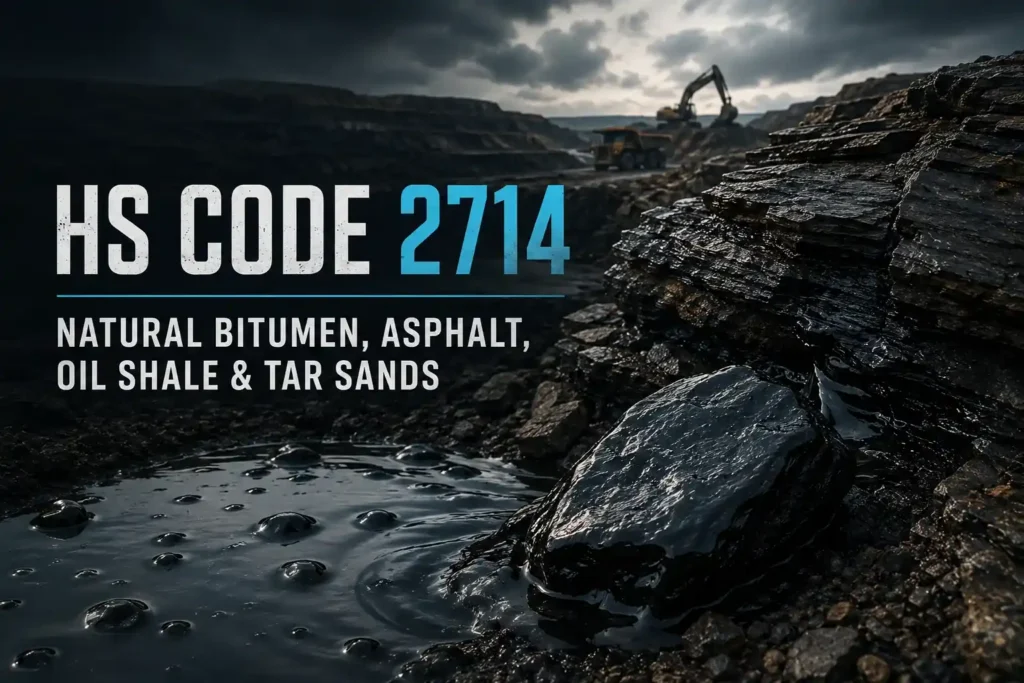
Heading 2714 covers natural bitumen and asphalt, bituminous or oil shale, tar sands, asphaltites and asphaltic rocks.
This heading should be distinguished from prepared bituminous mixtures classified in heading 2715.
Bituminous Mixtures
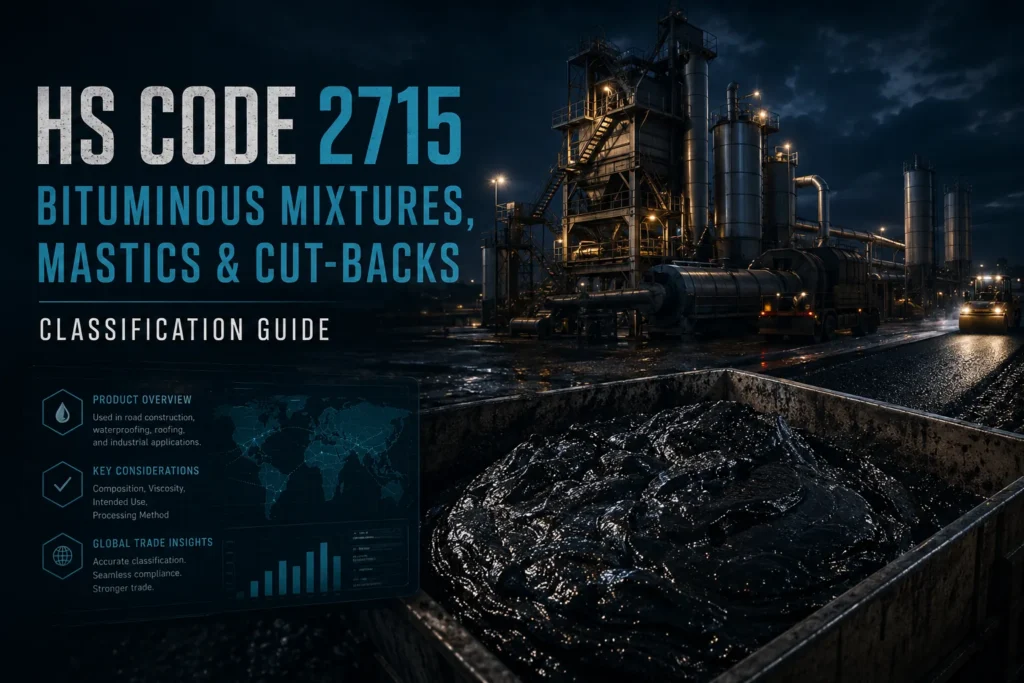
Heading 2715 covers bituminous mixtures based on materials such as natural asphalt, natural bitumen, petroleum bitumen, mineral tar or mineral tar pitch.
Examples can include qualifying bituminous mastics and cut-backs. This heading illustrates the importance of distinguishing a prepared mixture from a naturally occurring material.
Electrical Energy
Heading 2716 covers electrical energy. In the international HS nomenclature it is identified as an optional heading.
Common Commercial Products Associated with Chapter 27
Importers and exporters often begin reviewing HS Code Chapter 27 for products described commercially as:
- Crude oil
- Petroleum oil
- Fuel oils
- Light petroleum oils
- Certain waste oils
- Petroleum residues
- Natural gas
- LNG
- LPG
- Propane
- Butanes
- Other hydrocarbon gases
- Coal
- Anthracite
- Lignite
- Coke
- Petroleum coke
- Bitumen
- Paraffin wax
- Petroleum jelly
- Mineral waxes
- Natural asphalt
- Bituminous mixtures
- Electrical energy
These examples help identify potential Chapter 27 goods, but the actual HS classification must be determined from the characteristics of the specific product.
What HS Chapter 27 Does Not Cover
Chapter 27 contains legal exclusions that can move a product into another part of the Harmonized System.
One important exclusion relates to separately chemically defined organic compounds. As a general rule, such compounds do not belong in Chapter 27, subject to the specific exceptions provided in the Chapter Notes, including pure methane and pure propane of heading 2711.
The Chapter Notes also exclude medicaments of headings 3003 and 3004, as well as mixed unsaturated hydrocarbons of headings 3301, 3302 or 3805.
These exclusions mean that a product cannot be classified simply because it is petroleum-related or hydrocarbon-based.
Chapter 27 vs Chapter 29
Chapter 29 covers organic chemicals and is an important competing chapter when a product is a separately chemically defined organic compound.
Consider a material described commercially as a hydrocarbon solvent. Before selecting Chapter 27, the classifier may need to determine:
- Whether the product is a single chemically defined compound
- Whether it is a mixture
- The proportion of aromatic and non-aromatic constituents
- The production process
- Whether Chapter 29 contains a more specific description
Chapter 27 vs Chapter 34
Lubricating products can require careful comparison between petroleum headings and headings for prepared lubricants.
A product marketed as a “lubricant” is not automatically classified within heading 2710 simply because petroleum oil appears in the formulation.
Composition, additives and the nature of the finished preparation should be examined.
Chapter 27 vs Chapter 38
Specialty chemical preparations can also create classification questions between Chapter 27 and Chapter 38.
This can be relevant for complex industrial fluids, additive packages and preparations containing petroleum-derived constituents alongside other functional chemicals.
Chapter 27 vs Chapter 39
Chapter Note 2 specifically excludes certain liquid synthetic polyolefins from the petroleum-oil references in heading 2710.
The exclusion applies where less than 60% by volume distils at 300°C, after conversion to 1,013 millibars when a reduced-pressure distillation method is used. Such products fall within Chapter 39 rather than being brought into heading 2710 merely because they resemble petroleum oils.
This is another example of why the physical and chemical properties of the actual product can matter more than its commercial appearance.
Technical Data Needed for Chapter 27 Classification
Accurate classification of mineral oils, fuels and hydrocarbon preparations frequently requires technical information beyond the commercial invoice.
| Information | Why It Can Matter |
|---|---|
| Chemical composition | Helps determine whether the product is a defined substance, mixture or preparation and which headings are realistic. |
| Petroleum percentage | Can be directly relevant when evaluating preparations under heading 2710. |
| Aromatic vs non-aromatic content | The relationship between aromatic and non-aromatic constituents can affect the scope of certain petroleum-oil provisions. |
| Distillation data | International subheading definitions can use specific distillation criteria. |
| Physical state | Liquefied and gaseous hydrocarbons may fall under different six-digit subheadings. |
| Processing status | Helps distinguish crude, refined, calcined and other processed forms. |
| Biodiesel content | Heading 2710 has separate treatment for certain products containing biodiesel. |
| Additives | Additives may affect whether a finished material remains an oil of Chapter 27 or becomes another type of preparation. |
Documents That Can Support Classification
Depending on the goods, useful documentation may include:
- Commercial invoice
- Technical Data Sheet (TDS)
- Safety Data Sheet (SDS)
- Certificate of Analysis (COA)
- Product specification
- Full material composition
- Hydrocarbon composition
- Petroleum percentage
- Distillation results
- Density
- Viscosity
- Flash point
- Sulfur content
- Additive information
- Biodiesel content
- Manufacturing process
- Intended application
Not every classification requires every document. The objective is to obtain enough information to eliminate incorrect headings and compare the realistic classification alternatives.
How to Classify Products Under HS Code Chapter 27
A disciplined classification process reduces the risk of selecting a code merely because its description appears similar to the commercial name of the goods.
Identify the Actual Product
Replace generic descriptions such as “oil,” “fuel,” “chemical” or “gas” with a precise technical description of the goods.
Collect Technical Information
Review composition, state, processing, percentage data and other specifications that may influence the legal tariff description.
Review the Chapter Notes
Determine whether Chapter 27 contains a legal definition, threshold or exclusion relevant to the product.
Compare the Four-Digit Headings
Evaluate the wording of the realistic headings instead of selecting one solely because a single keyword matches.
Apply GRI 1 at Heading Level
For legal purposes, classification starts with the terms of the headings and the relevant Section or Chapter Notes. The remaining General Rules are applied where the heading terms or Notes do not otherwise resolve the classification.
Apply GRI 6 at Subheading Level
After establishing the four-digit heading, compare only subheadings at the same level, using their wording, related Subheading Notes and GRI 6 to determine the appropriate international six-digit classification.
Verify the Destination Tariff Extension
The international six-digit classification may need to be extended to the detailed tariff line required for the destination customs declaration.
Classify the Product — Not Just the Product Name
Use JAMAREK to analyze your actual product and identify the appropriate HS classification based on the information available for the goods.
Common HS Chapter 27 Classification Mistakes
1. Classifying Only from the Commercial Product Name
Terms such as “fuel oil,” “industrial oil,” “hydrocarbon” and “lubricant” can cover products with materially different compositions and legal tariff characteristics.
The commercial name should therefore be treated as a starting point, not as the final classification.
2. Assuming Every Lubricant Belongs Under 2710
The presence of petroleum oil does not automatically place a finished lubricant in heading 2710.
The percentage of petroleum oil, the additives and the overall nature of the preparation should be considered together with potentially competing headings.
3. Ignoring Composition Thresholds
Chapter 27 contains several technical and percentage-based rules. Ignoring those criteria can lead to classification at the wrong heading or subheading.
4. Ignoring Physical State
Under heading 2711, the distinction between liquefied products and gases presented in gaseous state affects the international subheading.
5. Confusing Crude and Refined Petroleum Products
Crude petroleum oils are classified differently from many refined petroleum oils and preparations.
Understanding the processing history of the material is therefore important.
6. Copying the Supplier's HS Code Without Verification
A supplier's code can be a useful reference, but it is not conclusive.
The supplier may be using a tariff extension from a different jurisdiction, may have classified a different version of the product, or the original classification may itself require correction.
7. Treating Six Digits as the Final Destination Declaration Code
Six digits represent the internationally harmonized subheading level. For an actual declaration, the current destination tariff must then be checked separately for Saudi Arabia, the UAE, Qatar, Oman, Kuwait or Bahrain.
HS Chapter 27 in Saudi Arabia, UAE, Qatar, Oman, Kuwait and Bahrain
Chapter 27 is especially relevant to Gulf trade because petroleum, natural gas, energy, petrochemical and industrial supply chains are significant across Saudi Arabia, the United Arab Emirates (UAE), Qatar, Oman, Kuwait and Bahrain.
These six countries participate in the Gulf customs-union framework, which includes a common external customs tariff and a Common Customs Law. The international Harmonized System classification remains the common starting point for identifying the goods.
For customs purposes, however, determining the international six-digit HS subheading is not necessarily the final operational step. The importer or exporter should then verify the current detailed tariff, customs procedures and regulatory requirements that apply in the actual destination market.
Identify the product → determine the international HS heading → select the international six-digit subheading → verify the current destination tariff and regulatory requirements in Saudi Arabia, UAE, Qatar, Oman, Kuwait or Bahrain.
This distinction is important for companies supplying the same product to several Gulf markets. The international HS analysis provides a common classification foundation, while destination-specific requirements are checked separately for the actual transaction.
This is also why an educational Chapter 27 article should not be treated as a substitute for classifying a specific shipment.
Explore HS Chapter 27 by Heading
Chapter 27 can be expanded into individual classification guides for each four-digit heading, with additional articles covering the corresponding six-digit international subheadings.
As each guide is published, these items can be converted into internal links. The four-digit guides can then link to their corresponding six-digit articles, creating a complete Chapter 27 content cluster.
Frequently Asked Questions About HS Code Chapter 27
What is HS Code Chapter 27?
Is crude oil classified under Chapter 27?
What HS heading covers refined petroleum oils?
What HS heading covers LPG?
What HS code is used for natural gas?
Is every lubricant classified under Chapter 27?
Are the first six digits of an HS code international?
Is a six-digit HS code enough for customs clearance in Saudi Arabia, UAE, Qatar, Oman, Kuwait or Bahrain?
Can two similar petroleum products have different HS codes?
What documents help classify mineral oils and fuels?
Classify Your Product with JAMAREK
Searching for a product name online can help identify possible HS headings, but it does not necessarily determine the correct classification of the actual goods being imported or exported.
A classification analysis may require comparing multiple headings, reviewing legal notes, applying the General Rules for Interpretation and considering technical product information.
JAMAREK is designed around the characteristics of the product being classified rather than relying only on a generic product-name search.
Instead of asking only:
the classification process can consider the actual description, specifications, supporting documentation, origin and destination of the goods.
Classify the Product — Not Just the Product Name
Use JAMAREK to analyze your actual product and identify the appropriate HS classification based on the information available for the goods.
Future Update: Confirmed HS 2028 Change in Chapter 27
This article is based on the HS 2022 nomenclature, which is the edition currently used for the international classification structure described in this guide.
The World Customs Organization has confirmed that HS 2028 will enter into force on 1 January 2028. The accepted amendments include a specific change within Chapter 27 affecting the waste-oil subheadings of heading 2710.
Under HS 2022, subheading 2710.91 covers waste oils containing PCBs, PCTs or PBBs. For HS 2028, subheading 2710.91 will be deleted and new subheadings 2710.92 and 2710.93 will be introduced to distinguish specified PCB concentration levels and other waste oils containing PCTs or PBBs.
This is a future change only. Until HS 2028 enters into force, current transactions should continue to be classified using the nomenclature and destination tariff legally in force at the time of the transaction.
Final Takeaway
HS Code Chapter 27 is the primary Harmonized System chapter for mineral fuels, petroleum oils, petroleum gases, coal, bituminous substances, mineral waxes and related commodities.
But identifying Chapter 27 is only the beginning.
A complete classification may require determining:
- The correct four-digit heading
- The correct six-digit international subheading
- The applicable detailed tariff extension
- Whether a legal Chapter Note excludes the goods
- Whether another chapter describes the product more specifically
- Whether percentage or technical thresholds apply
- Whether physical or chemical characteristics affect classification
For straightforward commodities, classification can be relatively direct. For petroleum preparations, industrial oils, specialty fuels, hydrocarbon mixtures and lubricants, the technical details can materially change the result.
Do not classify a product only because its commercial name resembles a tariff description.
Start with the actual goods, identify the relevant HS provisions and supporting technical information, and verify the current destination tariff and customs requirements in Saudi Arabia, UAE, Qatar, Oman, Kuwait or Bahrain before completing the customs declaration.
Official References
- World Customs Organization — HS 2022, Chapter 27
- World Customs Organization — General Rules for the Interpretation of the Harmonized System
- GCC Secretariat General — The GCC Customs Union
- GCC Secretariat General — Common Customs Law of the GCC States
- World Customs Organization — Accepted HS 2028 Amendments
This guide is provided for general educational and informational purposes only. HS classification depends on the characteristics of the specific goods, applicable legal tariff provisions, supporting documentation and customs requirements in force at the time of import or export.Product descriptions and examples in this guide should not be treated as a binding customs ruling or as a substitute for reviewing the applicable tariff and technical documentation for the actual goods. For transactions involving Saudi Arabia, the United Arab Emirates (UAE), Qatar, Oman, Kuwait or Bahrain, verify the current requirements applicable in the destination market.