

HS Code 2716: Electrical Energy Classification Guide
A detailed customs classification guide to HS Code 2716 covering electrical energy itself, the single international HS6 code 2716.00, the special “optional heading” wording, cross-border electricity transmitted through interconnected power systems, and the critical distinction between electrical energy and the equipment, fuels, batteries, certificates, services and infrastructure associated with producing, storing, transmitting or consuming electricity.
HS Code 2716 is the international Harmonized System heading for electrical energy.
Under HS 2022, the complete international HS6 structure is:
- 2716.00 — Electrical energy. (optional heading)
Unlike most customs headings, 2716 does not describe a conventional physical article such as a generator, transformer, cable, battery or solar panel.
It describes electrical energy itself.
This distinction becomes especially important when electricity is supplied across an international border through an interconnected transmission system.
The classification analysis should establish:
- whether the subject of the transaction is electrical energy itself;
- whether electricity actually crosses the customs frontier;
- whether heading 2716 is implemented in the relevant destination tariff;
- how the imported or exported quantity is measured;
- and whether separate equipment, services or intangible rights are being confused with the electrical energy.
Where HS Code 2716 sits within Chapter 27
Heading 2716 is the final heading of Chapter 27:
Mineral fuels, mineral oils and products of their distillation; bituminous substances; mineral waxes.
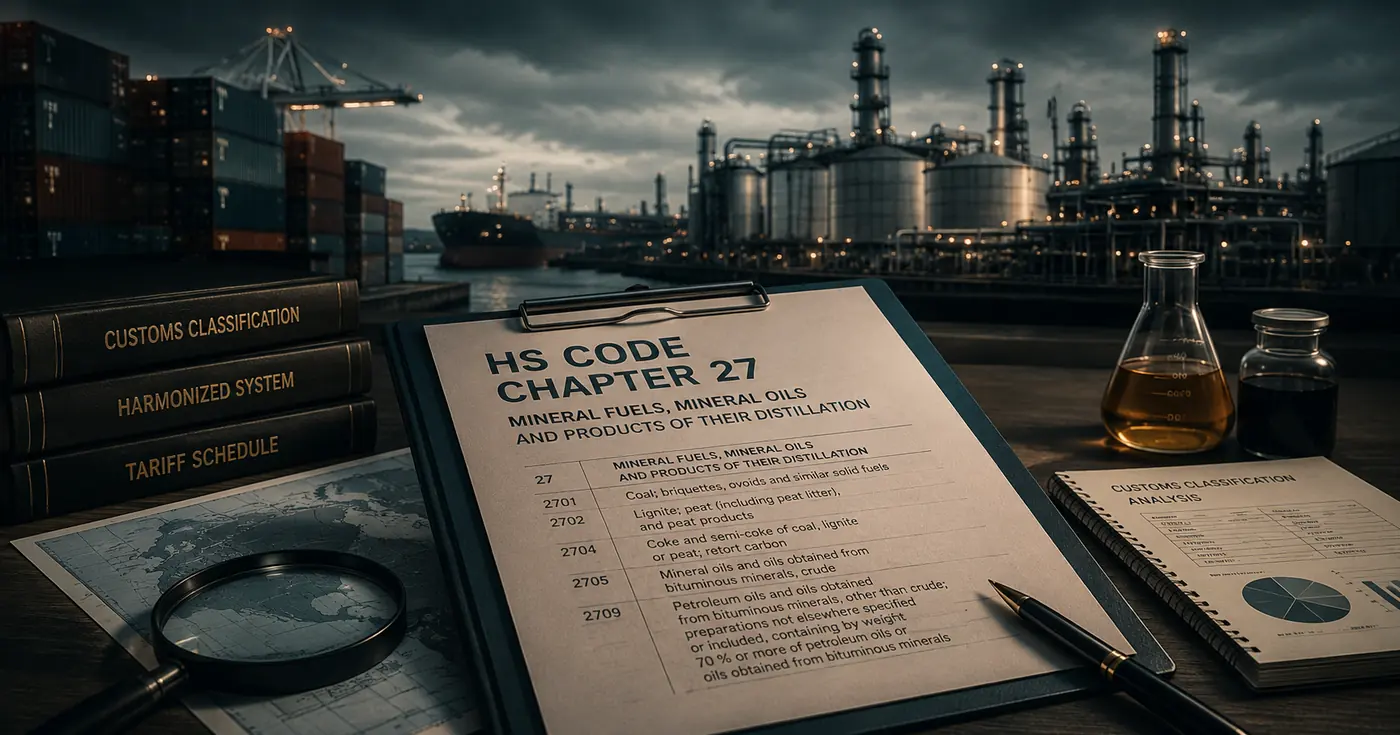
For the wider structure, see: HS Code Chapter 27 Classification Guide .
It follows:
- 2713 — petroleum coke, petroleum bitumen and other petroleum residues;
- 2714 — natural bitumen, natural asphalt, oil shale, tar sands and related materials;
- 2715 — bituminous mixtures.
Although electricity does not have the same physical form as the mineral products appearing earlier in Chapter 27, the Harmonized System places electrical energy in heading 2716.
Legal text of heading 2716
Under the WCO HS 2022 Nomenclature, heading 27.16 is:
The international six-digit code is:
The single international HS6 code under heading 2716.
There are no separate international HS6 subdivisions based on:
- renewable versus non-renewable electricity;
- solar generation;
- wind generation;
- hydroelectric generation;
- gas-fired generation;
- coal-fired generation;
- nuclear generation;
- voltage level;
- frequency;
- commercial customer type.
What does “optional heading” mean for HS 2716?
Heading 2716 is unusual because the WCO Nomenclature expressly labels it:
“optional heading”.
For practical classification work, this wording means that the existence of 2716.00 in the international HS should not be treated as proof that every national tariff, declaration platform or customs administration operationalises electricity transactions in exactly the same way.
Before declaring cross-border electrical energy, verify the tariff and customs procedures actually in force in the importing or exporting jurisdiction.
The wording is part of the published HS description and is particularly important when comparing different national tariff implementations.
The classification file should therefore distinguish between:
- the international HS nomenclature — where 2716.00 exists as an optional heading;
- the destination tariff — which must be checked for actual implementation;
- the customs declaration procedure — which may have specific operational rules for electricity transmitted through a grid.
International HS6 structure of heading 2716
International four-digit heading.
Single international HS6 code.
If a destination tariff uses additional digits, those digits are destination-specific tariff detail and should not be presented as additional international HS6 codes.
What is being classified under 2716?
The subject of heading 2716 is electrical energy itself.
In an international trade context, the most obvious case is electricity transmitted from the power system of one country into the power system of another country through an international interconnector.
Evidence may show:
- the exporting power system;
- the importing power system;
- the interconnection point;
- the metered electrical quantity;
- the settlement period;
- the supplier and purchaser;
- the contractual basis for the transaction.
The fact that electricity has no ordinary package, container or shipment weight does not convert a power plant, transmission line or meter into the classified product.
Those are separate physical articles.
Does the source of electricity change HS 2716?
At international HS6 level, heading 2716 contains only 2716.00.
Therefore, the HS6 code itself does not create separate categories for electricity generated from:
- solar power;
- wind power;
- hydroelectric power;
- natural gas;
- coal;
- oil;
- nuclear energy;
- geothermal energy;
- or other generating sources.
The generation source may still matter for:
- rules of origin;
- renewable-energy certification;
- regulatory requirements;
- emissions reporting;
- contractual pricing;
- energy-market rules.
Those issues should not be confused with the international HS6 structure.
A green attribute, renewable certificate or carbon-related instrument should also not automatically be treated as the electricity itself.
Cross-border electrical energy
HS 2716 becomes most relevant when actual electricity flows across an international frontier.
This may occur through:
- high-voltage AC interconnectors;
- high-voltage DC interconnectors;
- regional interconnected grids;
- cross-border power purchase arrangements;
- scheduled electricity imports or exports;
- market-based cross-border electricity trades.
Because electricity is continuously transmitted, evidence differs from the documentation normally used for containerised goods.
Relevant records may include:
- interconnector meter readings;
- grid operator settlement statements;
- electricity invoices;
- power purchase agreements;
- energy schedules;
- import/export settlement data;
- system operator confirmations;
- measurement period records.
Metering, kWh and MWh
Electrical energy is commonly measured commercially in units such as:
- kilowatt-hours — kWh;
- megawatt-hours — MWh;
- gigawatt-hours — GWh.
Metering information is important because electricity is not normally evidenced by gross weight, number of packages or container quantity.
However, the unit of measurement is not itself a classification rule.
The legal classification still begins with the product being electrical energy and the destination tariff's implementation of heading 2716.
Critical classification boundaries for HS 2716
| Product or transaction | Main question | Classification direction |
|---|---|---|
| Electrical energy crossing a border | Is the transaction for actual electricity transmitted into another country's power system? | Consider 2716.00 where the destination tariff implements the optional heading. |
| Electric generator | Is a physical generating machine being imported? | The equipment is not electrical energy; examine the appropriate machinery/electrical heading. |
| Transformer | Is the shipment an electrical transformer? | Not 2716. The transformer is a physical electrical article. |
| Transmission cable | Is insulated electrical cable being imported? | Not 2716. Classify the cable as a physical good. |
| Battery | Is the imported product an accumulator or battery containing stored electrochemical energy? | Classify the battery itself, not stored energy separately under 2716. |
| Solar panel | Is a photovoltaic module being imported rather than electricity? | Not 2716. Classify the module as the imported article. |
| Renewable-energy certificate | Is the subject a certificate or environmental attribute rather than electrical energy? | Do not automatically classify the certificate under 2716. |
| Electricity transmission service | Is a fee being paid for grid transmission or wheeling rather than for the electrical energy itself? | Separate the service component from the goods classification analysis. |
2716 versus generators
A generator produces electricity, but the generator is not electrical energy.
When a generator is physically imported, classify the generator according to its own technical characteristics.
Do not classify it under 2716 merely because electricity is its output.
2716 versus transformers
Transformers alter voltage or electrical characteristics within a power system.
They remain physical equipment and should be classified under the appropriate electrical machinery provisions, not under 2716.
2716 versus batteries and accumulators
A battery stores energy through an electrochemical system.
When a battery crosses a customs frontier, the imported good is the battery or accumulator itself.
The electrical energy potentially available from that battery should not normally be separated as a second imported good under 2716.
The fact that it contains stored energy does not transform the physical article into cross-border electrical energy of heading 2716.
2716 versus solar panels and wind turbines
Solar modules, inverters, wind turbines, generators and related equipment are physical goods.
They may produce electricity after installation, but that future electricity generation does not make the equipment 2716.
2716 versus fuels used to generate electricity
Natural gas, fuel oil, coal and other fuels should be classified according to the imported fuel itself.
The future production of electricity does not convert fuel shipments into electrical energy.
2716 versus renewable certificates and environmental attributes
Renewable-energy certificates, guarantees of origin, I-REC type instruments, carbon attributes or other contractual environmental rights may be associated with electricity.
However, the certificate or attribute is not automatically the electrical energy itself.
If a transaction separates:
- physical electrical energy;
- renewable attributes;
- transmission fees;
- balancing services;
the classification file should keep those elements distinct.
Evidence needed for HS 2716 classification
| Evidence | Why it matters |
|---|---|
| Transaction description | Confirms whether the subject is actual electrical energy or another product/service. |
| Power purchase agreement | Helps establish the parties, electricity quantity and commercial basis. |
| Cross-border interconnector details | Supports evidence that electricity physically crosses an international frontier. |
| Meter readings | Establish the quantity transferred during the relevant period. |
| Grid operator statement | Can support direction and quantity of cross-border power flow. |
| Settlement statement | Helps reconcile metered energy with commercial invoicing. |
| Electricity invoice | Supports quantity, price and contractual counterparty. |
| Export/import schedule | Supports the planned transfer of electrical energy. |
| Generation information | May be relevant to origin, renewable attributes or regulatory requirements. |
| Destination tariff | Essential because heading 2716 is expressly labelled optional. |
| Customs procedure guidance | Confirms how the jurisdiction handles electricity declarations operationally. |
| Separate service invoices | Helps distinguish electricity from transmission, wheeling, balancing or other services. |
| Certificate documentation | Helps separate environmental certificates or attributes from physical electrical energy. |
SDS, TDS and material composition are generally not the core evidence for electrical energy. Metering, grid, contractual and destination-tariff evidence are usually much more relevant.
Step-by-step HS 2716 classification process
Identify the subject of the transaction
Confirm whether the transaction is for electrical energy itself, physical electrical equipment, fuel, storage equipment, a certificate or a service.
Confirm actual cross-border movement
Establish whether electricity flows from one customs territory into another.
Review heading 2716 under GRI 1
Begin with the legal heading text: electrical energy.
Recognise the optional-heading status
Do not assume that national implementation is identical in every jurisdiction.
Check the destination tariff
Confirm whether 2716 is operationally included and whether additional tariff digits are used.
Identify the interconnection point
Document the physical point or system through which electricity crosses the border.
Obtain meter evidence
Confirm the transferred quantity in kWh, MWh or another recognised energy unit.
Reconcile the commercial documents
Compare meter readings, settlement data, invoices and power purchase documentation.
Separate physical equipment
Generators, transformers, batteries, cables, switchgear, meters and renewable-generation equipment must be classified as their own physical goods.
Separate services and certificates
Transmission fees, balancing services and environmental certificates should not automatically be treated as electrical energy.
Use 2716.00 where legally applicable
The international HS6 code is 2716.00.
Retain the evidence trail
Keep tariff references, meter records, contracts, invoices and customs-procedure evidence in the classification file.
Need to classify a cross-border electricity transaction?
JAMAREK helps structure customs classification analysis around the legal heading, actual transaction, destination tariff, supporting evidence and realistic classification boundaries.
Practical HS Code 2716 classification scenarios
Scenario 1 — Electricity imported through an international interconnector
Power is physically transmitted from the exporting country's grid into the importing country's grid.
Where the destination tariff implements heading 2716, 2716.00 should be examined.
Scenario 2 — Electricity exported through the same regional grid
Electricity flows in the opposite direction during another settlement period.
The electrical energy itself remains the product being analysed.
Verify the exporter's applicable tariff and customs procedure.
Scenario 3 — Solar-generated electricity crossing the border
Electricity was generated from a solar facility and then transmitted internationally.
HS 2716 does not contain a separate international HS6 subdivision for solar electricity.
Scenario 4 — Wind-generated electricity crossing the border
The generation source is wind.
At international HS6 level, there is still only 2716.00 if heading 2716 is applicable.
Scenario 5 — Gas-fired electricity imported
The power was generated by a natural-gas power plant.
The electricity is not classified as natural gas.
The fuel and the generated electricity are different products.
Scenario 6 — Natural gas imported for local electricity generation
Natural gas crosses the border and is burned domestically to generate electricity.
The imported product is natural gas, not electrical energy under 2716.
Scenario 7 — Diesel generator imported
A physical generator set is imported.
Do not use 2716.
Classify the generator according to its own technical characteristics.
Scenario 8 — High-voltage transformer imported
A transformer is shipped for installation at a substation.
It is electrical equipment, not electrical energy.
Scenario 9 — Transmission cable imported
High-voltage insulated cable is physically imported.
The cable must be classified as cable, not as electricity under 2716.
Scenario 10 — Solar panels imported
Photovoltaic modules are imported for a new solar farm.
The modules are the imported goods.
Future electricity generation does not make the panels 2716.
Scenario 11 — Wind turbine imported
A wind turbine or its components cross the customs frontier.
The physical machinery is classified separately.
Scenario 12 — Charged lithium-ion battery imported
A battery arrives partially or fully charged.
The imported article is the battery.
Do not create a separate 2716 declaration for the electricity stored inside it.
Scenario 13 — Grid-scale battery system imported
Containers containing battery modules, power-conversion equipment and control systems are imported.
The goods are physical equipment, not electrical energy under 2716.
Scenario 14 — UPS imported
An uninterruptible power supply is imported for a data centre.
The UPS is an electrical article and requires classification under its applicable heading.
Scenario 15 — Electricity invoice includes transmission charges
The invoice separately lists:
- electrical energy;
- transmission charges;
- system fees.
The classification file should distinguish the electrical energy from the service components.
Scenario 16 — Renewable-energy certificate sold separately
A renewable attribute certificate is transferred without a corresponding physical power flow.
Do not automatically use 2716.
The certificate is not, by itself, the physical electrical energy described by the heading.
Scenario 17 — Electricity and renewable certificate sold together
A contract includes both physical electricity and a renewable attribute.
Keep the physical electrical energy and the certificate conceptually separate in the customs analysis.
Scenario 18 — Carbon credit transaction
Carbon credits are sold in connection with low-carbon power generation.
The credits themselves are not electrical energy merely because they relate to electricity production.
Scenario 19 — EV charging at a domestic charging station
A vehicle is charged locally from a domestic charging network.
If there is no cross-border customs movement of electricity, a 2716 import declaration may not be the operative customs issue.
Scenario 20 — Data centre purchases electricity domestically
A domestic electricity retailer supplies a domestic data centre.
A normal domestic supply transaction should not be confused automatically with a customs import of electrical energy.
Scenario 21 — Cross-border balancing electricity
A regional grid exchanges energy to balance supply and demand.
Determine whether the settlement represents actual cross-border electrical energy, a balancing service, or both.
Scenario 22 — Emergency power support across an interconnector
Electricity is supplied temporarily from a neighbouring grid during a system emergency.
The temporary nature of the supply does not by itself change the product identity.
Check the applicable customs procedure and tariff implementation.
Scenario 23 — Power purchase agreement without physical delivery yet
A contract is signed for future electricity delivery, but no power has yet crossed the border.
The contract itself should not be treated as already-imported electrical energy.
Scenario 24 — Cross-border power measured monthly
Electricity continuously crosses the border, while the commercial quantity is reconciled monthly using meter data.
The settlement period does not change the nature of the product.
Accurate meter and grid records become central evidence.
Common HS Code 2716 classification mistakes
1. Classifying generators under 2716
A generator produces electricity but is not electrical energy itself.
2. Classifying transformers under 2716
Transformers are physical electrical equipment.
3. Classifying cables under 2716
Cables transmit electricity but remain physical goods.
4. Classifying batteries under 2716
A battery is an article with its own classification.
5. Separating stored battery energy as a second imported good
The stored energy does not normally create a separate 2716 shipment.
6. Classifying solar panels as electrical energy
Solar panels generate electricity after installation; they are not the electrical energy itself.
7. Classifying wind turbines as electrical energy
Wind turbines are machinery.
8. Classifying fuel used by a power plant as 2716
Fuel is classified according to the fuel itself.
9. Ignoring the words “optional heading”
The WCO expressly includes this wording in the legal nomenclature.
10. Assuming every country handles 2716 identically
National implementation and declaration procedures must be verified.
11. Inventing separate HS6 codes for renewable electricity
HS 2022 has only one international HS6 code under 2716.
12. Creating separate HS6 codes by voltage
Voltage does not create separate international 2716 subheadings.
13. Creating separate HS6 codes by generation technology
Solar, wind, hydro and gas-fired electricity are not separately divided at international HS6 level.
14. Confusing electricity with renewable certificates
A certificate or environmental attribute is not automatically the electrical energy itself.
15. Confusing electricity with transmission services
The energy and service components should be distinguished.
16. Confusing electricity with balancing services
Determine whether actual energy transfer, a service, or both are being settled.
17. Using only the commercial invoice
Cross-border electricity usually requires metering and grid evidence as well.
18. Ignoring meter data
Meter data is critical for proving transferred quantity.
19. Treating kWh as a legal classification test
The measurement unit proves quantity; it does not determine the HS heading by itself.
20. Applying 2716 when no electricity crossed a customs frontier
Domestic power supply should not automatically be treated as an import transaction.
21. Treating a future PPA as already imported electricity
A contract and actual power delivery are separate facts.
22. Ignoring the destination tariff
This is particularly risky because 2716 is labelled an optional heading.
23. Assuming HS6 is the complete declaration code
A national tariff may require additional destination-specific digits.
24. Mixing customs classification with energy regulation
Grid licensing, market regulation, renewable certification and customs classification are separate legal questions.
Building a defensible HS 2716 classification file
A strong classification file may include:
- description of the electricity transaction;
- exporting country;
- importing country;
- supplier;
- purchaser;
- power purchase agreement;
- interconnector identification;
- cross-border connection point;
- grid operator confirmation;
- meter identification;
- meter readings;
- energy quantity in kWh, MWh or GWh;
- measurement period;
- scheduled power quantity;
- actual settled power quantity;
- settlement statement;
- commercial invoice;
- transmission charges;
- balancing charges;
- other system charges;
- renewable certificate documentation where relevant;
- generation-source information where relevant;
- origin documentation where applicable;
- GRI 1 analysis;
- official HS 2022 heading text;
- confirmation of optional-heading status;
- destination-country tariff;
- destination customs declaration procedure;
- additional national tariff digits where applicable;
- supporting customs correspondence if available;
- classification conclusion;
- rejected alternatives and reasons.
1. Is the subject of the transaction electrical energy itself?
2. Did the electricity actually cross an international customs frontier?
3. How was the transferred quantity measured and verified?
4. Does the relevant national tariff implement heading 2716?
5. Have equipment, certificates and service charges been separated from the energy itself?
6. What detailed declaration code and customs procedure apply in the destination country?
HS Code 2716 in Saudi Arabia, UAE, Qatar, Oman, Kuwait and Bahrain
The international HS nomenclature provides:
2716.00 — Electrical energy. (optional heading)
However, because the heading is expressly described as optional, companies dealing with cross-border electricity involving:
- Saudi Arabia;
- United Arab Emirates (UAE);
- Qatar;
- Oman;
- Kuwait;
- Bahrain
should verify the current tariff and customs declaration procedures applicable to the specific transaction and destination.
The first six digits provide the international classification reference, but the destination tariff, national implementation and operational customs procedure must still be verified.
The classification question should also be separated from:
- electricity-market licensing;
- grid access;
- interconnection agreements;
- power purchase regulation;
- renewable-energy certificates;
- energy regulation;
- tax treatment;
- transmission and balancing rules.
Those may all be important to the transaction, but they are not substitutes for the HS classification analysis.
HS 2028 and heading 2716
This article is based on HS 2022.
The World Customs Organization has published the amendments for the HS 2028 edition, which will enter into force internationally on 1 January 2028.
The published Chapter 27 changes focus on amendments elsewhere in the Chapter, including changes concerning heading 2710.
The published amendment recommendation does not identify a change to heading 2716.
Accordingly, the currently published HS 2028 amendments do not indicate a change to the 2716 international heading structure.
A future HS edition should not be applied early merely because the amendments have already been published.
Frequently asked questions about HS Code 2716
What does HS Code 2716 cover?
What is the international HS6 code for electrical energy?
How many international HS6 codes are under heading 2716?
Why does the HS call 2716 an optional heading?
Is a generator classified under 2716?
Is a transformer classified under 2716?
Are electrical cables classified under 2716?
Are batteries classified under 2716?
Is the electricity stored inside a battery separately classified under 2716?
Are solar panels classified under 2716?
Are wind turbines classified under 2716?
Does solar electricity have a separate HS6 code?
Does wind electricity have a separate HS6 code?
Does hydroelectricity have a different HS code?
Does natural-gas-generated electricity have a different HS6 code?
Is natural gas used by a power plant classified as electrical energy?
Can cross-border electricity be classified under 2716.00?
Do I need meter records for electricity classification?
Does kWh determine HS classification?
Can electricity be measured in MWh for customs documentation?
Is a renewable-energy certificate classified under 2716?
Are carbon credits classified as electrical energy?
Is an electricity transmission fee classified under 2716?
Are balancing services electrical energy?
Does a power purchase agreement prove an electricity import?
Can a future electricity contract be classified as already imported electricity?
Does domestic electricity consumption require HS 2716?
Do Saudi Arabia, UAE, Qatar, Oman, Kuwait and Bahrain all use exactly the same detailed 2716 declaration structure?
Can a country add more digits after 2716.00?
Will heading 2716 change under HS 2028?
Classify the electricity — not the equipment around it
Generators, transformers, batteries, solar panels, cables, grid services and renewable certificates may all be connected to electricity, but they are not automatically electrical energy of HS 2716. Reliable classification begins by identifying exactly what is crossing the customs frontier.
Conclusion
HS Code 2716 covers electrical energy.
Under HS 2022, the international structure contains one HS6 code:
2716.00 — Electrical energy. (optional heading)
The phrase “optional heading” is an important part of the international nomenclature and should not be ignored.
For actual cross-border electricity transactions, the classification file should therefore confirm:
- that electrical energy itself is the subject of the transaction;
- that electricity crosses an international customs frontier;
- the relevant meter and grid records;
- the commercial settlement documentation;
- the destination tariff's implementation of 2716;
- the applicable detailed declaration code and customs procedure.
Physical articles such as:
- generators;
- transformers;
- batteries;
- solar panels;
- wind turbines;
- cables;
- switchgear;
- meters
should be classified as the physical goods they actually are, rather than as electrical energy.
Similarly, renewable certificates, environmental attributes, transmission charges and balancing services should not automatically be merged into the HS classification of the electricity itself.
Once the international classification has been established, always verify the current tariff and customs procedure required in Saudi Arabia, the United Arab Emirates, Qatar, Oman, Kuwait and Bahrain before declaration.
Official & Supporting Sources
This guide is provided for general educational and informational purposes only.
The international HS 2022 Nomenclature identifies 2716.00 as “Electrical energy. (optional heading)”. The optional nature of the heading makes it particularly important to verify the tariff, declaration system, customs procedure and any additional national tariff digits legally applicable to the specific importing or exporting jurisdiction.
A commercial relationship with electricity does not automatically make a product electrical energy for customs classification purposes.
Generators, transformers, batteries, accumulators, solar panels, wind turbines, cables, switchgear, meters, inverters, power-conversion systems and other electrical infrastructure are physical goods that require classification according to their own technical characteristics.
Renewable-energy certificates, guarantees of origin, environmental attributes, carbon-related instruments, transmission charges, wheeling charges, balancing services and other contractual or service elements should not automatically be treated as electrical energy under heading 2716.
Meter readings, grid operator records, power purchase agreements, settlement data and invoices are important supporting evidence, but they do not replace the legal heading wording, applicable tariff provisions or the General Rules for Interpretation.
Electricity-market licensing, grid access, energy regulation, renewable certification, taxation, market settlement and customs classification are separate legal and regulatory questions.
Nothing in this article constitutes a binding customs ruling. Before applying HS 2716 in Saudi Arabia, the United Arab Emirates, Qatar, Oman, Kuwait or Bahrain, verify the tariff and customs procedure legally in force for the relevant transaction and declaration date.