

HS Code 2712: Petroleum Jelly, Paraffin Wax and Mineral Waxes Classification Guide
A detailed customs classification guide to HS Code 2712 covering petroleum jelly, paraffin wax, micro-crystalline petroleum wax, slack wax, ozokerite, lignite wax, peat wax, other mineral waxes and similar products obtained by synthesis or by other processes. This guide explains the three international HS6 subheadings, the legally important less-than-0.75% oil threshold for paraffin wax, the residual scope of 2712.90, and important classification boundaries with petroleum oils, lubricating preparations, cosmetics, medicaments, artificial and prepared waxes, polishes, candles, dental waxes, vegetable and insect waxes, petroleum residues and chemical preparations.
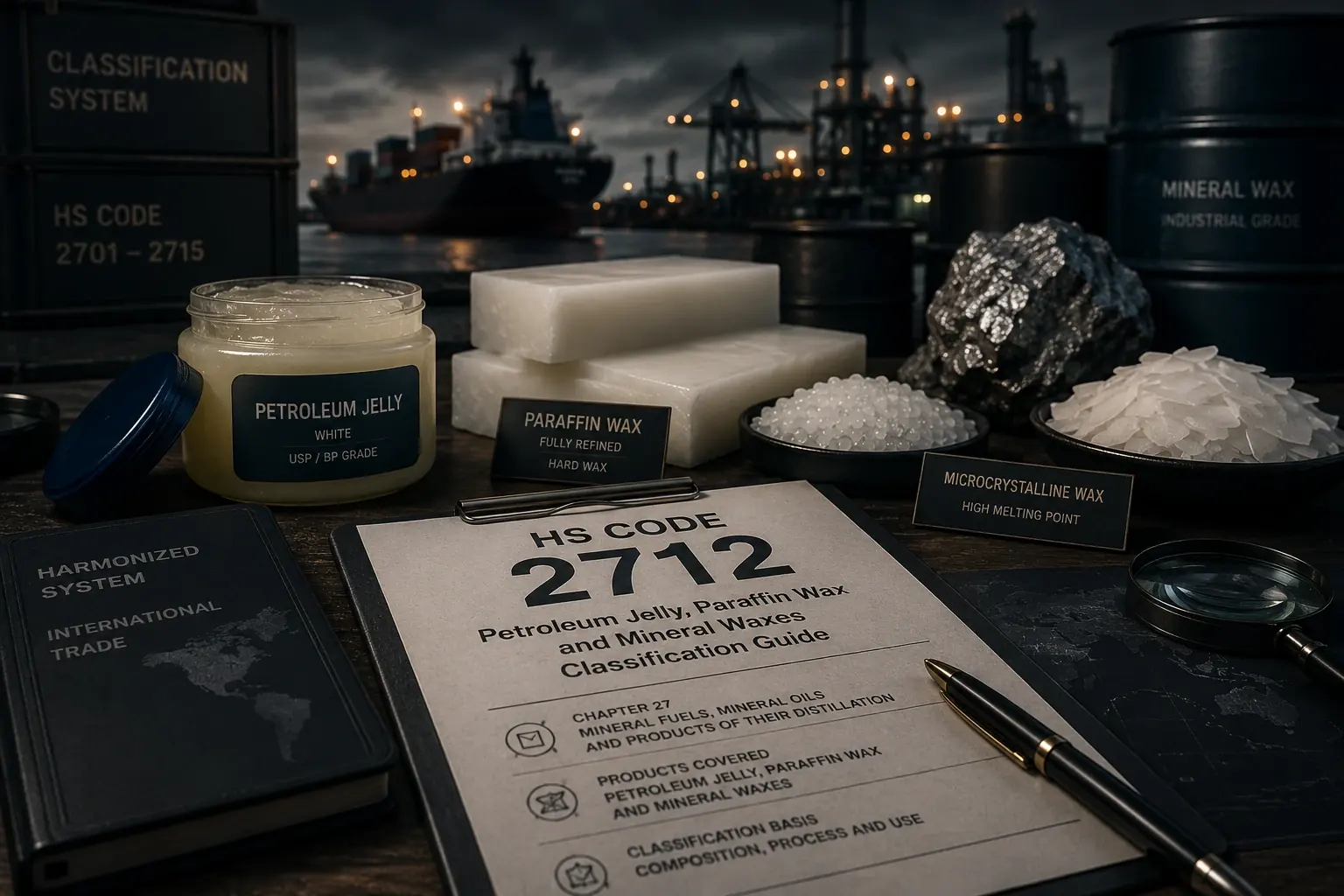
HS Code 2712 covers a legally defined group of petroleum, mineral and similar waxy products. Correct classification begins by identifying the actual material. Only after Heading 2712 has been established should the classifier move to its three international six-digit subheadings.
The heading expressly names:
- petroleum jelly;
- paraffin wax;
- micro-crystalline petroleum wax;
- slack wax;
- ozokerite;
- lignite wax;
- peat wax;
- other mineral waxes;
- and similar products obtained by synthesis or by other processes.
The heading also states that these goods may remain within its scope whether or not coloured.
Nevertheless, the presence of petroleum jelly or wax in a product does not automatically classify the finished goods in Heading 2712.
Depending on the facts, the imported product may instead require consideration as:
- a petroleum oil of Heading 2710;
- a medicament of Heading 3003 or 3004;
- a beauty or skin-care preparation of Heading 3304;
- a lubricating or anti-corrosion preparation of Heading 3403;
- an artificial or prepared wax of Heading 3404;
- a polish or cream of Heading 3405;
- a finished candle of Heading 3406;
- a dental wax or dental impression preparation of Heading 3407;
- a vegetable wax, beeswax, other insect wax or spermaceti of Heading 1521;
- a petroleum residue of Heading 2713;
- or another chemical preparation such as one potentially falling in Heading 3824.
Where Heading 2712 sits in Chapter 27
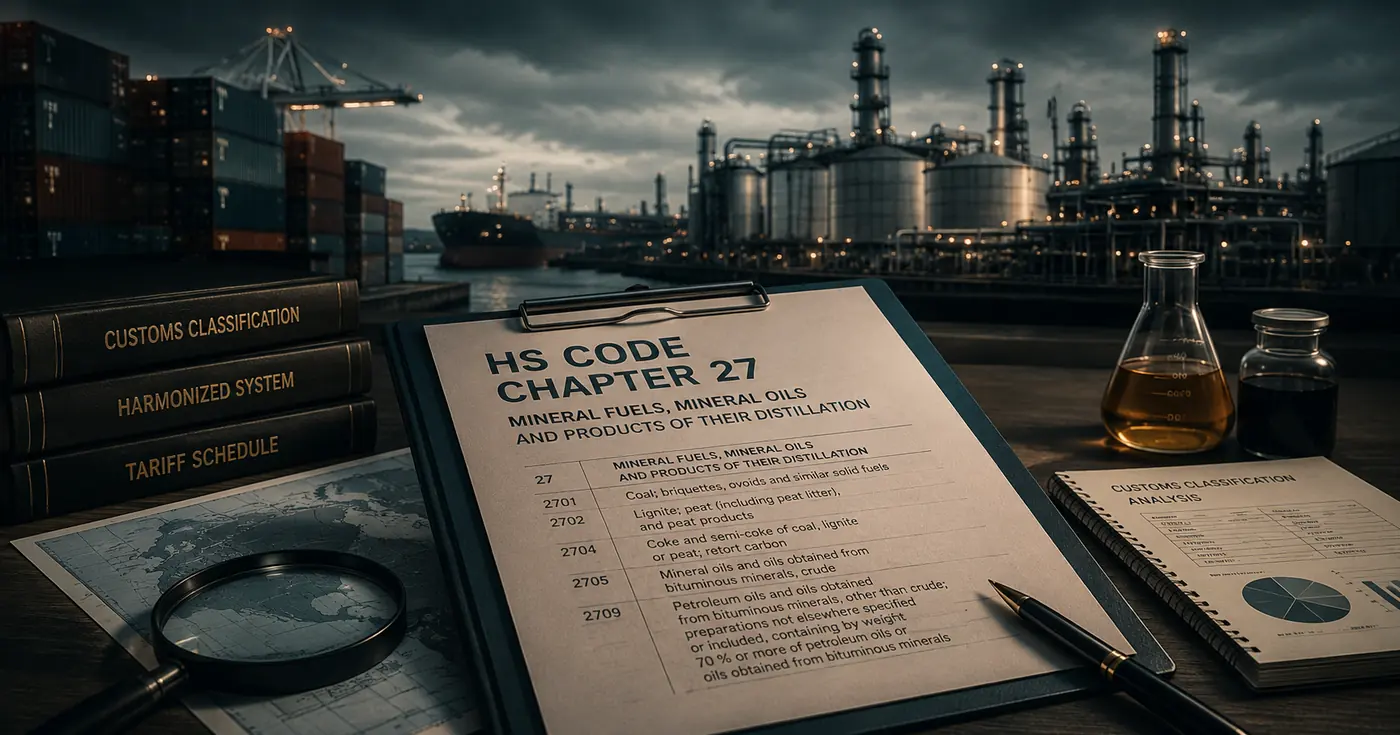
Heading 2712 forms part of Chapter 27: mineral fuels, mineral oils and products of their distillation; bituminous substances; mineral waxes.
For the broader Chapter structure, see: HS Code Chapter 27 Classification Guide .
Heading 2712 should be read in context with neighbouring petroleum headings.
In particular:
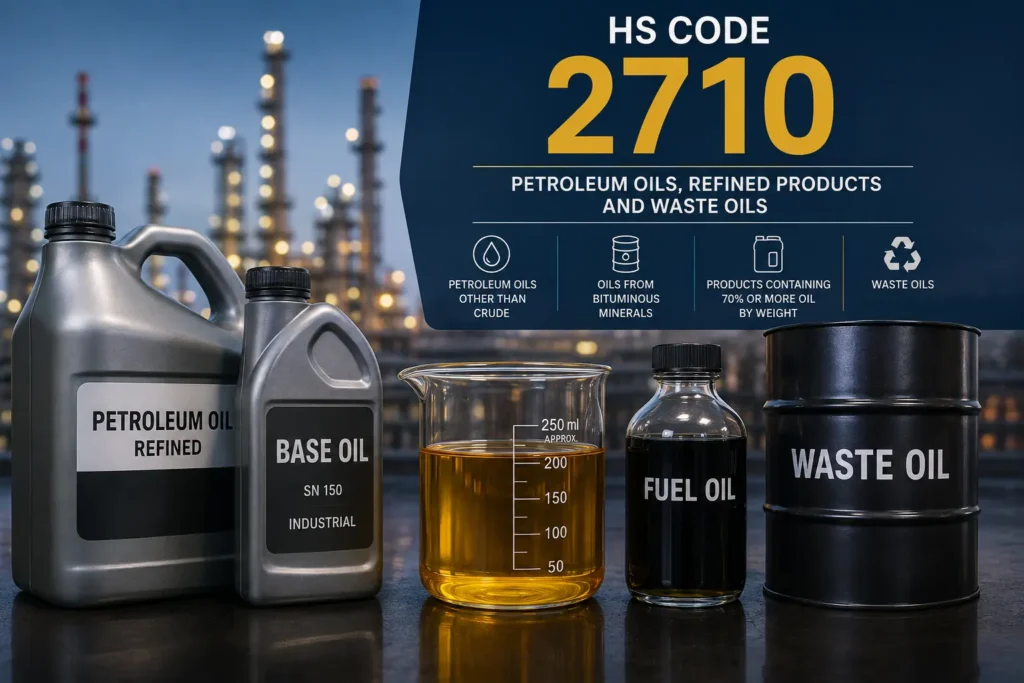
- 2710 deals with petroleum oils and certain preparations and waste oils;
- 2711 deals with petroleum gases and other gaseous hydrocarbons;
- 2712 deals with petroleum jelly and specified mineral or similar waxes;
- 2713 deals with petroleum coke, petroleum bitumen and other specified petroleum-oil residues.
The fact that several products share a petroleum origin does not make these headings interchangeable.
Legal text of Heading 2712
Under HS 2022, Heading 27.12 covers:
The wording creates several important legal consequences.
Petroleum jelly is specifically named
Petroleum jelly is not merely treated as an unspecified generic wax. It is named in the heading and receives its own international HS6 subheading.
Paraffin wax is only one product within Heading 2712
Micro-crystalline petroleum wax, slack wax, ozokerite, lignite wax and peat wax are separately named in the heading text.
A laboratory result showing low oil content therefore does not, by itself, make every mineral wax “paraffin wax” for 2712.20.
Synthetic origin does not automatically exclude Heading 2712
The legal text expressly includes similar products obtained by synthesis or by other processes.
Therefore:
The legal identity and composition of the actual product must still be analysed.
Colouring alone does not exclude Heading 2712
The heading expressly applies whether or not coloured.
A qualifying mineral wax does not cease to be a Heading 2712 product merely because a colourant has been added.
The legal text expressly tolerates colouring. It does not establish that every formulation containing fragrances, resins, surfactants, active pharmaceutical ingredients, abrasives, solvents or other functional additives must remain in Heading 2712.
International HS6 structure of Heading 2712
HS 2022 creates only three international six-digit subheadings:
The specific international HS6 provision for petroleum jelly.
A specific quantitative oil-content condition applies.
The residual HS6 provision for qualifying Heading 2712 goods not described by 2712.10 or 2712.20.
Correct legal decision sequence
A reliable HS 2712 analysis should follow the legal structure rather than begin with an isolated laboratory number.
Question 1 — What are the goods?
Determine the exact technical identity.
Are the goods:
- petroleum jelly;
- paraffin wax;
- micro-crystalline petroleum wax;
- slack wax;
- ozokerite;
- lignite wax;
- peat wax;
- another mineral wax;
- a similar qualifying product;
- a petroleum oil;
- or a prepared or finished product?
Question 2 — Does Heading 2712 describe the goods under GRI 1?
Classification begins with the terms of the heading and the relevant Section or Chapter Notes.
Do not choose 2712 merely because “wax” appears on the invoice.
Question 3 — Have the goods become a preparation or finished article?
Consider whether the material has been formulated or presented as:
- a skin-care preparation;
- a medicament;
- a lubricating preparation;
- an anti-rust or anti-corrosion preparation;
- a prepared wax;
- a polish;
- a candle;
- a dental wax;
- or another chemical preparation.
Question 4 — If Heading 2712 applies, is the product petroleum jelly?
If yes, test the specific subheading 2712.10.
Question 5 — If the product is paraffin wax, what is the oil content by weight?
Only after the product has been identified as paraffin wax should the 0.75% oil condition be used.
Question 6 — If neither specific subheading applies, does 2712.90 apply?
Apply GRI 6 and compare subheadings at the same level.
2712.90 is residual. It is not a shortcut for any product commercially described simply as “wax”.
HS 2712.10 — Petroleum jelly
Petroleum jelly has its own international HS6 provision: 2712.10.
The less-than-0.75% oil condition appearing in 2712.20 is not the legal test for petroleum jelly.
If the goods as imported are legally petroleum jelly, the six-digit analysis should begin with 2712.10.
Different commercial grades
At international HS6 level there are no separate 2712 subheadings for:
- white petroleum jelly;
- yellow petroleum jelly;
- technical grade petrolatum;
- cosmetic grade petrolatum;
- pharmaceutical grade petrolatum;
- crude or less refined commercial grades;
- or highly refined commercial grades.
Such information can nevertheless become relevant at more detailed destination-tariff levels or when determining whether the product has another legal character.
“Pharmaceutical grade” does not automatically create a Chapter 30 medicament, and “cosmetic grade” does not automatically create a Heading 3304 skin-care preparation.
Bulk petroleum jelly used industrially
Raw petroleum jelly may be imported for industrial manufacturing, corrosion protection, lubrication or use as an ingredient in another product.
An intended industrial use alone does not automatically turn the imported petroleum jelly into a lubricating preparation.
Classification concerns the goods as presented.
Petroleum jelly presented as a retail skin-care preparation
A different legal issue arises when goods are suitable and presented for use as a skin-care product.
Heading 3304 covers beauty or make-up preparations and preparations for the care of the skin, other than medicaments.
Chapter 33 Note 3 also gives legal significance to goods that are suitable for the uses of Headings 3303 to 3307 and are put up in packings of a kind sold by retail for such use.
Accordingly, petroleum jelly in retail skin-care presentation requires a real comparison between Heading 2712 and Heading 3304.
A small container alone does not resolve classification. Examine the product's composition, presentation, suitability for use, retail packaging and the applicable Chapter Notes.
HS 2712.20 — Paraffin wax containing less than 0.75% oil
Subheading 2712.20 has precise wording:
Each part of this wording matters.
1. The goods must be paraffin wax
The 0.75% figure is not a universal test for Heading 2712.
Before applying the number, establish that the goods are technically and legally paraffin wax.
2. Oil content is measured by weight
The subheading expressly uses the words “containing by weight”.
A volume percentage should not be substituted for the legal basis.
3. Oil content must be less than 0.75%
The wording does not say “0.75% or less”.
If qualifying paraffin wax contains exactly 0.75% oil by weight, it is not “less than 0.75%”. If Heading 2712 otherwise applies, 2712.90 must then be evaluated under GRI 6.
How to apply the 0.75% oil threshold
| Product | Oil content | HS6 analysis |
|---|---|---|
| Paraffin wax | 0.20% by weight | Meets the numerical condition of 2712.20, assuming the goods are genuinely paraffin wax. |
| Paraffin wax | 0.74% by weight | Less than 0.75%; 2712.20 is relevant. |
| Paraffin wax | 0.75% by weight | Does not meet “less than 0.75%”. Evaluate 2712.90 if Heading 2712 otherwise applies. |
| Paraffin wax | 1.20% by weight | Does not meet 2712.20. Evaluate the residual 2712.90 branch if the goods remain within Heading 2712. |
| Micro-crystalline petroleum wax | 0.40% by weight | Low oil content alone does not make it paraffin wax. Product identity points toward evaluation under 2712.90. |
| Petroleum jelly | Reported oil content of any amount | The 2712.20 paraffin test does not determine the HS6. Test the specific petroleum-jelly provision 2712.10. |
Evidence near the threshold
Where a paraffin wax shipment is close to 0.75%, reliable quantitative evidence becomes particularly important.
A classification file can include:
- a shipment-specific Certificate of Analysis;
- the exact reported oil content;
- confirmation that the result is by weight;
- the laboratory test method;
- relevant specification tolerances;
- and, where necessary, confirmation of any analytical requirements accepted by the destination authority.
If a test report is close to 0.75%, review the actual reported result, method and measurement basis. Technical uncertainty should not be resolved by changing the legal wording.
HS 2712.90 — Other
The legal wording of 2712.90 is simply: “Other.”
It is the residual international six-digit subheading within Heading 2712.
Depending on the facts, it can cover qualifying:
- paraffin wax that does not satisfy the less-than-0.75% oil condition;
- micro-crystalline petroleum wax;
- slack wax;
- ozokerite;
- lignite wax;
- peat wax;
- other mineral waxes;
- and similar products of Heading 2712 not falling under 2712.10 or 2712.20.
But “Other” is not a licence to skip the heading analysis.
The goods must first be legally classifiable in Heading 2712.
Named waxes normally examined under 2712.90
Micro-crystalline petroleum wax
Micro-crystalline petroleum wax is expressly named in Heading 2712, but no six-digit subheading bearing that name exists under HS 2022.
It is therefore examined within 2712.90 at the international HS6 level.
Do not select 2712.20 merely because its oil content happens to be below 0.75%.
Slack wax
Slack wax is also expressly named in Heading 2712.
Since it has no dedicated HS6 subheading, the residual 2712.90 branch is relevant.
Ozokerite
Ozokerite is expressly named in the Heading 2712 text.
At international six-digit level it is analysed within 2712.90.
Lignite wax
Lignite wax is expressly named in Heading 2712 and falls within the residual six-digit structure where the heading applies.
Peat wax
Peat wax is another expressly named wax without a dedicated HS6 line.
2712.90 is therefore the international branch to examine.
Other mineral waxes
Heading 2712 is not limited to the specifically listed waxes.
It expressly extends to other mineral waxes.
Similar products obtained by synthesis or other processes
The heading also expressly extends to similar products obtained by synthesis or by other processes.
That phrase is important in the boundary with Heading 3404.
HS 2710 vs HS 2712 — “liquid paraffin” and mineral oil
The commercial word “paraffin” is not enough to establish Heading 2712.
A particularly important example is a product sold as:
- liquid paraffin;
- paraffin oil;
- white mineral oil;
- white oil;
- or another petroleum oil grade.
Such descriptions should trigger analysis of Heading 2710, because Heading 2710 covers petroleum oils and specified preparations, while Heading 2712 specifically deals with petroleum jelly and wax products.
Determine the actual technical product. If the material is a petroleum oil rather than paraffin wax, 2712.20 is not the correct starting point.
Useful evidence includes:
- product specification;
- physical form;
- viscosity;
- distillation characteristics where relevant;
- congealing or melting information;
- manufacturer's technical description;
- and full composition.
HS 2712 vs Heading 3404 — artificial and prepared waxes
This is one of the most important legal boundaries for wax products.
Heading 2712 expressly includes qualifying similar products obtained by synthesis or by other processes.
Heading 3404, meanwhile, covers artificial waxes and prepared waxes.
Chapter 34 Note 5 defines the scope of Heading 3404.
Subject to the exclusions in that Note, the expression can include:
- chemically produced organic products of a waxy character;
- products obtained by mixing different waxes;
- products of a waxy character based on one or more waxes and containing fats, resins, mineral substances or other materials.
Crucially, the same Note expressly excludes from Heading 3404:
What does that exclusion mean?
It means a product that is legally a mineral wax or similar product of Heading 2712 is not moved into 3404 merely because it is intermixed or merely coloured.
However, the Note should not be reversed into an automatic rule that any formulation containing a Heading 2712 wax must itself be classified in 2712.
The first question remains:
What are the imported goods as a whole?
If they have become a distinct prepared wax or another preparation, the full legal framework must be applied.
“Synthetic = 3404” is too broad.
“Contains mineral wax = 2712” is also too broad.
Colouring, intermixtures and functional additives
Colouring
Heading 2712 expressly permits qualifying goods whether or not coloured.
Chapter 34 Note 5 also confirms that merely colouring a mineral wax or similar Heading 2712 product does not bring it into Heading 3404.
Intermixtures
Chapter 34 Note 5 expressly refers to Heading 2712 products whether or not intermixed when excluding them from Heading 3404.
Nevertheless, the exact materials in the mixture remain legally important.
The classifier should establish that the goods as a whole are still properly described as mineral waxes or similar products of Heading 2712.
Functional additives
More substantial formulation can change the character of the imported goods.
Particular attention is required where the formulation contains:
- fragrances;
- pharmaceutical active ingredients;
- skin-care ingredients;
- resins;
- surfactants;
- solvents;
- abrasives;
- anti-corrosion additives;
- lubricating additives;
- polishing agents;
- fillers;
- or other functional materials.
In those cases, analyse the imported formulation as a whole.
Important HS Code 2712 classification boundaries
| Competing heading | Main legal issue | Evidence to review |
|---|---|---|
| 1521 | Vegetable waxes, beeswax, other insect waxes and spermaceti, rather than mineral waxes of 2712. | Biological/mineral source, composition and manufacturing process. |
| 2710 | Petroleum oils and qualifying oil preparations rather than wax products. Relevant to products commercially called liquid paraffin or white mineral oil. | Product identity, physical properties, specification and manufacturing data. |
| 2713 | Petroleum coke, petroleum bitumen and other specified petroleum-oil residues. | Product identity, refinery process and technical characteristics. |
| 3003 / 3004 | Qualifying medicaments for therapeutic or prophylactic uses. | Formula, active ingredients, therapeutic/prophylactic character, dose and presentation. |
| 3304 | Beauty or make-up preparations and preparations for the care of the skin, other than medicaments. | Formula, suitability for use, retail presentation, packaging and product character. |
| 3403 | Lubricating preparations, anti-rust or anti-corrosion preparations, mould-release preparations and other preparations described by Heading 3403. | Complete formulation, additives, function and petroleum-oil content where relevant. |
| 3404 | Artificial waxes and prepared waxes, subject to Chapter 34 Note 5 and its exclusion for Heading 2712 products. | Composition, manufacturing route, wax identity and added materials. |
| 3405 | Polishes, creams and similar preparations. | Function, formulation, use and presentation. |
| 3406 | Finished candles, tapers and similar articles. | Physical form and condition as imported. |
| 3407 | Preparations known as dental wax or dental impression compounds, when put up in the forms or presentations described by Heading 3407. | Dental use, product composition, form and retail/set presentation. |
| 3824 | Certain chemical products and preparations not elsewhere specified or included. It is a residual heading, not a first-choice wax heading. | Full formulation, specific function and exclusion of more specific headings. |
2712 vs 1521 — mineral wax versus biological wax
Heading 1521 expressly covers:
- vegetable waxes, other than triglycerides;
- beeswax;
- other insect waxes;
- and spermaceti;
whether or not refined or coloured.
These goods do not become mineral waxes simply because all are commercially called “wax”.
2712 vs 3304 — petroleum jelly and skin-care products
Heading 3304 covers preparations for the care of the skin, other than medicaments.
Chapter 33 Note 3 further applies to products suitable for use as goods of Headings 3303 to 3307 and put up in packings of a kind sold by retail for such use.
Therefore, retail presentation of petroleum jelly for skin care should not be ignored.
At the same time, the analysis should not be reduced to packaging alone.
2712 vs Chapter 30 — medicaments
Chapter 27 Note 1 expressly excludes medicaments of Heading 3003 or 3004.
Heading 3003 covers specified medicaments not put up in measured doses or in forms or packings for retail sale.
Heading 3004 covers specified medicaments put up in measured doses or in forms or packings for retail sale.
But Chapter 30 Note 1 also expressly excludes preparations of Headings 3303 to 3307 even where they have therapeutic or prophylactic properties.
Expressions such as “medicated”, “healing”, “protective” or “pharmaceutical” must be tested against the legal terms of Chapters 30 and 33 and the actual formulation and presentation.
2712 vs 3403 — lubricating and anti-corrosion preparations
Heading 3403 expressly covers lubricating preparations, including certain:
- cutting-oil preparations;
- bolt or nut release preparations;
- anti-rust or anti-corrosion preparations;
- mould-release preparations based on lubricants;
- and preparations used for oil or grease treatment of certain materials.
The heading also contains an exclusion for preparations containing, as basic constituents, 70% or more by weight of petroleum oils or oils obtained from bituminous minerals.
A drum of raw petroleum jelly does not become a Heading 3403 preparation merely because it will be used for lubrication or corrosion protection.
But a deliberately formulated finished lubricating or anti-corrosion preparation requires separate analysis under Heading 3403 and any other relevant provisions.
2712 vs 3404 — prepared waxes
The Chapter 34 Note 5 boundary should be applied carefully.
Mineral waxes or similar products that are legally products of Heading 2712 are excluded from Heading 3404 even when intermixed or merely coloured.
A product that has become a distinct prepared wax, however, may require Heading 3404 analysis.
2712 vs 3405 — polishes
Heading 3405 covers polishes and creams for footwear, furniture, floors, coachwork, glass or metal, as well as specified scouring preparations and similar products.
A finished furniture polish containing paraffin wax should not be classified solely according to its paraffin ingredient.
2712 vs 3406 — candles
Heading 3406 specifically covers candles, tapers and the like.
Raw paraffin wax used to manufacture candles and a finished paraffin candle are not the same goods for customs classification.
2712 vs 3407 — dental wax
Heading 3407 specifically covers, among other products, preparations known as “dental wax” or “dental impression compounds” when put up:
- in sets;
- in packings for retail sale;
- in plates;
- in horseshoe shapes;
- in sticks;
- or in similar forms.
Therefore, a dental product should not be placed in 2712 merely because wax is its principal material.
2712 vs 2713 — wax versus petroleum bitumen or petroleum residue
Heading 2713 covers petroleum coke, petroleum bitumen and other specified residues of petroleum oils or oils obtained from bituminous minerals.
Physical appearance alone cannot decide the classification.
A solid or semi-solid petroleum product may still be petroleum bitumen, petroleum jelly, wax or another material depending on its technical identity.
2712 vs 3824 — formulated chemical preparations
Heading 3824 covers specified chemical products and preparations not elsewhere specified or included.
That residual wording matters.
A wax-containing formulation should not be sent directly to Heading 3824 without first testing more specific headings.
Where the goods are a distinct chemical preparation containing wax, water, surfactants, fillers or other functional ingredients, the entire preparation must be classified.
Technical evidence for HS Code 2712
| Technical information | Why it matters |
|---|---|
| Exact technical product name | Distinguishes petroleum jelly, paraffin wax, microcrystalline wax, slack wax, petroleum oils and prepared waxes. |
| Commercial trade name | Useful context, but must be reconciled with the technical identity. |
| Source of the material | Helps distinguish mineral/petroleum waxes from vegetable or insect waxes. |
| Manufacturing process | Relevant to petroleum-derived, synthetic and prepared-wax boundaries. |
| Full composition | Shows whether the goods remain wax material or have become a formulation. |
| Oil content by weight | Legally decisive when the goods are paraffin wax and 2712.20 is being tested. |
| Certificate of Analysis | Strong shipment-specific evidence for oil content and other specifications. |
| Laboratory method | Important where the result is close to a legal threshold. |
| Physical state and form | Helps distinguish wax material, petroleum oils, preparations and finished articles. |
| Melting / congealing characteristics | May support technical product identity when interpreted with the relevant product specification. |
| Penetration / hardness data | May help distinguish petroleum jelly and different wax grades. |
| Viscosity | Can be relevant where a “paraffin” product may actually be a petroleum oil rather than wax. |
| Colourants | Colouring alone does not exclude qualifying Heading 2712 goods. |
| Functional additives | Lubricants, resins, surfactants, medicines, abrasives or other ingredients can change the classification analysis. |
| TDS | Supports product identity, grade, composition and physical properties. |
| SDS | Useful technical evidence, but not itself a binding customs classification rule. |
| Packaging and label | Relevant to cosmetic, pharmaceutical, dental and other finished-product boundaries. |
| Retail or bulk presentation | Can be legally relevant under Chapters such as Chapter 33. |
| Actual function of a preparation | Relevant to 3403, 3405, 3407 and other prepared-product headings. |
A supplier's TDS, SDS, CoA or suggested HS code can help establish facts. Classification still depends on the legal tariff text, applicable Notes and the General Rules for Interpretation.
Step-by-step HS Code 2712 classification process
Identify the exact goods
Do not stop at “wax”. Establish the actual technical identity.
Check the source
Determine whether the material is petroleum/mineral, vegetable, insect-derived, synthetic or another product.
Review the manufacturing process
Determine whether the material is refined wax, a similar synthetic product, a prepared wax or another formulation.
Obtain the complete composition
Identify waxes, petroleum oils, water, resins, surfactants, active ingredients and other additives.
Determine whether the goods remain wax material
Check whether they have become a skin-care product, medicament, lubricant, polish, candle, dental wax or chemical preparation.
Apply GRI 1
Start with the terms of the headings and relevant legal Notes.
Check the 2710 boundary where relevant
Products described as liquid paraffin, paraffin oil or white mineral oil may be petroleum oils rather than paraffin wax.
If petroleum jelly, test 2712.10
Do not use the paraffin-wax oil threshold for petroleum jelly.
If paraffin wax, obtain oil content by weight
The legal threshold is less than 0.75%.
If oil content is below 0.75%, test 2712.20
Confirm both paraffin-wax identity and the quantitative result.
If oil content is 0.75% or above, do not use 2712.20
If Heading 2712 otherwise applies, evaluate 2712.90.
For other named mineral waxes, examine 2712.90
This includes microcrystalline petroleum wax, slack wax, ozokerite, lignite wax and peat wax.
For synthetic or intermixed wax products, apply the 2712 / 3404 boundary
Use Chapter 34 Note 5 rather than assuming classification from the word “synthetic”.
Review Chapter 33 and Chapter 30 where relevant
Especially for petroleum-jelly products presented for skin care or therapeutic use.
Review Heading 3403 for formulated lubricating products
Particularly anti-rust, anti-corrosion, mould-release and lubricating preparations.
Review 3405, 3406 and 3407 for finished products
Check polishes, candles and dental-wax preparations.
Review 1521, 2713 and 3824 when the facts require it
Compare biological waxes, petroleum residues and residual chemical preparations.
Apply GRI 6
Once Heading 2712 is established, compare only subheadings at the same level: 2712.10, 2712.20 and 2712.90.
Document realistic rejected alternatives
Explain why competing headings do not describe the actual goods.
Verify the destination tariff
Confirm the legally effective detailed code in Saudi Arabia, UAE, Qatar, Oman, Kuwait or Bahrain.
Need help classifying petroleum jelly, paraffin wax or mineral wax?
JAMAREK helps structure customs classification around product identity, composition, oil content, formulation, legal Notes, competing headings and the destination tariff.
Practical HS Code 2712 classification scenarios
Scenario 1 — Bulk technical petroleum jelly
Petroleum jelly is imported in industrial drums as raw material.
If the goods remain petroleum jelly as presented, 2712.10 is the international HS6 provision to test.
Scenario 2 — Highly refined petroleum jelly in bulk
The product is a highly refined grade imported for further manufacture.
HS 2022 does not create a separate six-digit line merely because petroleum jelly is highly refined.
2712.10 remains the specific HS6 provision where the goods are petroleum jelly.
Scenario 3 — Petroleum jelly sold as a retail skin-care preparation
The goods are suitable and packaged for sale as a skin-care preparation.
Do not automatically assign 2712.10 from the base material alone.
Heading 3304 and Chapter 33 Note 3 must be considered.
Scenario 4 — Petroleum-jelly formulation with active medicinal ingredients
The formulation contains active ingredients and therapeutic claims.
Review the actual legal character under Chapters 30 and 33.
Neither the petroleum-jelly base nor the word “medicated” is sufficient by itself.
Scenario 5 — Paraffin wax with 0.30% oil by weight
Reliable evidence confirms that the product is paraffin wax containing 0.30% oil by weight.
2712.20 is relevant.
Scenario 6 — Paraffin wax with 0.74% oil by weight
0.74% is less than 0.75%.
If the goods are genuinely paraffin wax, 2712.20 is relevant.
Scenario 7 — Paraffin wax with exactly 0.75% oil
Exactly 0.75% does not satisfy “less than 0.75%”.
If the goods otherwise remain in Heading 2712, 2712.90 should be evaluated.
Scenario 8 — Paraffin wax with 2% oil
The 2712.20 condition is not satisfied.
If Heading 2712 applies, 2712.90 is the residual HS6 branch to examine.
Scenario 9 — Micro-crystalline petroleum wax with 0.30% oil
The low oil percentage does not convert micro-crystalline petroleum wax into paraffin wax.
2712.90 should be examined.
Scenario 10 — Slack wax
Technical documentation confirms slack wax.
Slack wax is expressly named in Heading 2712 and is examined under 2712.90 at HS6 level.
Scenario 11 — Ozokerite
The material is technically identified as ozokerite.
It is expressly named in Heading 2712, with 2712.90 being the relevant residual HS6 branch.
Scenario 12 — Coloured paraffin wax
The material remains paraffin wax but contains a colourant.
Colouring alone does not remove it from Heading 2712.
The oil-content condition must still be tested.
Scenario 13 — Product described as “liquid paraffin”
The supplier describes the goods as liquid paraffin or white mineral oil.
Do not apply 2712.20 from the word “paraffin”.
Establish whether the product is a petroleum oil, in which case Heading 2710 requires analysis.
Scenario 14 — Synthetic wax
The invoice states only “synthetic wax”.
This is insufficient.
Heading 2712 expressly permits certain similar products obtained by synthesis, while Heading 3404 covers artificial and prepared waxes.
Obtain the composition and production process.
Scenario 15 — Finished anti-rust wax preparation
A formulation contains wax together with functional anti-corrosion ingredients and is manufactured and sold as a finished anti-rust preparation.
Do not classify it solely from its wax component.
Heading 3403 should be evaluated together with any other relevant heading.
Scenario 16 — Raw petroleum jelly used by customer for lubrication
The imported goods themselves are unformulated petroleum jelly.
The customer's later lubricating use does not automatically make the imported raw material a Heading 3403 preparation.
Scenario 17 — Finished paraffin candle
The imported goods are already candles.
Heading 3406 applies to candles, tapers and the like.
Do not classify the finished article as raw paraffin wax.
Scenario 18 — Wax-based furniture polish
The goods are a finished polish formulated with wax and other ingredients.
Heading 3405 should be examined.
Scenario 19 — Dental wax preparation
A product is presented as dental wax in retail packs, plates, sticks or another form described by Heading 3407.
Heading 3407 should be evaluated rather than classifying from the wax ingredient alone.
Scenario 20 — Beeswax
The goods are genuine beeswax.
Beeswax is expressly within Heading 1521, not Heading 2712.
Scenario 21 — Vegetable wax
Technical documents identify a genuine vegetable wax.
The relevant starting point is Heading 1521.
Scenario 22 — Petroleum bitumen
The material is technically petroleum bitumen, although it may be solid or semi-solid.
Heading 2713 is relevant.
Visual consistency alone does not make the product a wax.
Scenario 23 — Industrial wax emulsion
The imported product contains wax, water, surfactants and functional ingredients and is marketed as a finished chemical preparation.
Do not assume Heading 2712.
Analyse the function and all potentially applicable headings, with residual Heading 3824 considered only where its wording is satisfied and no more specific heading applies.
Scenario 24 — Invoice says only “Candle Wax”
“Candle wax” is not sufficiently precise.
It could be:
- paraffin wax;
- a mixture of waxes;
- a vegetable wax;
- a prepared wax;
- or another formulation.
Obtain the technical composition before choosing the tariff heading.
Common HS Code 2712 classification mistakes
1. Treating every product called “wax” as Heading 2712
“Wax” is commercially broader than the legal heading.
2. Applying the 0.75% threshold before identifying the material
The threshold is specifically part of the paraffin-wax subheading.
3. Applying the 0.75% rule to petroleum jelly
Petroleum jelly has its own specific HS6 provision.
4. Applying the 0.75% rule to micro-crystalline petroleum wax
Low oil content does not change the wax identity.
5. Reading “less than 0.75%” as “0.75% or less”
Exactly 0.75% does not qualify for 2712.20.
6. Using oil content by volume
The legal subheading refers to oil content by weight.
7. Rounding a laboratory result through the threshold without support
The actual result and measurement basis should be documented.
8. Using a generic TDS as proof of a shipment-specific result
A maximum specification may not prove the actual shipment composition.
9. Assuming slack wax is automatically paraffin wax
Slack wax is expressly named separately in Heading 2712.
10. Assuming every low-oil wax belongs in 2712.20
The product must first be paraffin wax.
11. Treating “liquid paraffin” as paraffin wax
The goods may instead be a petroleum oil requiring Heading 2710 analysis.
12. Classifying from physical appearance alone
Petroleum jelly, bitumen, waxes and oils require technical identification.
13. Assuming highly refined petroleum jelly has a different HS6 code
HS 2022 contains one specific petroleum-jelly HS6 provision under 2712.
14. Assuming “pharmaceutical grade” automatically means Chapter 30
A quality specification is not the legal definition of a medicament.
15. Assuming “cosmetic grade” automatically means Heading 3304
Actual product character and presentation still require analysis.
16. Ignoring retail skin-care presentation
Chapter 33 Note 3 can be relevant.
17. Assuming therapeutic claims automatically create Heading 3004
Chapter 30 and Chapter 33 must both be examined.
18. Assuming every synthetic wax belongs in Heading 3404
Heading 2712 expressly includes qualifying similar products obtained by synthesis.
19. Assuming every synthetic wax belongs in Heading 2712
Artificial and prepared waxes can fall in Heading 3404.
20. Misreading Chapter 34 Note 5 on intermixtures
The Note excludes qualifying 2712 products from 3404; it does not make every wax-containing formulation a 2712 product.
21. Removing wax from 2712 merely because it is coloured
Heading 2712 expressly permits colouring.
22. Ignoring functional additives
Substantial formulation can change the legal identity of the imported goods.
23. Classifying a finished anti-corrosion preparation as raw wax
Heading 3403 should be considered for qualifying preparations.
24. Moving raw petroleum jelly to 3403 merely because it will be used as a lubricant
End use alone does not necessarily change the identity of the imported raw material.
25. Classifying furniture polish in 2712 because it contains paraffin
Heading 3405 can apply to prepared polishes.
26. Classifying finished candles as raw paraffin wax
Heading 3406 specifically covers candles, tapers and the like.
27. Classifying dental wax as ordinary mineral wax without checking Heading 3407
Heading 3407 expressly covers specified dental-wax preparations.
28. Classifying beeswax or vegetable wax in Heading 2712
Heading 1521 expressly covers specified biological waxes.
29. Using Heading 3824 too early
3824 is residual and applies to goods not elsewhere specified or included.
30. Stopping at HS6
The destination tariff can subdivide the international HS6 code further.
Building a defensible HS 2712 classification file
Depending on the goods, a strong classification record can include:
- exact technical product name;
- commercial trade name;
- wax or material type;
- petroleum, mineral, vegetable or insect source;
- whether the product is synthetic or conventionally derived;
- manufacturing process;
- refining and deoiling information;
- complete chemical or material composition;
- oil content by weight;
- shipment-specific Certificate of Analysis;
- laboratory method;
- measurement and specification tolerances;
- melting or congealing information;
- viscosity where relevant;
- penetration or hardness data;
- colourants;
- fragrances;
- resins;
- surfactants;
- solvents;
- abrasives;
- lubricating additives;
- anti-corrosion additives;
- active pharmaceutical ingredients;
- other functional additives;
- TDS;
- SDS;
- product label;
- packaging photographs;
- retail or bulk presentation;
- intended function;
- Chapter 27 analysis;
- Heading 2710 comparison where relevant;
- Heading 2713 comparison where relevant;
- Chapter 30 analysis where relevant;
- Chapter 33 analysis where relevant;
- Heading 3403 analysis where relevant;
- Chapter 34 Note 5 and Heading 3404 analysis;
- Heading 3405 comparison;
- Heading 3406 comparison;
- Heading 3407 comparison;
- Heading 1521 comparison;
- Heading 3824 comparison where relevant;
- GRI 1 reasoning;
- GRI 6 reasoning;
- rejected alternative headings;
- and the legally effective destination tariff extension.
1. What is the actual material?
2. Does it remain a wax or petroleum-jelly material, or has it become a preparation or finished article?
3. If Heading 2712 applies, which of the three HS6 subheadings is correct under GRI 6?
HS Code 2712 in Saudi Arabia, UAE, Qatar, Oman, Kuwait and Bahrain
Saudi Arabia, the United Arab Emirates (UAE), Qatar, Oman, Kuwait and Bahrain use the Harmonized System as the international foundation of their customs tariff structures.
Under HS 2022, the international six-digit structure of Heading 2712 is:
- 2712.10 — Petroleum jelly;
- 2712.20 — Paraffin wax containing by weight less than 0.75% of oil;
- 2712.90 — Other.
The international HS6 code should not automatically be treated as the complete customs declaration code.
Destination tariffs can contain additional digits and more detailed distinctions.
Those detailed tariff lines must be checked in the actual destination:
- Saudi Arabia;
- United Arab Emirates (UAE);
- Qatar;
- Oman;
- Kuwait;
- Bahrain.
The destination may also impose separate regulatory requirements according to the actual use and presentation of the goods, particularly for:
- cosmetics;
- medicaments;
- industrial chemical preparations;
- dental products;
- food-contact applications;
- and other regulated uses.
A correct HS code does not by itself establish that every permit, registration, labelling or safety requirement has been satisfied.
HS 2028 and Heading 2712
This article is based on HS 2022.
The World Customs Organization has published amendments for the next HS edition, scheduled to enter into force internationally on 1 January 2028.
In the published recommendation, Chapter 27 contains changes to the waste-oil structure under Heading 2710:
- 2710.91 is deleted;
- new 2710.92 is introduced;
- new 2710.93 is introduced.
The published Chapter 27 amendment section then proceeds to Chapter 28 without listing an amendment to Heading 2712 itself.
Therefore, the published HS 2028 recommendation does not currently identify a change to the international Heading 2712 structure.
This does not mean that every national or regional tariff extension below Heading 2712 must remain unchanged.
Use the tariff legally in force on the declaration date. Do not apply a future HS amendment to a current shipment merely because the amendment has already been published.
Frequently asked questions about HS Code 2712
What does HS Code 2712 cover?
How many international HS6 codes are under Heading 2712?
What is HS 2712.10?
What is HS 2712.20?
What is HS 2712.90?
Does paraffin wax containing exactly 0.75% oil qualify for 2712.20?
Does paraffin wax containing 0.74% oil qualify for 2712.20?
Is the 0.75% test measured by weight or volume?
Does the 0.75% rule apply to petroleum jelly?
Does the 0.75% rule apply automatically to microcrystalline wax?
What is the HS6 code for slack wax?
What is the HS6 code for micro-crystalline petroleum wax?
Is liquid paraffin classified under HS 2712?
Can coloured paraffin wax remain in Heading 2712?
Are all synthetic waxes classified in Heading 3404?
Are all synthetic waxes classified in Heading 2712?
Does mixing mineral wax automatically move it to 3404?
Is petroleum jelly always 2712.10 when sold in a retail skin-care jar?
Does pharmaceutical-grade petroleum jelly automatically fall in Chapter 30?
Does a therapeutic claim automatically make a petroleum-jelly product HS 3004?
Can a wax-based lubricant fall in Heading 3403?
Are finished paraffin candles classified in Heading 2712?
Is furniture wax polish classified under Heading 2712?
Can dental wax fall outside Heading 2712?
Is beeswax classified in Heading 2712?
Are vegetable waxes classified under Heading 2712?
Does an SDS determine the HS code?
What evidence is most useful near the 0.75% paraffin-wax threshold?
Can Heading 3824 be used for any wax-containing chemical mixture?
Do Saudi Arabia, UAE, Qatar, Oman, Kuwait and Bahrain use the same international HS6 structure for 2712?
Will Heading 2712 change in HS 2028?
Classify wax products from their legal and technical identity
Petroleum jelly, paraffin wax, microcrystalline wax, slack wax and formulated wax products can follow different tariff routes. The correct classification depends on the actual goods, not only their commercial name.
Final takeaway
HS Code 2712 covers a defined group of petroleum, mineral and similar wax products.
Under HS 2022 there are only three international HS6 subheadings:
- 2712.10 — Petroleum jelly;
- 2712.20 — Paraffin wax containing by weight less than 0.75% of oil;
- 2712.90 — Other.
The less-than-0.75% oil condition is important, but it applies only after the goods have been established as paraffin wax.
Exactly 0.75% does not satisfy that wording.
Petroleum jelly has its own HS6 provision and does not use that numerical test.
Micro-crystalline petroleum wax, slack wax, ozokerite, lignite wax, peat wax and other qualifying mineral waxes normally require the residual 2712.90 branch at international HS6 level.
The word “paraffin” must also be handled carefully. Products commercially described as liquid paraffin, paraffin oil or white mineral oil may require Heading 2710 analysis rather than 2712.20.
Synthetic origin alone does not decide the boundary between 2712 and 3404.
Chapter 34 Note 5 expressly excludes mineral waxes or similar products of Heading 2712 from Heading 3404, whether or not intermixed or merely coloured, but this does not make every wax-containing formulation a Heading 2712 product.
Significant competing headings include:
- 1521 — vegetable waxes, beeswax, other insect waxes and spermaceti;
- 2710 — petroleum oils and qualifying petroleum-oil preparations;
- 2713 — petroleum coke, petroleum bitumen and specified petroleum residues;
- 3003 / 3004 — qualifying medicaments;
- 3304 — beauty and skin-care preparations;
- 3403 — lubricating, anti-rust and related preparations;
- 3404 — artificial and prepared waxes;
- 3405 — polishes and similar preparations;
- 3406 — candles, tapers and the like;
- 3407 — specified dental-wax and dental-impression preparations;
- 3824 — certain residual chemical products and preparations.
A defensible classification should therefore establish:
- the exact technical identity;
- source and manufacturing process;
- complete composition;
- oil content by weight where paraffin wax is involved;
- physical characteristics;
- functional additives;
- bulk or retail presentation;
- and whether the imported goods remain a wax material or have become a preparation or finished article.
TDS, SDS, CoA and supplier information can support those facts, but they do not replace the legal tariff text, Chapter Notes or General Rules for Interpretation.
Finally, after the international HS6 classification is established, verify the legally effective detailed tariff and regulatory requirements in the actual destination: Saudi Arabia, the United Arab Emirates (UAE), Qatar, Oman, Kuwait or Bahrain.
Official Sources
- World Customs Organization — HS 2022 Chapter 27
- World Customs Organization — HS 2022 General Rules for the Interpretation of the Harmonized System
- World Customs Organization — HS 2022 Chapter 15
- World Customs Organization — HS 2022 Chapter 30
- World Customs Organization — HS 2022 Chapter 33
- World Customs Organization — HS 2022 Chapter 34
- World Customs Organization — HS 2022 Chapter 38
- World Customs Organization — Harmonized System Explanatory Notes
- World Customs Organization — Official HS 2028 Amendment Recommendation
This guide is provided for general educational and informational purposes only. Correct customs classification depends on the actual identity of the goods, composition, source, manufacturing process, oil content, physical characteristics, additives, packaging, presentation, technical documentation and the tariff legally in force at the time of import or export.
The less-than-0.75% oil condition discussed in this guide is the international HS6 wording for paraffin wax under subheading 2712.20. It should not be applied mechanically to petroleum jelly, micro-crystalline petroleum wax, slack wax or another wax type.
Commercial expressions such as “liquid paraffin”, “candle wax”, “pharmaceutical grade”, “cosmetic grade”, “synthetic wax” or “industrial wax” should not be treated as complete tariff descriptions. Their actual technical meaning must be established.
TDS, SDS, Certificates of Analysis, laboratory reports, supplier declarations, labels and packaging information can provide important supporting evidence, but they do not replace the legal tariff wording, applicable Section or Chapter Notes, Subheading provisions or the General Rules for Interpretation.
Cosmetic, pharmaceutical, dental, chemical, safety and other regulatory classifications are separate legal questions and may require additional analysis.
Nothing in this article constitutes a binding customs ruling. Before applying a classification in Saudi Arabia, the United Arab Emirates, Qatar, Oman, Kuwait or Bahrain, verify the current detailed tariff, customs procedures and applicable regulatory requirements in the destination country.