

HS Code 2702: Lignite, Whether or Not Agglomerated, Excluding Jet
A practical customs classification guide to HS Code 2702 covering lignite, often called brown coal, including non-agglomerated and agglomerated forms, with classification guidance for Saudi Arabia, the United Arab Emirates (UAE), Qatar, Oman, Kuwait and Bahrain.
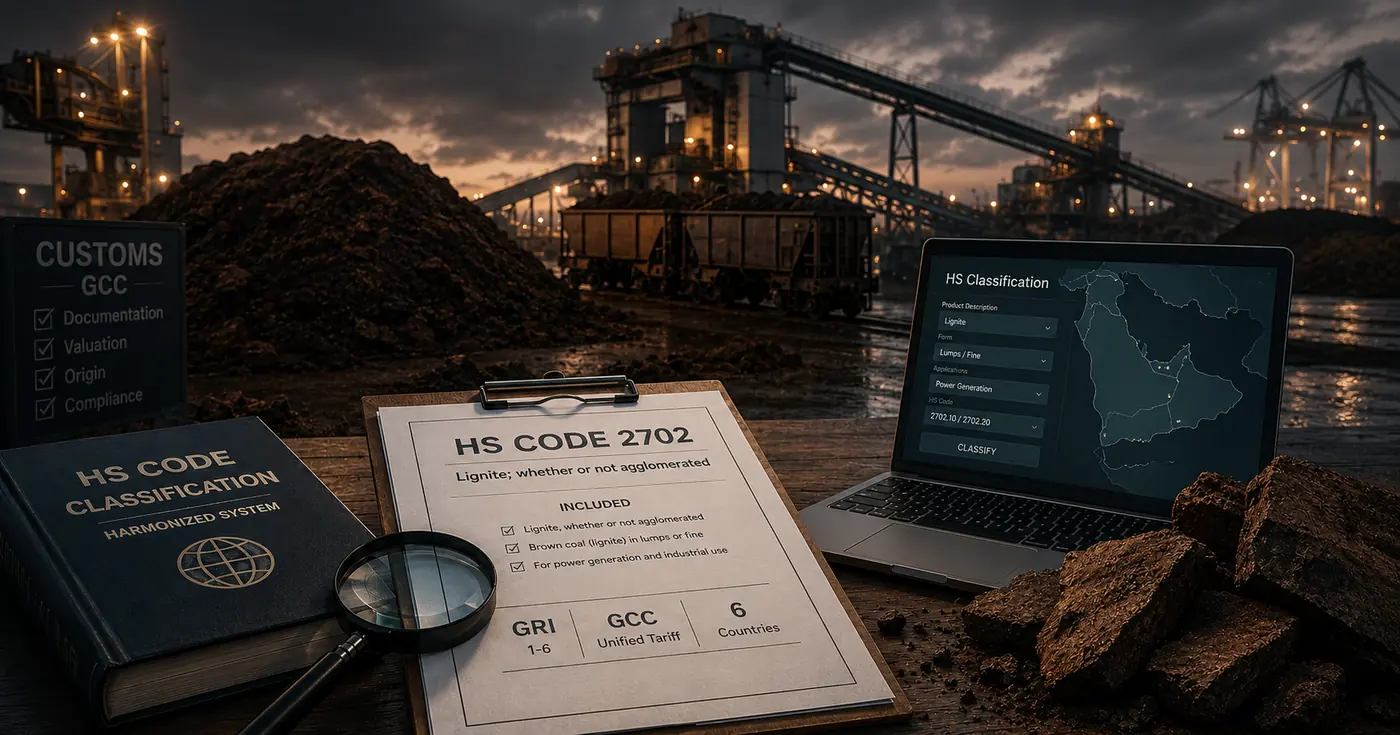
HS Code 2702 is the international four-digit heading for lignite, whether or not agglomerated, while expressly excluding jet. The heading is structurally simple: at the six-digit international level, the Harmonized System separates lignite that is not agglomerated from lignite that has been agglomerated.
The simplicity of the tariff structure does not mean every product described commercially as “brown coal,” “low-rank coal,” “lignite fuel,” “lignite powder” or “lignite briquettes” can be classified from the invoice description alone. The classifier still needs to confirm what the goods actually are, whether the material is lignite rather than coal, peat or coke, and whether the product is presented in a non-agglomerated or agglomerated form.
This matters for importers, exporters, power producers, industrial plants, commodity traders, procurement teams and customs professionals handling mineral fuels in Saudi Arabia, the United Arab Emirates (UAE), Qatar, Oman, Kuwait and Bahrain. The international HS classification is the common starting point, while the current destination tariff and customs requirements must be checked for the actual market of import.
Where HS Code 2702 Sits in Chapter 27
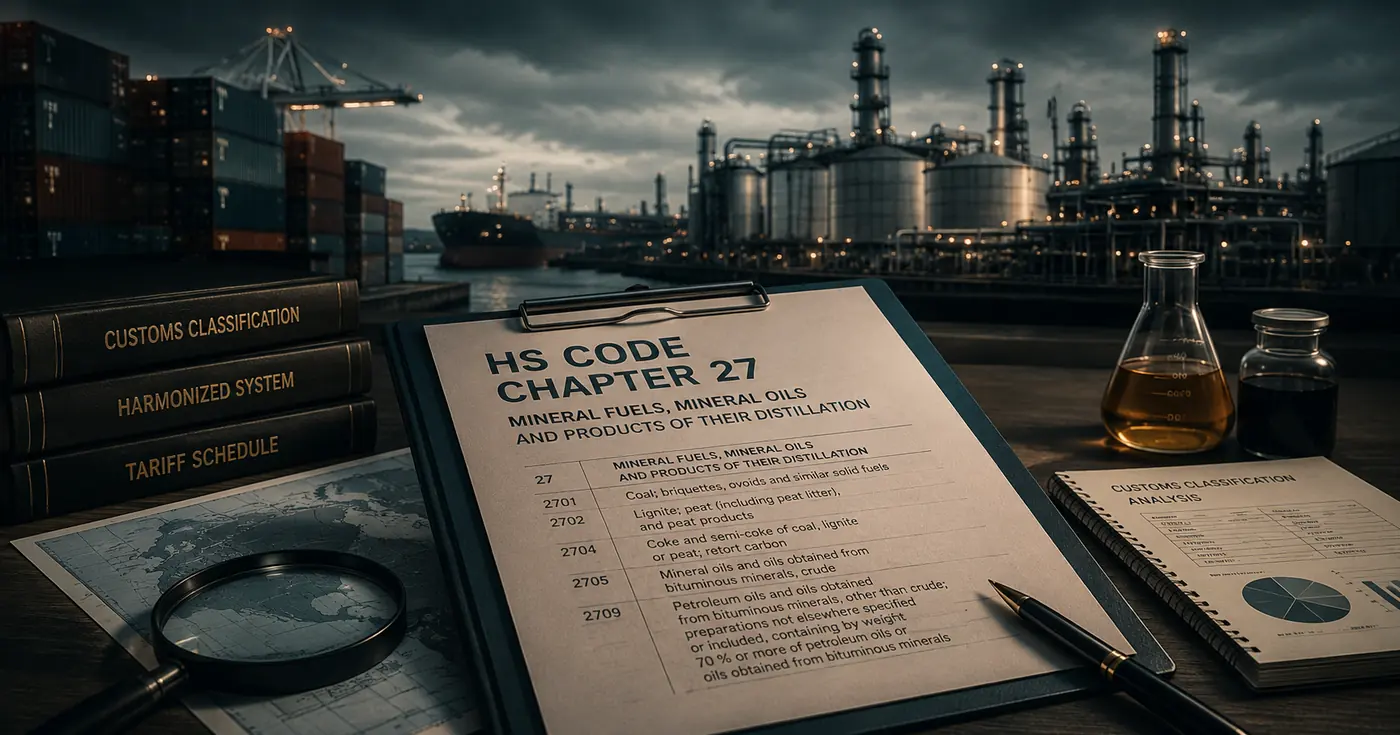
Heading 2702 belongs to Chapter 27 of the Harmonized System, which covers mineral fuels, mineral oils, products of their distillation, bituminous substances and mineral waxes. The broader chapter also contains headings for coal, peat, coke, petroleum oils, petroleum gases, mineral waxes, bitumen and other energy-related materials.
For the broader legal and technical context, see the HS Code Chapter 27 guide. The nearest classification comparison is often Heading 2701 for coal, and the published HS Code 2701 coal guide explains that heading in detail.
The official HS 2022 nomenclature places Heading 2702 immediately after coal in 2701 and before peat in 2703. That sequence is useful because many classification problems arise at the boundary between these related solid mineral fuels rather than from a dispute about the numerical subheading within 2702 itself.
How the Chapter 27 Notes Affect HS Code 2702
The Chapter 27 legal notes are important, including the notes you should review before treating any energy-related product as automatically belonging in this chapter. Chapter Note 1 excludes certain separately chemically defined organic compounds, subject to the specific exceptions for pure methane and pure propane of Heading 2711. It also excludes medicaments of Headings 3003 and 3004 and certain mixed unsaturated hydrocarbons classified elsewhere.
For a normal shipment of natural lignite, those exclusions may not be the central issue, but they still form part of the legal framework of the chapter. More importantly, the remaining Chapter Notes and Subheading Notes demonstrate something useful about 2702: the HS 2022 legal text does not prescribe a special numerical moisture, volatile-matter, carbon or calorific-value threshold for the two 2702 subheadings.
This is different from Heading 2701. The Chapter 27 Subheading Notes expressly define anthracite under 2701.11 and bituminous coal under 2701.12 using technical thresholds. Those 2701 definitions should not be copied across and treated as if they were legal tests for lignite under 2702.
Likewise, Chapter Notes 2 and 3 deal specifically with petroleum oils and waste oils of Heading 2710, while other Subheading Notes address products in 2707 and 2710. They should not be converted into artificial rules for lignite classification.
HS 2022 contains no Chapter 27 Subheading Note that says lignite must meet a particular numerical calorific value, moisture percentage or volatile-matter threshold to enter 2702. Technical test data can still be useful evidence of product identity, but it should not be presented as an invented HS threshold for this heading.
HS Code 2702 Classification Structure
International structure of Heading 2702
The four-digit international heading.
Covers the non-agglomerated branch, including lignite that has been pulverised.
Covers lignite presented in an agglomerated form.
This structure creates a practical classification question that is much simpler than the anthracite and bituminous-coal tests under 2701: once the product is correctly identified as lignite, the six-digit split is based primarily on whether the lignite is agglomerated.
The wording of 2702.10 is especially important because it expressly says “whether or not pulverised.” Therefore, crushing or pulverising lignite does not by itself make the material agglomerated and does not automatically move it to 2702.20.
HS 2702.10 — Lignite, Whether or Not Pulverised, but Not Agglomerated
Subheading 2702.10 covers lignite that remains non-agglomerated. The product can be presented in lumps, smaller pieces, granules, fines or pulverised form, provided the goods remain lignite and have not been agglomerated into the type of consolidated product described by the alternative subheading.
This wording prevents a common mistake: equating small particle size with agglomeration. Pulverisation is a reduction in particle size. Agglomeration is a different physical condition in which smaller particles are combined or consolidated into larger units. The tariff text itself confirms that pulverised lignite can remain within 2702.10.
Does drying change 2702.10 automatically?
Drying can materially change commercial properties such as moisture, handling behaviour and energy performance, but the fact that lignite has been dried does not create a separate six-digit subheading under the current HS 2702 structure. The classifier should review whether the material remains lignite as presented and whether the processing has transformed it into another separately described product.
The same disciplined approach applies to screening, sizing, crushing and pulverising. These operations may be commercially significant but should not be converted into tariff rules that do not appear in the legal text.
What about lignite fines or powder?
If the goods are genuinely lignite, remain non-agglomerated and are merely in fine or pulverised form, 2702.10 is the international subheading to evaluate. The product name “lignite powder” is useful, but supporting information should still confirm that the material is lignite rather than another mineral fuel or processed carbonaceous material.
HS 2702.20 — Agglomerated Lignite
Subheading 2702.20 covers agglomerated lignite. Here, the key difference from 2702.10 is not a numerical moisture or calorific-value threshold; it is the presentation of the lignite in an agglomerated form.
In commercial practice, lignite fines may be consolidated to improve handling, transport, storage or use as a solid fuel. When reviewing such goods, useful evidence can include photographs, product dimensions, manufacturing descriptions and information about how the material is formed.
If binders or other materials are present, their nature and proportion should be documented where relevant. The heading text does not provide a universal binder percentage that automatically determines whether a product stays in 2702.20. If additional materials materially change the nature of the finished goods, the complete product should be reviewed under the applicable legal provisions rather than relying on the word “briquette” alone.
Agglomerated does not mean every manufactured fuel block
A dark compressed fuel block is not automatically agglomerated lignite. The classifier should establish the actual feedstock and composition. A coal-based briquette may be relevant to Heading 2701, a peat product may raise Heading 2703, and a carbonised product can require comparison with Heading 2704. Product appearance alone is therefore not enough.
Why Heading 2702 Says “Excluding Jet”
The official wording of Heading 2702 expressly reads “Lignite, whether or not agglomerated, excluding jet.” That exclusion is part of the legal heading text and should not be omitted from a classification review simply because most commercial lignite shipments are industrial fuel rather than jet.
The practical point is straightforward: if the goods are commercially or technically identified as jet, do not classify them under 2702 merely because they may be associated with lignitic material. The exclusion must be respected and the appropriate alternative classification should be reviewed from the actual characteristics of the goods and the relevant tariff provisions.
For normal bulk lignite used as a mineral fuel, the more frequent classification issue is usually not jet. It is whether the goods are correctly identified as lignite and, if so, whether they are non-agglomerated or agglomerated.
HS 2702 vs Similar Chapter 27 Headings
A reliable classification file should identify the nearest realistic alternatives. For lignite, the most important comparisons are typically Heading 2701 for coal, Heading 2703 for peat and Heading 2704 for coke and semi-coke.
| Heading | General Scope | Key Distinction from 2702 |
|---|---|---|
| 2701 | Coal and certain solid fuels manufactured from coal | Coal has its own heading and specific six-digit structure. Lignite is separately named in 2702. |
| 2702 | Lignite, whether or not agglomerated, excluding jet | The subject of this guide; split into non-agglomerated and agglomerated lignite. |
| 2703 | Peat, including peat litter, whether or not agglomerated | Peat is a separately described material and should not be classified as lignite merely because both can be used as fuel. |
| 2704 | Coke and semi-coke of coal, lignite or peat; retort carbon | Carbonised or processed products described by 2704 are not classified as the original lignite feedstock. |
2702 vs 2701 — Lignite or Coal?
This is one of the most important boundaries. Commercial documents may use “brown coal,” “low-rank coal,” “coal fuel” or simply “coal.” The HS, however, gives lignite its own Heading 2702 rather than treating it as an “other coal” category inside 2701.
Where the supplier description is ambiguous, obtain technical and commercial documentation that can establish the identity of the mineral material. Do not import the anthracite and bituminous-coal thresholds from 2701 and pretend that they constitute the legal definition of lignite under 2702.
2702 vs 2703 — Lignite or Peat?
Peat is separately covered by Heading 2703, including peat litter, whether or not agglomerated. The fact that a material is brown, carbonaceous or combustible does not make it lignite. Supplier specifications, source information and technical description should support the identity of the goods.
2702 vs 2704 — Lignite or Coke/Semi-Coke?
Heading 2704 specifically covers coke and semi-coke of coal, lignite or peat, whether or not agglomerated, as well as retort carbon. This creates an important processing boundary. If lignite has undergone carbonisation or another process that results in a product described as coke or semi-coke, classification should follow the goods as presented rather than the original raw-material source.
Commercial Descriptions That Need Verification
Lignite can be traded under names that are useful commercially but are not complete tariff conclusions. Examples include brown coal, lignite coal, low-rank coal, lignite fines, lignite powder, dried lignite, pulverised lignite, lignite briquettes and solid lignite fuel.
Brown Coal
A common commercial description associated with lignite. It can support product identification, but the actual goods and documentation should still be reviewed.
Lignite Fines
Fine particle size does not mean the goods are agglomerated. Non-agglomerated fines can remain relevant to 2702.10.
Pulverised Lignite
The wording of 2702.10 expressly covers lignite whether or not pulverised, provided it is not agglomerated.
Lignite Briquettes
A briquetted or consolidated lignite product may point toward 2702.20, but composition and actual form should be verified.
The purpose of reviewing these descriptions is not to reject commercial terminology. It is to connect that terminology with the legal tariff structure and with evidence showing what the imported or exported goods actually are.
Technical Data Needed for HS Code 2702
Heading 2702 does not contain the same explicit numerical subheading definitions used for anthracite and bituminous coal under 2701. Nevertheless, technical data can be very useful when product identity is uncertain, when the documents use broad terms such as “coal,” or when customs needs evidence that the goods are lignite rather than another carbonaceous material.
| Information | Why It Can Matter |
|---|---|
| Exact product identity | Confirms whether the material is lignite rather than coal, peat, coke or another mineral fuel. |
| Physical form | Central to deciding between non-agglomerated 2702.10 and agglomerated 2702.20. |
| Source / geological description | Can support the supplier's identification of the material as lignite. |
| Moisture | Can help describe and compare the material, but HS 2702 does not prescribe a special legal moisture threshold in the Chapter 27 notes. |
| Ash / mineral matter | Useful technical evidence for understanding the material and reviewing supplier specifications. |
| Volatile matter | Can support product characterisation, but should not be presented as a 2702 numerical legal threshold. |
| Calorific value | Commercially important and potentially useful evidence, but the 2702 subheading split itself is not expressed through a calorific-value threshold. |
| Particle size | Helps distinguish lumps, fines and pulverised product; pulverisation alone does not make lignite agglomerated. |
| Manufacturing process | Important where the material has been dried, crushed, compacted, agglomerated or carbonised. |
| Binder / additives | Relevant when agglomerated goods contain materials beyond lignite and the finished product requires closer review. |
Useful Supporting Documents
- Commercial invoice and purchase order
- Supplier product specification
- Technical Data Sheet (TDS), if available
- Certificate of Analysis (COA)
- Laboratory or fuel analysis report
- Moisture, ash and volatile-matter data where relevant
- Calorific-value information where relevant
- Photographs showing physical form
- Particle-size specification
- Description of drying, crushing or pulverising operations
- Agglomeration or briquetting process information
- Binder or additive composition when relevant
- Information describing any carbonisation or heat-treatment process
The objective is not to request every possible document for every shipment. The objective is to obtain enough evidence to answer the classification questions that matter: Is the material lignite? Has it remained non-agglomerated? Has it been agglomerated? Or has processing created a product that should be considered under another heading?
Processing Operations and Their Classification Impact
Crushing and Pulverising
Crushing and pulverising reduce particle size. Because 2702.10 explicitly says “whether or not pulverised,” these operations do not automatically remove non-agglomerated lignite from that subheading.
Drying
Lignite can be dried to reduce moisture or improve handling and fuel performance. Drying by itself is not named as a separate HS6 category under 2702. The product should be reviewed as presented to confirm whether it remains lignite and whether any additional processing changes its tariff identity.
Agglomerating or Briquetting
When lignite is consolidated into an agglomerated form, 2702.20 becomes the relevant six-digit branch to evaluate. Photographs and manufacturing details can be particularly helpful where the invoice uses broad terms such as “lignite fuel blocks.”
Carbonisation
Carbonisation can create a more significant classification boundary because Heading 2704 expressly covers coke and semi-coke of lignite. If the processing results in a product described by that heading, the original lignite feedstock should not automatically keep the goods in 2702.
How to Classify a Product Under HS Code 2702
Identify the Actual Material
Confirm whether the goods are lignite. Treat broad terms such as brown coal, solid fuel or coal powder as starting information, not final classification.
Review the Chapter 27 Notes
Apply the Chapter Notes and confirm there is no legal exclusion relevant to the goods. Do not import numerical tests from unrelated headings.
Compare the Closest Four-Digit Headings
Consider 2701, 2702, 2703 and 2704 where the identity or processing of the carbonaceous material creates a realistic boundary question.
Apply GRI 1 at Heading Level
Use the wording of the headings together with relevant Section and Chapter Notes to establish whether Heading 2702 legally describes the goods.
Determine Whether the Lignite Is Agglomerated
If it is not agglomerated, including when pulverised, evaluate 2702.10. If it is agglomerated, evaluate 2702.20.
Apply GRI 6 at Subheading Level
Compare the applicable subheadings at the same level using the subheading wording and relevant notes.
Document the Rejected Alternatives
Record why the material is not coal under 2701, peat under 2703, or coke/semi-coke under 2704 where those alternatives are reasonably possible.
Verify the Destination Tariff and Requirements
After establishing the international HS classification, check the current detailed tariff line and customs or regulatory requirements in Saudi Arabia, UAE, Qatar, Oman, Kuwait or Bahrain according to the actual destination.
Need to Classify a Specific Lignite Product?
A description such as brown coal, lignite powder or lignite briquettes may not contain enough information for a defensible customs classification. Use JAMAREK to analyse the actual product and supporting information for your shipment.
Practical HS 2702 Classification Examples
The examples below illustrate classification logic only. They are not binding customs rulings and do not replace review of the actual goods and current tariff requirements.
Example 1 — Bulk Lignite in Lumps
A shipment consists of material identified by the supplier and supporting specifications as lignite. It is supplied as irregular lumps and has not been agglomerated. The international analysis should focus on 2702.10 because the material is lignite in non-agglomerated form.
Example 2 — Pulverised Lignite Powder
An industrial user imports lignite that has been milled into a fine powder. The goods remain loose and have not been compacted or agglomerated. The fact that the material is pulverised does not by itself move it out of 2702.10 because the subheading wording specifically includes lignite whether or not pulverised.
Example 3 — Agglomerated Lignite Fuel Units
Lignite fines are consolidated into stable fuel units. Product photographs and manufacturing documents confirm that the material is agglomerated lignite. Provided the finished goods remain properly described as lignite and no competing heading better describes the product, 2702.20 is the international subheading to evaluate.
Example 4 — Carbonised Product Made from Lignite
A manufacturer starts with lignite but subjects it to a process that produces semi-coke. The fact that lignite was the feedstock does not automatically keep the finished goods in 2702. Heading 2704 should be considered because it expressly covers coke and semi-coke of lignite.
Example 5 — Product Described Only as “Brown Solid Fuel”
The invoice says “brown solid fuel” but provides no reliable technical identity. The classifier should not guess 2702 from colour and intended use. Obtain supplier specifications or other evidence to distinguish lignite from coal, peat, agglomerated products or processed carbonaceous materials.
HS Code 2702 in Saudi Arabia, UAE, Qatar, Oman, Kuwait and Bahrain
Saudi Arabia, the United Arab Emirates (UAE), Qatar, Oman, Kuwait and Bahrain operate within the Gulf customs framework, while customs declarations and operational requirements are administered through the competent authorities and systems applicable in the destination state.
For lignite, the international HS classification provides the common starting point. Heading 2702 and its six-digit subheadings distinguish non-agglomerated lignite from agglomerated lignite. This article intentionally stops at the internationally harmonized six-digit level rather than publishing a detailed destination tariff code as if it automatically applied to every Gulf shipment.
After the HS classification is established, the importer or exporter should verify the current detailed tariff line, customs documentation and any destination-specific regulatory requirements in the actual market: Saudi Arabia, United Arab Emirates, Qatar, Oman, Kuwait or Bahrain.
Confirm the product → establish Heading 2702 → select the correct HS6 subheading → check the current tariff and customs requirements of the destination market.
Common HS Code 2702 Classification Mistakes
1. Treating Every “Brown Coal” Description as Conclusive
Commercial terminology can support the review, but the actual identity of the material should be verified where classification is uncertain.
2. Using the 2701 Anthracite or Bituminous-Coal Thresholds for Lignite
The specific volatile-matter and calorific-value definitions in the Chapter 27 Subheading Notes apply to 2701.11 and 2701.12. They are not written as legal definitions for 2702.
3. Assuming Pulverised Lignite Is Agglomerated
The tariff text expressly includes pulverised lignite in 2702.10 when it is not agglomerated. Particle-size reduction and agglomeration are different facts.
4. Ignoring the Agglomerated Form
If lignite has been agglomerated, the classification review should not remain at 2702.10 merely because the feedstock originally consisted of loose lignite fines.
5. Classifying Coke or Semi-Coke as Lignite
Heading 2704 separately covers coke and semi-coke of lignite. The goods are classified as presented, not solely by their original feedstock.
6. Guessing from Colour or Use
A brown combustible material used in a boiler is not automatically lignite. Product identity and the legal tariff wording come first.
7. Inventing a Numerical HS Threshold for 2702
Moisture, ash, volatile matter and calorific value may be useful technical evidence, but the current Chapter 27 legal notes do not set a dedicated numerical threshold for the two 2702 subheadings.
8. Copying a Supplier Code Without Reviewing the Current Goods
A supplier may use another jurisdiction's tariff extension or may have classified a different product form. Confirm the international HS basis for the actual shipment.
Building a Defensible Lignite Classification File
A defensible customs classification record should show the reasoning, not merely the selected number. For a potentially disputed lignite product, an internal file can record the exact description, product form, supporting specifications, relevant processing steps and the reasons alternative headings were rejected.
- Record the supplier's exact product description.
- Confirm why the material is identified as lignite.
- Record whether it is loose, pulverised or agglomerated.
- Keep photographs where physical form matters.
- Retain relevant technical or laboratory information.
- Document processing such as drying, crushing, agglomeration or carbonisation.
- Record why 2701, 2703 and 2704 were rejected when they were realistic alternatives.
- Identify the selected six-digit international subheading.
- Separately verify the destination tariff and regulatory requirements.
This approach is especially valuable when the same company buys lignite from multiple suppliers or in different physical forms. A classification based on clear product facts is easier to review and update than a code copied from a historic invoice.
Explore HS 2702 by Six-Digit Subheading
Heading 2702 has only two international six-digit subheadings. Dedicated JAMAREK articles can therefore build a clean content cluster beneath this page.
Until the individual HS6 articles are published, these remain plain text rather than placeholder links. Once published, the child articles should link back to this 2702 heading guide and to the Chapter 27 parent article.
Frequently Asked Questions About HS Code 2702
What is HS Code 2702?
What is the HS code for non-agglomerated lignite?
What is the HS code for agglomerated lignite?
Is pulverised lignite classified as agglomerated lignite?
Does HS 2702 have a specific calorific-value threshold?
Does HS 2702 have a specific moisture threshold?
Is lignite classified as “other coal” under 2701?
Can lignite coke remain under 2702?
Why does Heading 2702 exclude jet?
Does the same six-digit HS structure apply in Saudi Arabia, UAE, Qatar, Oman, Kuwait and Bahrain?
Classify the Actual Lignite Product — Not Just the Invoice Wording
Whether the supplier calls the goods brown coal, lignite fines, pulverised lignite or lignite briquettes, the classification should reflect the actual material and physical form. Use JAMAREK to review the product information available for your shipment.
Future Update: HS 2028
This guide is based on HS 2022, the current international nomenclature in 2026. The World Customs Organization has published HS 2028, which will enter into force on 1 January 2028.
In the official published HS 2028 amendment document, Chapter 27 contains a specific change to the waste-oil structure under Heading 2710: subheading 2710.91 is deleted and new subheadings 2710.92 and 2710.93 are introduced. The published amendment set does not identify a specific change to Heading 2702 or to subheadings 2702.10 and 2702.20.
That future information should not be treated as a current 2026 tariff rule. Transactions taking place after HS 2028 enters into force should be checked against the final HS 2028 nomenclature and the tariff implemented by the destination customs administration.
Final Takeaway
HS Code 2702 is a focused but important Chapter 27 heading. It covers lignite, whether or not agglomerated, while excluding jet. At the international six-digit level, the structure separates non-agglomerated lignite — including pulverised lignite — under 2702.10 from agglomerated lignite under 2702.20.
The most important practical lesson is that the HS legal notes do not create a special numerical moisture, volatile-matter or calorific-value threshold for 2702. Technical data can be very useful for proving what the material is, but it should not be turned into an unsupported legal test.
A reliable classification starts by confirming the product identity, comparing lignite with coal, peat and coke where necessary, determining whether the goods are agglomerated, applying GRI 1 and GRI 6 at the appropriate levels, and documenting why competing classifications were rejected.
After the international HS classification is established, verify the current tariff and customs requirements of the destination market — Saudi Arabia, United Arab Emirates, Qatar, Oman, Kuwait or Bahrain — before completing the declaration.
Classify the goods as they are presented, using the legal HS structure and evidence about the actual product — not simply a commercial label.
Official Sources
This guide is provided for general educational and informational purposes only. Correct HS classification depends on the characteristics of the actual goods, the legally applicable nomenclature, supporting technical documentation and the customs requirements in force at the time of import or export.
The examples in this article are not binding customs rulings. For transactions involving Saudi Arabia, the United Arab Emirates (UAE), Qatar, Oman, Kuwait or Bahrain, verify the current tariff and requirements applicable in the destination market before completing the customs declaration.