

HS Code 2701: Coal, Anthracite, Bituminous Coal and Coal Briquettes
A detailed classification guide to HS Code 2701 covering anthracite, bituminous coal, other non-agglomerated coal, and briquettes, ovoids and similar solid fuels manufactured from coal, with practical customs context for Saudi Arabia, the United Arab Emirates (UAE), Qatar, Oman, Kuwait and Bahrain.
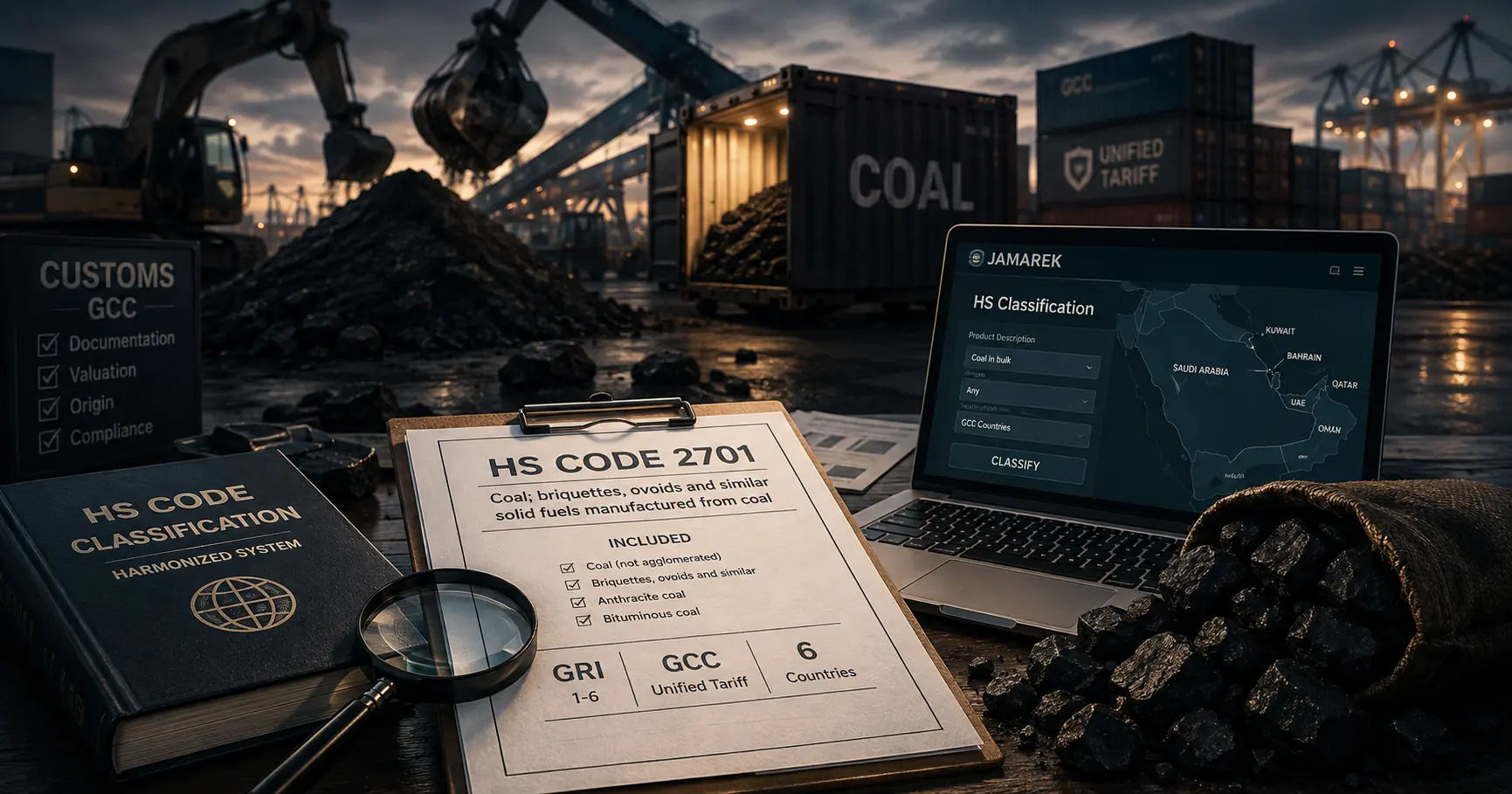
HS Code 2701 covers coal and specific solid fuel forms manufactured from coal. The heading may appear straightforward, but the correct six-digit international subheading can depend on technical test results and on whether the goods are presented as non-agglomerated coal or as briquettes, ovoids or similar manufactured solid fuels.
This distinction can matter to importers, exporters, manufacturers, commodity traders, industrial users and customs teams moving coal into or out of Saudi Arabia, the United Arab Emirates (UAE), Qatar, Oman, Kuwait and Bahrain.
Commercial documents may describe coal as thermal coal, steam coal, metallurgical coal, coking coal, hard coal, coal fines, pulverized coal, anthracite or coal briquettes. These names can be useful for understanding the transaction, but the Harmonized System applies its own legal structure and technical definitions.
The classification question should therefore go beyond the product name. A stronger approach is to identify the actual material, understand its physical form, review the relevant analytical results and then compare those facts with the wording of Heading 2701 and its international subheadings.
Where HS Code 2701 Sits in the Harmonized System
HS 2701 belongs to Chapter 27, which covers mineral fuels, mineral oils and products of their distillation, bituminous substances and mineral waxes. Heading 2701 narrows that broad chapter to coal and particular solid fuels manufactured from coal.
For the broader chapter structure, see the HS Code Chapter 27 guide .
The international nomenclature first separates coal that is not agglomerated from briquettes, ovoids and similar solid fuels manufactured from coal. Within the non-agglomerated branch, the six-digit structure then distinguishes anthracite, bituminous coal and other coal.
This structure matters because the line reading “coal, whether or not pulverised, but not agglomerated” is a grouping line inside Heading 2701; the actual international six-digit subheadings beneath it are 2701.11, 2701.12 and 2701.19. The fourth six-digit subheading is 2701.20.
HS Code 2701 Classification Structure
International six-digit structure of Heading 2701
Non-agglomerated coal meeting the HS technical definition for anthracite.
Non-agglomerated coal meeting the applicable volatile-matter and calorific-value criteria.
Other qualifying non-agglomerated coal within Heading 2701.
Manufactured solid fuel forms covered by the wording of this subheading.
The first three subheadings sit under the grouping “coal, whether or not pulverised, but not agglomerated.” This means pulverization by itself does not move coal into the briquette subheading. The material must still be evaluated according to its actual physical form and the wording of the subheadings.
HS 2701.11 — Anthracite
For the purposes of international subheading 2701.11, the HS defines anthracite using a specific volatile-matter limit. The coal must have a volatile matter content of not more than 14%, calculated on a dry, mineral-matter-free basis.
This is more precise than a commercial description. A supplier may market a material as anthracite, hard coal or premium coal, but the classification review should still confirm whether the technical result satisfies the relevant Subheading Note.
The analytical basis is particularly important. Coal certificates may report properties on an as-received basis, dry basis or another analytical basis. A percentage shown on a certificate should not be compared directly with the HS threshold unless the result is expressed on the basis required by the Subheading Note or has been appropriately converted by competent technical analysis.
Is the word “anthracite” on the invoice enough?
No. The invoice description is useful evidence of what the parties believe they are trading, but it is not a substitute for the HS definition where a technical threshold controls the subheading.
A stronger classification file links the trade description to the relevant certificate of analysis or other reliable technical information. If the supplier's commercial grade and the HS technical definition do not align, the legal classification should follow the applicable HS provisions rather than the marketing terminology alone.
HS 2701.12 — Bituminous Coal
Bituminous coal also has a technical definition under the HS Subheading Notes. Two criteria are important. The coal must have volatile matter exceeding 14% on a dry, mineral-matter-free basis, and it must have a calorific value equal to or greater than 5,833 kcal/kg on a moist, mineral-matter-free basis.
Both the value and the analytical basis matter. The number on a laboratory report should therefore be read together with the basis on which the result was calculated. A calorific value reported on a different basis should not simply be assumed to satisfy the HS definition.
The same caution applies to volatile matter. Because the HS definition expressly refers to a dry, mineral-matter-free basis, the classifier should verify that the test result used for the customs analysis is comparable to that requirement.
What about thermal coal, steam coal and coking coal?
Thermal coal, steam coal, metallurgical coal and coking coal are common commercial expressions. They can communicate intended use, market grade or industrial performance, but they do not replace the legal wording of the HS subheadings.
A product sold as thermal coal because it is intended for electricity generation still needs to be evaluated against the applicable 2701 subheading criteria. Likewise, a product sold as coking coal for steelmaking should not be assigned a six-digit HS code solely from its intended use.
“For power generation,” “for steelmaking” or “for industrial boilers” can help describe the transaction, but the international HS subheading should still be determined from the goods as presented and the applicable legal criteria.
HS 2701.19 — Other Coal
Subheading 2701.19 covers other qualifying non-agglomerated coal within Heading 2701 after the more specific anthracite and bituminous coal subheadings have been considered.
The word “other” should not be treated as a shortcut for incomplete product information. Before selecting a residual subheading, a good classification analysis should establish why the specific alternatives do not apply.
Depending on the issue being reviewed, the file may need to show that the material is coal rather than lignite, peat or coke; that it is not agglomerated; and that the relevant laboratory results do not place it in 2701.11 or 2701.12.
This creates a more defensible classification record than simply choosing “other coal” because the invoice contains a broad or unfamiliar grade name.
HS 2701.20 — Briquettes, Ovoids and Similar Solid Fuels Manufactured from Coal
Subheading 2701.20 uses a different classification concept from the first three subheadings. Instead of distinguishing coal by the anthracite or bituminous definitions, it covers briquettes, ovoids and similar solid fuels manufactured from coal.
The key question is the form of the goods as presented. Coal that has merely been crushed or pulverized remains within the non-agglomerated branch if it otherwise satisfies that wording. By contrast, a product presented as a manufactured coal briquette, ovoid or similar solid fuel should be evaluated against 2701.20.
Pulverized coal is not automatically a coal briquette
Pulverization reduces particle size. It does not by itself mean that the material has been formed into briquettes or similar manufactured solid fuel units. This distinction is expressly reflected in the structure of Heading 2701 because non-agglomerated coal may be “whether or not pulverised.”
What if binders or other materials are present?
If a manufactured solid fuel contains binders or other additional materials, their nature and proportion should be documented where relevant. Whether those materials affect the classification depends on the actual composition and characteristics of the finished goods and the applicable Harmonized System provisions.
The HS heading text itself does not provide a general binder percentage for 2701.20. For that reason, the presence of a binder should not be converted into an unsupported numerical rule. Where the composition creates a genuine classification question, the complete product should be reviewed under the applicable General Rules and legal notes.
Commercial Coal Names That Can Cause Classification Errors
Coal is traded using commercial and industrial terminology that does not necessarily match the legal HS subheadings. Common examples include thermal coal, steam coal, coking coal, metallurgical coal, hard coal, coal fines, washed coal and pulverized coal.
These descriptions can help explain intended use, grade or physical form, but they should not replace the HS definitions. For example, “thermal coal” does not by itself establish 2701.12, “hard coal” does not automatically mean anthracite, and “coal fines” do not automatically mean coal briquettes. The correct classification should connect the commercial description with the actual product characteristics and the relevant HS provisions.
HS 2701 vs Similar Headings
A strong classification review should consider not only why Heading 2701 may apply, but also whether another Chapter 27 heading describes the material more accurately. For coal-related goods, the most important comparisons are commonly 2702, 2703 and 2704.
| Heading | General Scope | Key Distinction from 2701 |
|---|---|---|
| 2701 | Coal; briquettes, ovoids and similar solid fuels manufactured from coal | The subject of this guide. Classification then depends on the applicable coal subheading or the manufactured solid-fuel form. |
| 2702 | Lignite, whether or not agglomerated, excluding jet | Lignite has its own heading and should not be classified as “other coal” under 2701 simply because it is a combustible mineral material. |
| 2703 | Peat, including peat litter, whether or not agglomerated | Peat is separately classified and is not brought into 2701 merely because it is used as fuel. |
| 2704 | Coke and semi-coke of coal, lignite or peat; retort carbon | Coke and semi-coke are separately described processed carbonaceous products rather than the coal heading itself. |
2701 vs 2702 — Coal or Lignite?
This comparison becomes important when commercial documents use broad terms such as coal, brown coal or solid mineral fuel. Lignite is not a residual form of Heading 2701; it has a separate heading under 2702.
Supplier specifications, geological description and appropriate technical information can help establish the identity of the material before the classifier begins choosing among the 2701 subheadings.
2701 vs 2703 — Coal or Peat?
Peat is separately covered by Heading 2703, including peat litter, whether or not agglomerated. The fact that a material may be burned as fuel does not make it coal for tariff purposes.
2701 vs 2704 — Coal or Coke?
Coke and semi-coke are separately covered by Heading 2704. The classification therefore follows the goods presented to customs, not simply the feedstock from which the goods were produced.
If commercial documents describe the goods as coke, semi-coke or retort carbon, the product and processing history should be reviewed before using Heading 2701.
Technical Information Needed to Classify Coal
Not every coal shipment requires an extensive laboratory investigation. However, when the distinction between 2701.11, 2701.12 and 2701.19 is in question, technical data can be essential because the HS Subheading Notes use measurable criteria.
| Information | Why It Matters |
|---|---|
| Product identity | Establishes whether the material is coal, lignite, peat, coke or another carbonaceous product. |
| Volatile matter | Directly relevant to the HS definitions of anthracite and bituminous coal. |
| Calorific value | Required when evaluating the international definition of bituminous coal. |
| Analytical basis | Essential because the HS thresholds refer to specific dry or moist, mineral-matter-free bases. |
| Physical form | Helps distinguish non-agglomerated coal, including pulverized coal, from briquettes, ovoids and similar manufactured solid fuels. |
| Manufacturing information | Useful where the goods have been formed, agglomerated or processed into a product that may fall under another heading. |
| Additional materials, if any | Relevant for manufactured solid fuels containing binders or other materials that may affect the analysis of the finished goods. |
| Intended use | Provides commercial context, but should not replace the legal and technical classification analysis. |
Useful Supporting Documents
- commercial invoice;
- purchase specification;
- technical data sheet (TDS), where available;
- certificate of analysis (COA);
- laboratory test report;
- volatile-matter result and stated analytical basis;
- calorific-value result and stated analytical basis;
- product photographs;
- particle-size or physical-form information;
- manufacturing or agglomeration information where relevant;
- composition details for additional materials where relevant;
- supplier product specification.
The goal is not to collect documents for their own sake. The supporting information should answer the classification questions that actually determine the heading and subheading.
Understanding the Analytical Bases Used in HS 2701
One of the easiest ways to make a coal classification error is to compare a laboratory number with an HS threshold without checking the basis on which the number was calculated.
The anthracite definition uses volatile matter on a dry, mineral-matter-free basis. The bituminous coal definition uses volatile matter on that same dry, mineral-matter-free basis, but its calorific-value threshold is stated on a moist, mineral-matter-free basis.
Those words are part of the legal definition. A result expressed on another basis should therefore be interpreted carefully rather than treated as automatically comparable.
How to Classify a Product Under HS Code 2701
Confirm the Material Is Coal
Start by distinguishing coal from lignite, peat, coke and other carbonaceous products. Do not rely only on a generic description such as “mineral fuel.”
Identify the Physical Form
Determine whether the coal is loose, crushed or pulverized but not agglomerated, or whether it is presented as briquettes, ovoids or a similar solid fuel manufactured from coal.
Apply GRI 1 at Heading Level
For legal purposes, classification begins with the terms of the headings and any relevant Section or Chapter Notes. Confirm that Heading 2701 describes the goods before moving to its subheadings.
Review the Relevant Technical Data
For non-agglomerated coal, review volatile matter and, where the bituminous coal definition is being considered, calorific value on the analytical bases specified in the Subheading Notes.
Apply GRI 6 at Subheading Level
Classification within Heading 2701 is determined according to the terms of the subheadings and related Subheading Notes, comparing only subheadings at the same level as required by GRI 6.
Document the Alternatives Considered
Where relevant, record why the goods are not lignite under 2702, peat under 2703, or coke or semi-coke under 2704, and why other 2701 subheadings were rejected.
Check the Destination Tariff and Requirements
After the international HS classification is established, verify the current detailed tariff line and any applicable customs or regulatory requirements in Saudi Arabia, the United Arab Emirates (UAE), Qatar, Oman, Kuwait or Bahrain, according to the actual destination.
Need to Classify a Specific Coal Product?
Commercial names such as anthracite, thermal coal, coking coal, coal fines or coal briquettes may not provide enough information for a reliable classification. Choose a JAMAREK plan and classify the actual product using the technical and commercial information available for your shipment.
HS Code 2701 in Saudi Arabia, UAE, Qatar, Oman, Kuwait and Bahrain
Saudi Arabia, the United Arab Emirates (UAE), Qatar, Oman, Kuwait and Bahrain operate within a common Gulf customs framework while customs declarations are still completed through the competent authority and requirements of the destination state.
For a product under Heading 2701, the internationally harmonized four-digit heading and six-digit subheading provide the common starting point for identifying the goods. This article therefore focuses on the international HS structure rather than presenting a destination-specific extended tariff code as though it applied automatically to every shipment.
Once the correct international classification is established, the importer or exporter should check the current detailed tariff line and operational requirements in the actual destination: Saudi Arabia, the United Arab Emirates (UAE), Qatar, Oman, Kuwait or Bahrain.
This approach is especially useful for businesses selling the same coal product into several Gulf markets. The technical HS analysis can remain a consistent foundation, while the destination-specific tariff and customs review is completed separately for the relevant transaction.
identify the actual product → determine the correct international heading → determine the correct six-digit subheading → verify the current destination tariff and customs requirements in Saudi Arabia, UAE, Qatar, Oman, Kuwait or Bahrain.
Common HS Code 2701 Classification Mistakes
1. Using “Coal” as the Complete Classification
Establishing that a product is coal may identify Heading 2701, but it does not necessarily determine the correct six-digit international subheading.
2. Assuming a Supplier's Trade Name Is an HS Definition
A supplier may call a product anthracite, steam coal or coking coal according to commercial practice. The customs classification should still confirm whether the relevant HS criteria support the selected subheading.
3. Ignoring the Analytical Basis
A volatile-matter or calorific-value result cannot be compared responsibly with the HS threshold without knowing the basis on which it is reported.
4. Treating Pulverized Coal as a Briquette
The HS structure expressly allows non-agglomerated coal to be pulverized. Pulverization therefore does not automatically place the product under 2701.20.
5. Classifying Coke as Coal Because Coal Was the Feedstock
Classification follows the goods as presented. Coke and semi-coke have their own Heading 2704 and should not be brought back into 2701 merely because coal was used to produce them.
6. Selecting 2701.19 Without Testing the Specific Alternatives
“Other coal” should normally be the result of the subheading analysis rather than a shortcut used when the necessary technical information has not been obtained.
7. Copying a Code from an Earlier Shipment Without Rechecking the Product
A previous classification can be useful background, but coal specifications can vary by supplier, mine, grade, blend or shipment. The current goods should be reviewed against the classification basis rather than assumed to be identical.
8. Classifying Solely by Intended Use
A power-generation or steelmaking use can provide useful commercial context, but it does not replace the technical definitions used within Heading 2701.
Explore HS 2701 by Six-Digit Subheading
As the JAMAREK classification library expands, Heading 2701 will be supported by dedicated articles for each genuine international six-digit subheading.
These remain plain text until the individual articles are published. Once published, this Heading 2701 guide can link downward to the corresponding six-digit articles, while each six-digit article links back to this page and to the Chapter 27 parent guide.
Frequently Asked Questions About HS Code 2701
What is HS Code 2701?
What is the HS code for anthracite coal?
What is the HS code for bituminous coal?
What is the HS code for coal briquettes?
Is pulverized coal classified as coal briquettes?
Does the same international HS classification apply in Saudi Arabia, UAE, Qatar, Oman, Kuwait and Bahrain?
Classify the Actual Coal Product — Not Just the Trade Name
Whether the documents say anthracite, thermal coal, bituminous coal, coal fines or briquettes, the classification should reflect the actual product characteristics. Use JAMAREK to analyse the information available for the goods and identify the appropriate classification direction.
Future Update: HS 2028
This guide is written for the current HS 2022 structure. The World Customs Organization has published the HS 2028 amendments, which will enter into force on 1 January 2028.
In the WCO's published HS 2028 amendment document, no specific amendment to Heading 2701 or its four six-digit subheadings is identified. For that reason, this guide does not claim a future change to HS 2701 that has not been officially stated.
That does not remove the need to recheck the official nomenclature before classifying transactions under HS 2028. JAMAREK will review this guide against the final applicable nomenclature and official implementation material before the new edition takes effect.
Final Takeaway
HS Code 2701 is more than a generic “coal code.” It is a structured international heading that separates non-agglomerated coal according to technical definitions and separately identifies briquettes, ovoids and similar solid fuels manufactured from coal.
At the international six-digit level, the relevant subheadings are 2701.11 for anthracite, 2701.12 for bituminous coal, 2701.19 for other coal and 2701.20 for briquettes, ovoids and similar solid fuels manufactured from coal.
The most important practical points are to confirm the actual material, distinguish coal from lignite, peat and coke, identify whether the coal is agglomerated, verify the correct analytical basis for technical results and apply GRI 1 and GRI 6 at the appropriate stages of the classification.
After the international HS classification is established, the current destination tariff and customs requirements should be checked separately for Saudi Arabia, the United Arab Emirates (UAE), Qatar, Oman, Kuwait or Bahrain.
A reliable HS classification starts with the actual goods and the legal HS structure — not with a trade name copied from an invoice or an old shipment.
Official Sources
This guide is provided for general educational and informational purposes. Correct HS classification depends on the actual characteristics of the goods, the legally applicable nomenclature, supporting technical documentation and the customs requirements in force at the time of import or export.
The examples and classification explanations in this article are not binding customs rulings and should not replace review of the actual goods and current official tariff information. For transactions involving Saudi Arabia, the United Arab Emirates (UAE), Qatar, Oman, Kuwait or Bahrain, verify the current requirements applicable in the destination market.