

HS Code 2709: Crude Petroleum Oils and Oils from Bituminous Minerals Classification Guide
A practical customs classification guide to crude petroleum oils and crude oils obtained from bituminous minerals under HS Code 2709, including the meaning of the crude-product requirement, the international HS6 structure, the importance of production and processing history, and the principal classification boundaries with coal-tar products, refined petroleum oils, petroleum residues, natural bituminous materials and other Chapter 27 goods.
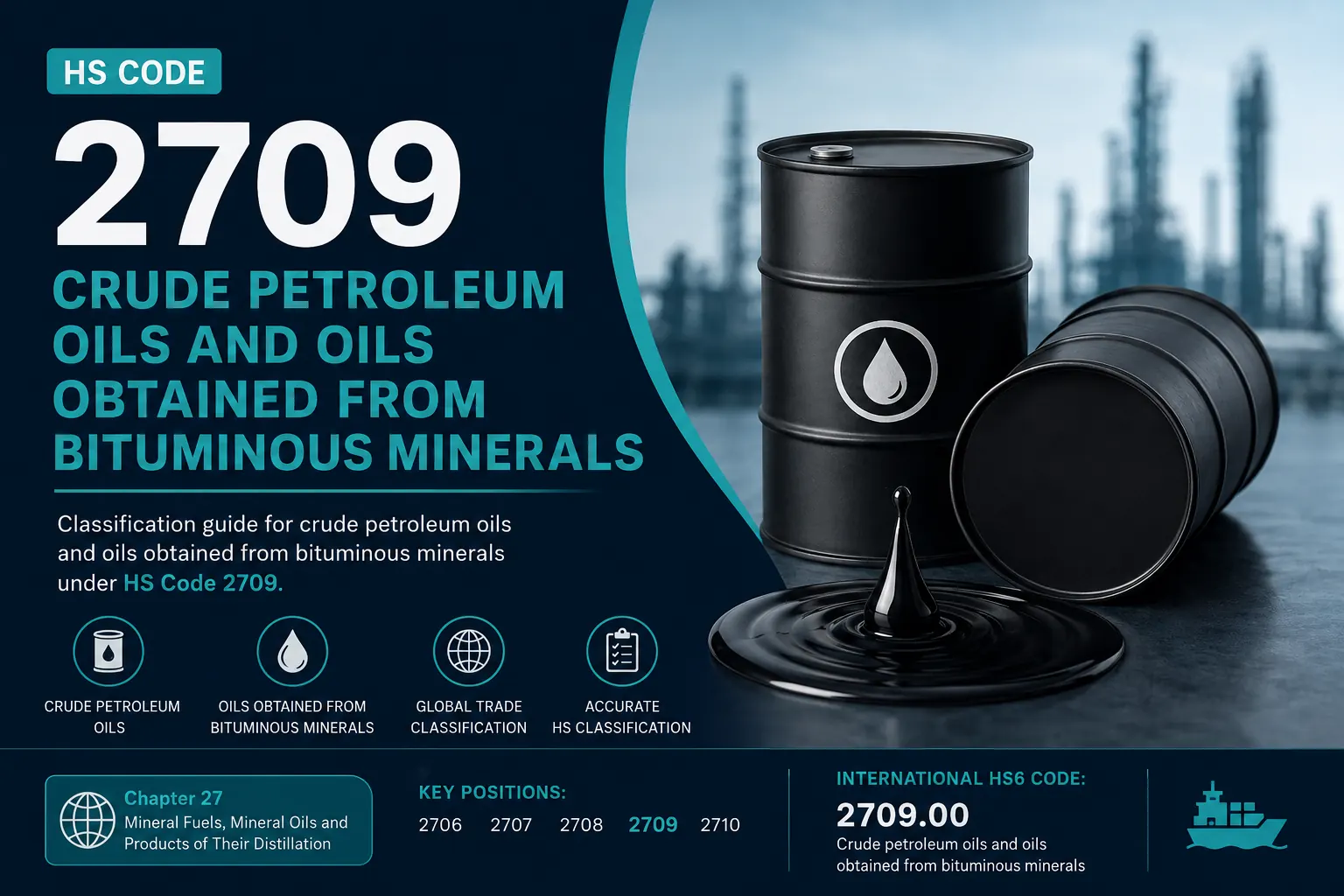
HS Code 2709 covers petroleum oils and oils obtained from bituminous minerals, crude. At the international six-digit level, the heading is represented by 2709.00.
The legal description is short, but one word carries major classification significance: crude.
Heading 2709 is not a general heading for every oil connected with the petroleum industry. The Harmonized System separately provides for petroleum oils and oils obtained from bituminous minerals that are other than crude under Heading 2710.
This means that the classifier should not stop after establishing that the material originated from petroleum.
The file should also establish the condition of the product at the time of import or export, the relevant production and processing history, and whether the material remains a crude oil for tariff purposes or has become another petroleum product covered elsewhere.
This distinction is especially important in large-volume energy and petrochemical trade because descriptions such as “crude oil,” “stabilized crude,” “petroleum feedstock,” “hydrocarbon liquid,” “oil blend,” “condensate,” “refinery feed,” or simply “oil” may require substantially more technical information before a customs classification can be defended.
Importers, exporters and compliance teams operating in Saudi Arabia, the United Arab Emirates (UAE), Qatar, Oman, Kuwait and Bahrain should therefore connect the commercial documents to the legal tariff description rather than relying solely on the trade name used by a producer, terminal or supplier.
Where HS Code 2709 sits in Chapter 27
Heading 2709 belongs to Chapter 27 of the Harmonized System, covering mineral fuels, mineral oils and products of their distillation, bituminous substances and mineral waxes.
For the broader structure, see: HS Code Chapter 27 Classification Guide .
The sequence around 2709 is particularly useful because Chapter 27 separates several materials that may all be loosely described as dark hydrocarbon oils, residues or bituminous materials.
- Heading 2707 addresses oils and other products of the distillation of high-temperature coal tar and qualifying similar aromatic-rich products.
- Heading 2708 covers pitch and pitch coke obtained from coal tar or other mineral tars.
- Heading 2709 covers petroleum oils and oils obtained from bituminous minerals, crude.
- Heading 2710 covers petroleum oils and oils obtained from bituminous minerals other than crude, together with certain preparations and waste oils described by that heading.
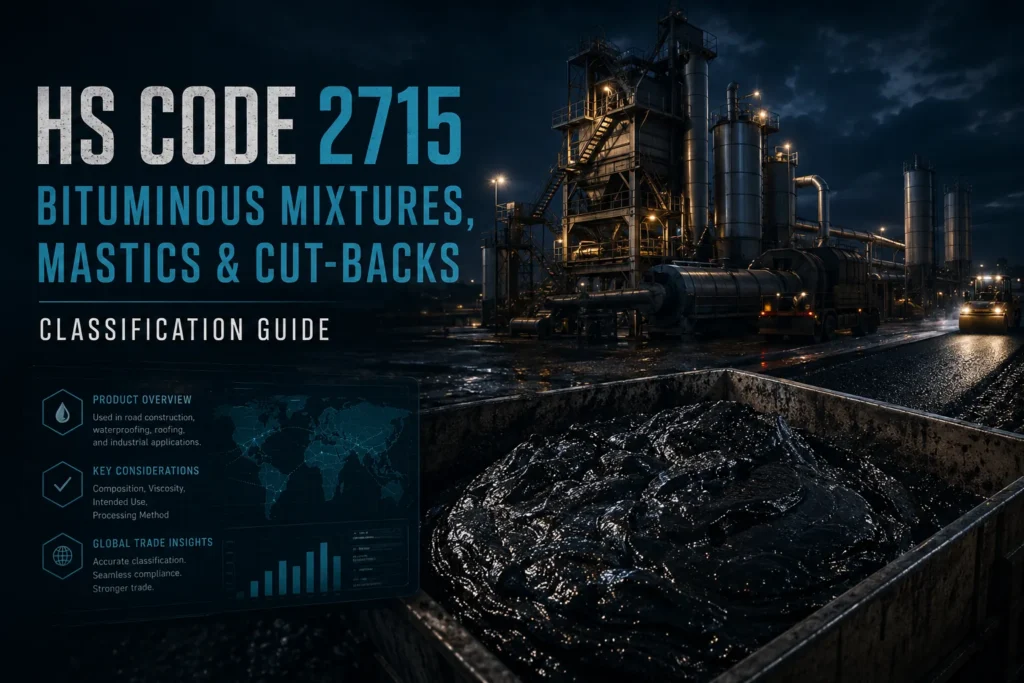
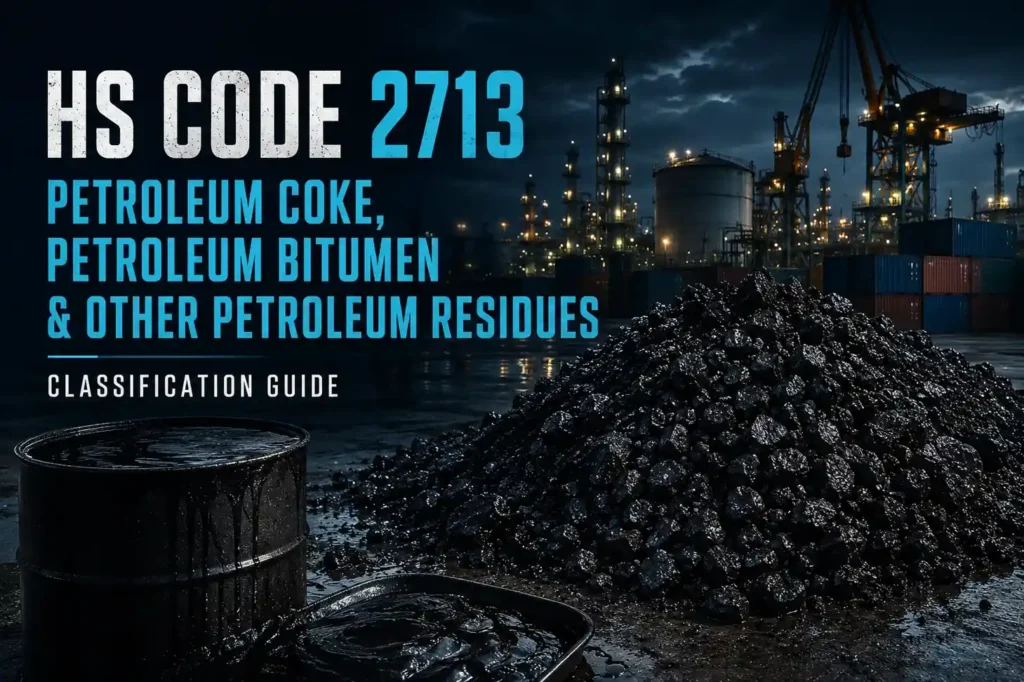
- Heading 2713 covers petroleum coke, petroleum bitumen and other specified residues of petroleum oils or oils obtained from bituminous minerals.
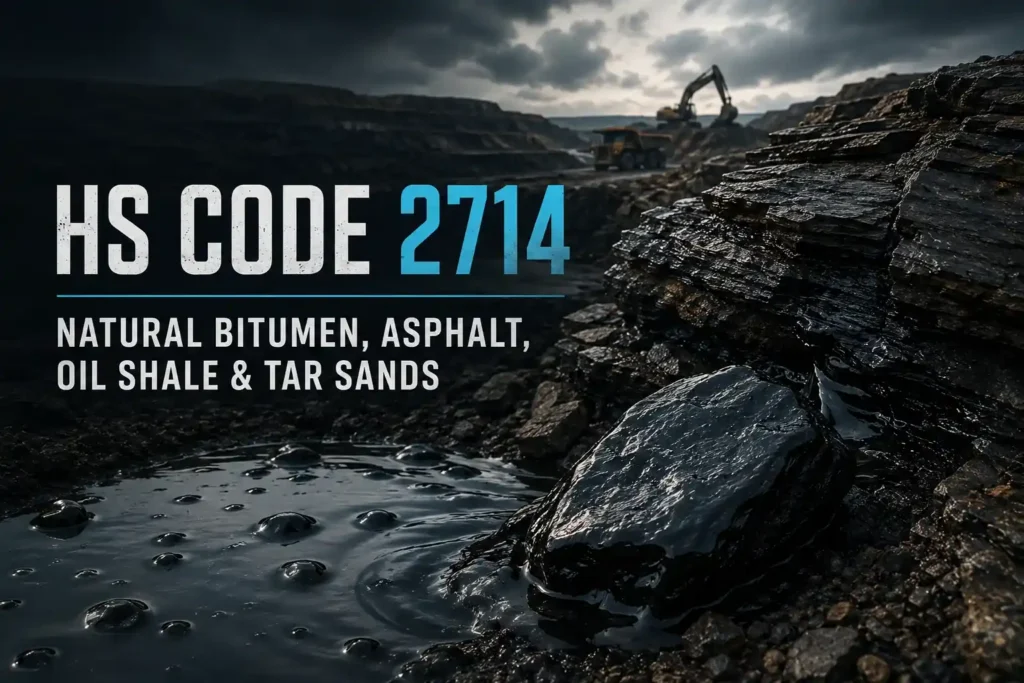
- Heading 2714 covers natural bitumen and asphalt, bituminous or oil shale and tar sands, asphaltites and asphaltic rocks.
Classification therefore depends on identifying not only the broad hydrocarbon family but the actual product stage.
HS Code 2709 structure
Heading 2709 has a very simple international numerical structure.
International HS6 under Heading 2709
Unlike headings that contain several six-digit subheadings, 2709 does not require a practical choice between multiple international HS6 subdivisions.
The main classification work occurs before that point: determining whether the goods actually belong in Heading 2709 at all.
Once the legal four-digit heading has been established, the international six-digit representation is 2709.00.
The difficult issue is usually proving that the oil presented to customs is still within the legal concept of crude petroleum oil rather than a non-crude oil or another Chapter 27 product.
Why the word “crude” matters in HS Code 2709
The word crude distinguishes Heading 2709 from one of its most important neighbouring headings: 2710.
Heading 2710 begins by referring to petroleum oils and oils obtained from bituminous minerals other than crude.
Accordingly, the condition and treatment history of the imported oil can be central to classification.
A classifier should avoid converting the word “crude” into an unsupported assumption that absolutely no treatment can ever have occurred before shipment.
In real oil-production and logistics chains, materials may undergo field, terminal or transport-related operations before export.
The relevant question is whether the goods presented remain properly characterised as crude petroleum oil under the tariff, rather than whether the material has literally never passed through any equipment or handling process.
At the same time, extensive refining, fractionation or transformation can indicate that the imported product is no longer the crude oil described by Heading 2709.
Do not invent a universal processing threshold
Product specifications can contain information about stabilization, dehydration, desalting, separation, heating, storage treatment or other operations.
These facts should be reviewed carefully, but no arbitrary universal rule such as “one treatment is allowed but two treatments are not” should be invented.
The legal analysis should focus on the identity of the product after the actual operations performed.
Petroleum oils and oils obtained from bituminous minerals
Heading 2709 is not limited to petroleum oils in the narrowest commercial wording.
Its legal text also expressly includes oils obtained from bituminous minerals, provided they are in the crude state covered by the heading.
This makes it important to distinguish between:
- the oil obtained from a bituminous mineral; and
- the bituminous mineral itself.
Heading 2714 separately identifies natural bitumen and asphalt, bituminous or oil shale, tar sands, asphaltites and asphaltic rocks.
Therefore, an importer should not classify the mineral-bearing material itself as crude oil merely because oil can be extracted from it.
Conversely, when an oil has actually been obtained from a bituminous mineral, the analysis should consider whether that oil, as presented, satisfies Heading 2709 or another heading based on its processing condition.
Processing history and product identity
For many 2709 classifications, the most valuable technical question is: what happened to the material between production and shipment?
A commercial invoice may simply say “crude oil,” but a stronger classification file should understand the production chain.
Useful information can include:
- production source or field;
- wellstream or upstream processing information;
- separation history;
- stabilization information;
- water-removal information;
- salt-removal information;
- terminal handling;
- blending history;
- fractionation or distillation history;
- refinery treatment, if any;
- final export specification.
These facts should not be viewed as a checklist where one specific operation automatically changes the HS code.
Instead, they help establish whether the final material remains crude oil or has become a processed petroleum oil, fraction, preparation or residue.
Blended crude oils
Crude petroleum oils may sometimes be commercially blended to achieve a particular export grade or specification.
The existence of blending should be documented rather than ignored.
The classifier should understand what materials were blended and whether the resulting goods remain properly described as crude petroleum oil.
A blend containing materials of a materially different nature may require a broader classification analysis rather than automatically inheriting the HS code of one component.
Important classification boundaries for HS Code 2709
2707 vs 2709 — Coal-tar products or crude petroleum oil?
Heading 2707 concerns high-temperature coal-tar distillation products and qualifying similar aromatic-rich products.
Heading 2709 concerns crude petroleum oils and crude oils obtained from bituminous minerals.
A dark hydrocarbon liquid should therefore not be placed in 2709 simply because it looks like crude oil.
Feedstock, production origin and process history help distinguish petroleum crude from coal-tar-derived oils and qualifying similar products.
2709 vs 2710 — Crude or other than crude?
This is usually the most important boundary.
Heading 2709 covers the crude oils described by its text.
Heading 2710 covers petroleum oils and oils obtained from bituminous minerals other than crude, together with specified preparations and waste oils.
If the imported material has undergone processing that results in a non-crude petroleum oil, classification should not remain under 2709 merely because the material originally came from crude petroleum.
The product must be classified in the condition in which it is presented.
2709 vs 2713 — Crude oil or petroleum residue?
Heading 2713 covers petroleum coke, petroleum bitumen and other specified residues of petroleum oils or oils obtained from bituminous minerals.
A refinery residue should not automatically be classified in 2709 merely because crude petroleum was its original feedstock.
The classification should reflect the identity of the final residue.
2709 vs 2714 — Oil or the bituminous mineral itself?
Heading 2714 covers natural bitumen and asphalt, bituminous or oil shale, tar sands, asphaltites and asphaltic rocks.
Heading 2709, by contrast, can cover crude oil obtained from bituminous minerals.
This distinction requires the classifier to identify what is physically being imported: the mineral-bearing material itself, or an oil obtained from that material.
2709 vs 2715 — Crude petroleum oil or prepared bituminous mixture?
Heading 2715 covers specified bituminous mixtures based on natural asphalt, natural bitumen, petroleum bitumen, mineral tar or mineral-tar pitch.
Such prepared mixtures are different from crude petroleum oils of Heading 2709.
| Heading | General scope | Key classification question |
|---|---|---|
| 2707 | High-temperature coal-tar distillation products and qualifying similar products. | Is the oil coal-tar-related rather than crude petroleum? |
| 2709 | Petroleum oils and oils obtained from bituminous minerals, crude. | Is the imported product actually crude oil within the legal heading? |
| 2710 | Petroleum oils and oils from bituminous minerals other than crude, certain preparations and waste oils. | Has the material become a non-crude petroleum oil or covered preparation? |
| 2713 | Petroleum coke, petroleum bitumen and specified petroleum residues. | Is the product a petroleum residue rather than crude oil? |
| 2714 | Natural bitumen, asphalt and specified naturally occurring bituminous materials. | Is the imported material the mineral itself rather than oil obtained from it? |
| 2715 | Specified prepared bituminous mixtures. | Is the shipment a formulated bituminous product rather than crude petroleum oil? |
Technical information to review for HS Code 2709
A robust HS 2709 classification normally requires more than an invoice description saying “crude oil.”
| Information or document | Why it may matter |
|---|---|
| Exact product name | Helps determine whether the material is commercially identified as crude petroleum oil, a crude blend, refinery feed, condensate, a petroleum fraction or another product. |
| Production source | Helps establish whether the oil is petroleum-derived or obtained from bituminous minerals. |
| Production / process history | Critical for understanding whether the product remains crude or has been materially transformed. |
| Supplier technical declaration | Can clarify product identity and explain operations that are not visible from the commercial invoice. |
| Crude assay | Can provide extensive technical characteristics supporting identification of a particular crude grade. |
| Density / API gravity | Useful for identifying and comparing crude grades, but not a standalone legal HS rule for Heading 2709. |
| Sulfur content | Can help identify crude grade and quality, but does not independently determine the heading. |
| Water and sediment | May support understanding of product condition and handling history. |
| Salt content | May help document the condition of crude and any upstream or terminal treatment. |
| Distillation / boiling-range information | May help identify whether the material is crude or a separated/refined fraction, depending on the overall technical context. |
| Blending information | Important when multiple crude streams or other materials have been combined. |
| TDS | Can support product identity and specification but does not itself establish the legal HS code. |
| SDS | Useful supporting evidence for product identity and hazards; it is not a binding customs classification. |
| CoA / quality certificate | Can help confirm the actual grade or shipment characteristics. |
| Refining or fractionation statement | Particularly important if there is uncertainty whether the product remains crude or has moved toward Heading 2710 or another heading. |
How to evaluate classification under HS Code 2709
Identify the actual product presented to customs
Start with the goods as imported or exported, not merely the original material at the well, mine or upstream facility.
Confirm the exact technical product name
Establish whether the material is crude petroleum oil, oil obtained from bituminous minerals, a crude blend, a separated fraction or another hydrocarbon product.
Confirm the source
Determine whether the oil is petroleum oil or oil obtained from a bituminous mineral.
Document the production history
Understand extraction, separation and other operations before shipment.
Review any treatment before export
Identify stabilization, dehydration, desalting, heating, blending, fractionation, distillation or other relevant processes.
Determine whether the material remains crude
Evaluate the product after the actual processing rather than assuming that its original petroleum source automatically preserves 2709.
Compare Heading 2710
If the product may be a petroleum oil other than crude, 2710 is a central competing heading.
Check coal-tar-related alternatives
If the material may originate from coal-tar processing or another aromatic-rich stream, evaluate 2707 where relevant.
Check whether the shipment is a petroleum residue
If the material is a downstream residue rather than crude oil, evaluate Heading 2713.
Distinguish oil from the bituminous mineral itself
If the imported goods are tar sands, bituminous shale, asphaltite or another material described by 2714 rather than extracted oil, review that heading.
Review blending
Determine what components were combined and whether the final blend remains properly characterised as crude oil.
Reconcile all technical documents
Compare the invoice, contract description, assay, TDS, SDS, CoA and producer or supplier declaration for consistency.
Apply GRI 1
Determine whether the legal text of Heading 2709 and the relevant Chapter provisions describe the goods.
Verify the destination tariff
After identifying international HS6 2709.00, verify the current detailed tariff line and customs requirements in Saudi Arabia, UAE, Qatar, Oman, Kuwait or Bahrain.
Need help classifying crude oil or another petroleum stream?
Use JAMAREK to review product identity, production source, processing history, technical evidence and competing Chapter 27 headings before finalising the customs classification.
Practical HS Code 2709 classification scenarios
Scenario 1 — Conventional crude petroleum oil exported from a production terminal
The producer identifies the shipment as a crude petroleum grade, and the technical and commercial documents consistently support that identity.
There is no indication that the shipment has become a refined petroleum fraction or another product.
Heading 2709 is directly relevant and 2709.00 becomes the international HS6 candidate.
Scenario 2 — Invoice says “crude oil” but production history is missing
The commercial invoice uses the words “crude oil,” but there is no technical statement explaining the material or its production history.
The name is useful, but stronger evidence should be obtained if there is meaningful doubt about whether the product is crude or processed.
Scenario 3 — Crude oil after upstream water removal
Documents indicate that water was removed before export.
The operation should be documented and considered in context. The classifier should not automatically assume that any water removal destroys crude status, nor should crude status be assumed without examining the actual final product.
Scenario 4 — Crude oil after desalting-related treatment
Technical documents mention salt reduction before shipment.
The relevant question remains whether the actual product is still properly described as crude petroleum oil after the operations performed.
Scenario 5 — Refined petroleum fraction
A product originated from crude petroleum, but refinery information shows that it has been separated or refined into a distinct petroleum fraction.
Original crude origin does not keep the product in 2709. Heading 2710 or another applicable heading should be evaluated based on the final goods.
Scenario 6 — Oil obtained from bituminous minerals
The material has been obtained as an oil from a bituminous mineral and is presented in a crude state.
The legal wording of 2709 expressly includes oils obtained from bituminous minerals, crude, so Heading 2709 should be evaluated.
Scenario 7 — Tar sands are imported rather than extracted oil
The shipment consists of the mineral-bearing tar-sand material itself.
This is not the same thing as crude oil obtained from bituminous minerals. Heading 2714 should be reviewed for tar sands and the other materials specified there.
Scenario 8 — Petroleum residue from refinery processing
The material began with crude petroleum but is now a downstream petroleum residue from refining.
Classification should follow the final residue rather than the original feedstock. Heading 2713 may need evaluation.
Scenario 9 — Dark aromatic oil from coal-tar processing
A black liquid resembles crude oil visually, but the production record shows that it is a coal-tar distillation product.
Physical appearance does not make it crude petroleum oil. Heading 2707 should be evaluated.
Scenario 10 — Blend of two crude petroleum streams
Two crude streams are blended to meet an export specification.
Blending should be documented. If the resulting material remains properly characterised as crude petroleum oil, 2709 may remain relevant.
The exact components and final condition should still be reviewed rather than relying on the label “blend.”
Scenario 11 — “Refinery feedstock” with unclear identity
The invoice describes the product only as “refinery feedstock.”
This does not identify whether it is crude petroleum oil, a petroleum fraction, a residue, or another hydrocarbon stream.
Technical information should be obtained before choosing 2709.
Scenario 12 — Supplier gives HS 2709 but assay describes a separated fraction
The invoice carries 2709, but technical evidence suggests that the material is a separated or processed petroleum fraction rather than crude.
The supplier code should not override contradictory technical evidence.
Scenario 13 — Petroleum bitumen
The product is highly viscous and dark, and commercial staff call it “heavy crude.”
Technical documents, however, identify it as petroleum bitumen.
Heading 2713 should be evaluated rather than relying on the informal commercial description.
Scenario 14 — Natural bitumen sold as an energy feedstock
A naturally occurring bituminous material is sold for later processing.
Its intended use as feedstock does not convert the mineral itself into crude petroleum oil. Heading 2714 may be relevant.
Common HS Code 2709 classification mistakes
1. Assuming every petroleum-derived liquid belongs in 2709
Heading 2709 is specifically limited to the crude oils described by its text.
2. Ignoring the word “crude”
This word is central to the distinction between 2709 and 2710.
3. Classifying according to original feedstock instead of final goods
A refined petroleum fraction does not remain in 2709 simply because it began as crude petroleum.
4. Treating every process as automatically disqualifying
Production and handling operations must be evaluated in context rather than through invented universal rules.
5. Treating every upstream operation as irrelevant
The opposite mistake is equally risky. Processing history may be important to understanding what the product has become.
6. Using API gravity as the legal classification test
API gravity can identify grades and physical characteristics but does not replace the tariff wording.
7. Using sulfur content as the HS rule
Sweet or sour crude terminology may be commercially useful, but sulfur level alone does not establish Heading 2709.
8. Treating every black hydrocarbon liquid as crude oil
Coal-tar oils, petroleum fractions and other products can resemble crude petroleum physically.
9. Ignoring Heading 2707 for coal-tar-related oils
Feedstock and production route should be verified.
10. Ignoring Heading 2710 for non-crude petroleum oils
This is one of the most important competing headings.
11. Ignoring Heading 2713 for petroleum residues
Refinery residues should be classified according to their actual identity.
12. Confusing oils obtained from bituminous minerals with the minerals themselves
Tar sands and certain natural bituminous materials are specifically covered by Heading 2714.
13. Assuming “refinery feedstock” means crude oil
The term describes intended use, not necessarily the technical identity of the material.
14. Assuming “condensate” automatically means 2709
Broad commercial names may cover different hydrocarbon streams. Product identity and processing history must be reviewed.
15. Copying the supplier's code without technical verification
Supplier codes can be useful evidence but should not replace independent classification.
16. Treating SDS as the final customs ruling
SDS is supporting technical evidence, not a legal classification decision.
17. Failing to document crude blending
The composition and nature of a blend can matter to the classification analysis.
18. Stopping at international HS6
2709.00 is the international six-digit code, but the detailed declaration code and requirements in the destination market must still be verified.
How to build a defensible HS 2709 classification file
A strong classification file should explain why the actual shipment is crude petroleum oil or crude oil obtained from bituminous minerals, rather than a product of a neighbouring heading.
- Record the exact commercial description.
- Record the producer's technical product name.
- Identify the production source.
- Confirm whether the source is petroleum or a bituminous mineral.
- Obtain a crude assay where relevant.
- Record density or API gravity where supplied.
- Record sulfur content where supplied.
- Record water, sediment and salt data where relevant.
- Document upstream separation or treatment.
- Document stabilization information where relevant.
- Document dehydration or desalting information where relevant.
- Document blending history.
- Determine whether fractionation or distillation occurred.
- Determine whether refinery processing occurred.
- Keep the latest TDS and SDS.
- Keep shipment-specific CoA or quality certificates where available.
- Evaluate 2707 where coal-tar-derived oils are a realistic alternative.
- Evaluate 2710 where the product may be other than crude.
- Evaluate 2713 where the product may be a petroleum residue.
- Evaluate 2714 where the imported product may be the bituminous mineral itself.
- Document the application of GRI 1.
- Explain why realistic competing headings were rejected.
- Verify the detailed tariff line in the destination country.
HS Code 2709 in Saudi Arabia, UAE, Qatar, Oman, Kuwait and Bahrain
The international Harmonized System provides the common six-digit classification foundation used for crude petroleum oils traded with Saudi Arabia, the United Arab Emirates (UAE), Qatar, Oman, Kuwait and Bahrain.
The international HS6 code under Heading 2709 is:
- 2709.00 — Petroleum oils and oils obtained from bituminous minerals, crude.
However, the international six-digit code should not be confused with the complete detailed tariff code required for an actual customs declaration in the destination country.
Detailed tariff extensions, statistical subdivisions, declaration procedures, customs documentation and other regulatory requirements may need separate confirmation.
Importers and exporters should therefore verify the current tariff and customs requirements in Saudi Arabia, UAE, Qatar, Oman, Kuwait or Bahrain before filing the final declaration.
Identify the actual oil → confirm production source → document processing history → determine whether it remains crude → compare 2710 → review 2707 if coal-tar-related → review 2713 for petroleum residues → distinguish extracted oil from materials of 2714 → review technical documents → apply GRI 1 → confirm 2709.00 → verify the destination tariff.
Future update: HS 2028
This guide is based on HS 2022, the international Harmonized System edition currently applicable in 2026.
The World Customs Organization has adopted amendments for HS 2028, which are scheduled to enter into force on 1 January 2028.
The official amendments accepted pursuant to the WCO Recommendation of 26 June 2025 include changes across the nomenclature.
In the published recommendation, the listed Chapter 27 change concerns subheading 2710.91, which is replaced by new subdivisions 2710.92 and 2710.93.
The published official recommendation does not list an amendment to Heading 2709.
Businesses should nevertheless review the final HS 2028 nomenclature, correlation tables and the implementation adopted by the relevant destination customs authority before applying the 2028 edition.
Frequently asked questions about HS Code 2709
What does HS Code 2709 cover?
What is the international HS6 code for Heading 2709?
Does HS 2709 have multiple international six-digit subheadings?
Is every petroleum oil classified under 2709?
What is the main difference between 2709 and 2710?
Does any treatment automatically remove crude oil from 2709?
Can stabilized crude still require consideration under 2709?
Does dehydration automatically change crude oil to HS 2710?
Does desalting determine the HS code?
Can blended crude oils remain under 2709?
Does API gravity determine HS Code 2709?
Does sulfur content determine whether oil is HS 2709?
What is the difference between 2707 and 2709?
Is petroleum bitumen classified under 2709?
Are petroleum refinery residues classified under 2709?
Are tar sands classified under 2709?
Can oil obtained from bituminous minerals fall under 2709?
Is “refinery feedstock” enough to confirm HS 2709?
Is an SDS enough to classify crude oil?
What documents can support an HS 2709 classification?
Should the supplier's HS code be accepted automatically?
Do Saudi Arabia, UAE, Qatar, Oman, Kuwait and Bahrain share the same international HS6 basis for 2709?
Is Heading 2709 changing in HS 2028?
Build a stronger crude-oil classification file before declaration
Use JAMAREK to review the actual petroleum stream, its production source, processing history, technical evidence and competing Chapter 27 headings before selecting the final customs tariff code.
Final takeaway
HS Code 2709 covers petroleum oils and oils obtained from bituminous minerals, crude.
The international six-digit code is 2709.00.
Although the numerical structure is simple, the classification analysis can be technically demanding.
The main challenge is often proving that the actual product presented to customs remains crude oil.
Petroleum origin alone does not establish 2709.
A petroleum-derived material may instead be a non-crude petroleum oil, a separated fraction, a preparation, a waste oil, petroleum bitumen, petroleum coke or another petroleum residue.
Likewise, a dark hydrocarbon oil may have originated from coal-tar processing rather than petroleum, while a bituminous mineral such as tar sands is different from oil actually obtained from that mineral.
For this reason, a defensible 2709 classification file may need to examine the complete production and logistics history.
Useful evidence can include the crude assay, production source, density or API gravity, sulfur data, water and sediment, salt data, processing statements, blending history, TDS, SDS and shipment-specific quality certificates.
These technical characteristics help establish product identity, but they should not be converted into invented HS thresholds.
The legal analysis begins with the wording of Heading 2709 and the actual goods presented to customs.
When uncertainty exists, one of the first comparisons should usually be Heading 2710, because that heading expressly addresses petroleum oils and oils obtained from bituminous minerals other than crude.
Other realistic boundaries can include 2707 for certain coal-tar-related oils, 2713 for petroleum coke, petroleum bitumen and certain residues, and 2714 for natural bituminous materials themselves.
After international HS6 2709.00 has been established, importers and exporters dealing with Saudi Arabia, the United Arab Emirates (UAE), Qatar, Oman, Kuwait and Bahrain should verify the current detailed tariff code, declaration requirements and applicable customs procedures in the actual destination market.
Official Sources
- World Customs Organization — HS 2022 Chapter 27
- World Customs Organization — General Rules for the Interpretation of the Harmonized System
- GCC Secretariat General — Customs Digital Library
- World Customs Organization — HS 2028 Amendments
- World Customs Organization — Official HS 2028 Amendment Recommendation
This guide is provided for general educational and informational purposes only. Correct customs classification depends on the actual identity of the goods, their source, production method, processing history, composition, physical condition, blending history, presentation, supporting technical documentation and the tariff in force at the time of import or export.
Crude assays, TDS, SDS, CoA, quality certificates, producer declarations and processing statements may provide important technical evidence, but they do not replace the legal wording of the tariff, applicable Section or Chapter Notes, subheading provisions or the General Rules for Interpretation.
Nothing in this article constitutes a binding customs ruling. Before using any classification in Saudi Arabia, the United Arab Emirates, Qatar, Oman, Kuwait or Bahrain, verify the current detailed tariff, customs requirements and any applicable regulatory obligations in the destination country.