

HS Code 2708: Pitch and Pitch Coke from Coal Tar Classification Guide
A practical customs classification guide to pitch and pitch coke obtained from coal tar or other mineral tars under HS Code 2708, including the distinction between HS 2708.10 and 2708.20, the importance of product origin and processing stage, and the main classification boundaries with coal tar, coal-tar distillation products, petroleum coke, petroleum bitumen, natural bitumen and bituminous mixtures.
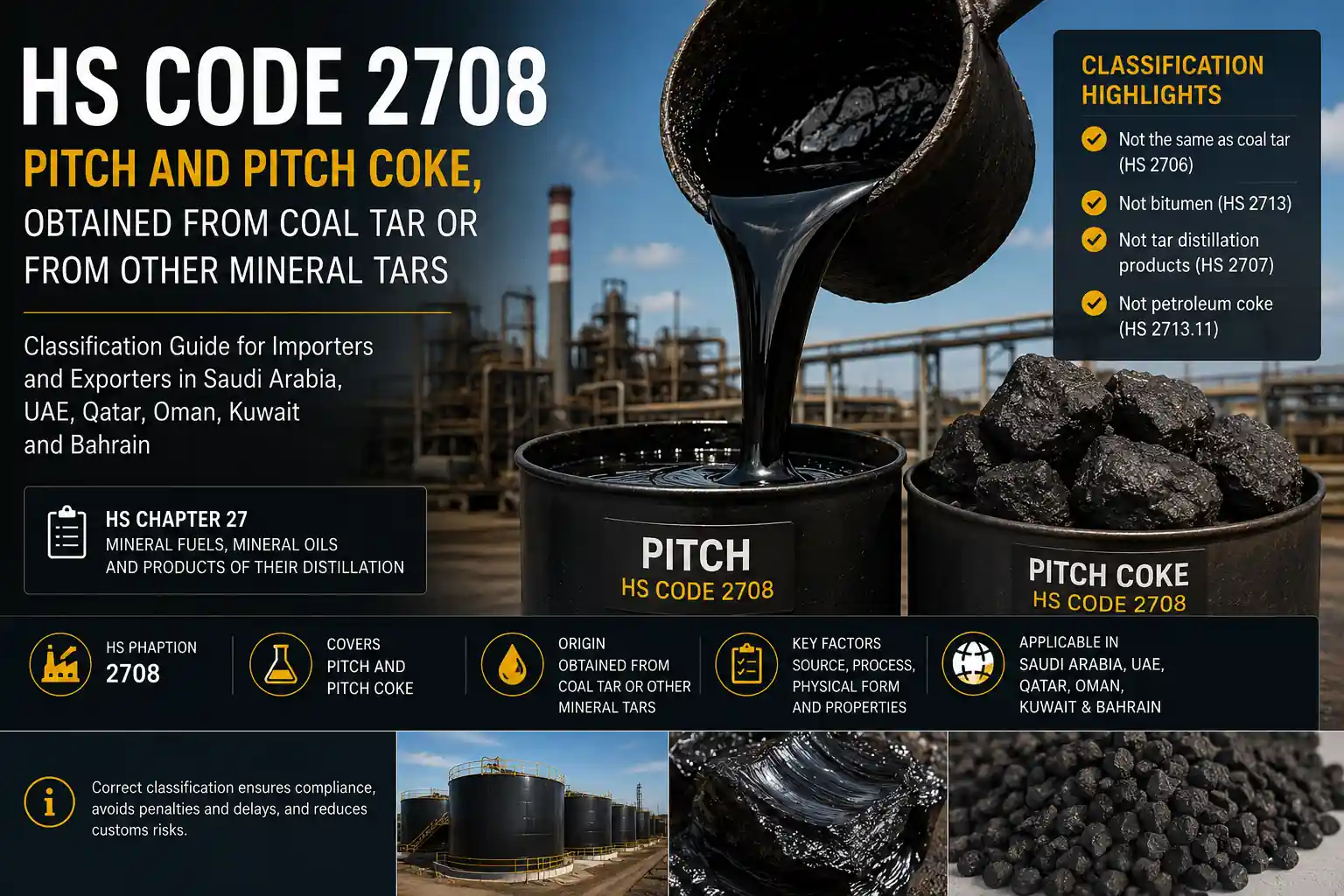
HS Code 2708 covers pitch and pitch coke obtained from coal tar or from other mineral tars. At the international six-digit level, the heading is divided into 2708.10 for pitch and 2708.20 for pitch coke.
The wording appears simple, but classification can become difficult when the commercial description is broad or when several dark, carbon-rich or bituminous materials look similar. Terms such as “coal tar pitch,” “binder pitch,” “electrode pitch,” “pitch coke,” “carbon material,” “bitumen,” “petroleum coke,” “tar residue” or “asphalt” should not be treated as interchangeable customs descriptions.
The legal question is not simply whether the product is black, viscous, carbon-rich or used by the aluminium, graphite, electrode, refractory, construction or carbon industries. The analysis must establish the actual identity of the material, the source from which it was obtained, and its stage in the production process.
A material obtained as a heavy residue from the processing or distillation of coal tar may be very different for customs purposes from petroleum bitumen, natural bitumen, petroleum coke, a prepared bituminous mixture, or the mineral tar from which the material originated.
This distinction matters for importers, exporters and trade-compliance teams operating in Saudi Arabia, the United Arab Emirates (UAE), Qatar, Oman, Kuwait and Bahrain, because a description that is commercially convenient may not provide enough information to support the final tariff declaration.
Where HS Code 2708 sits in Chapter 27
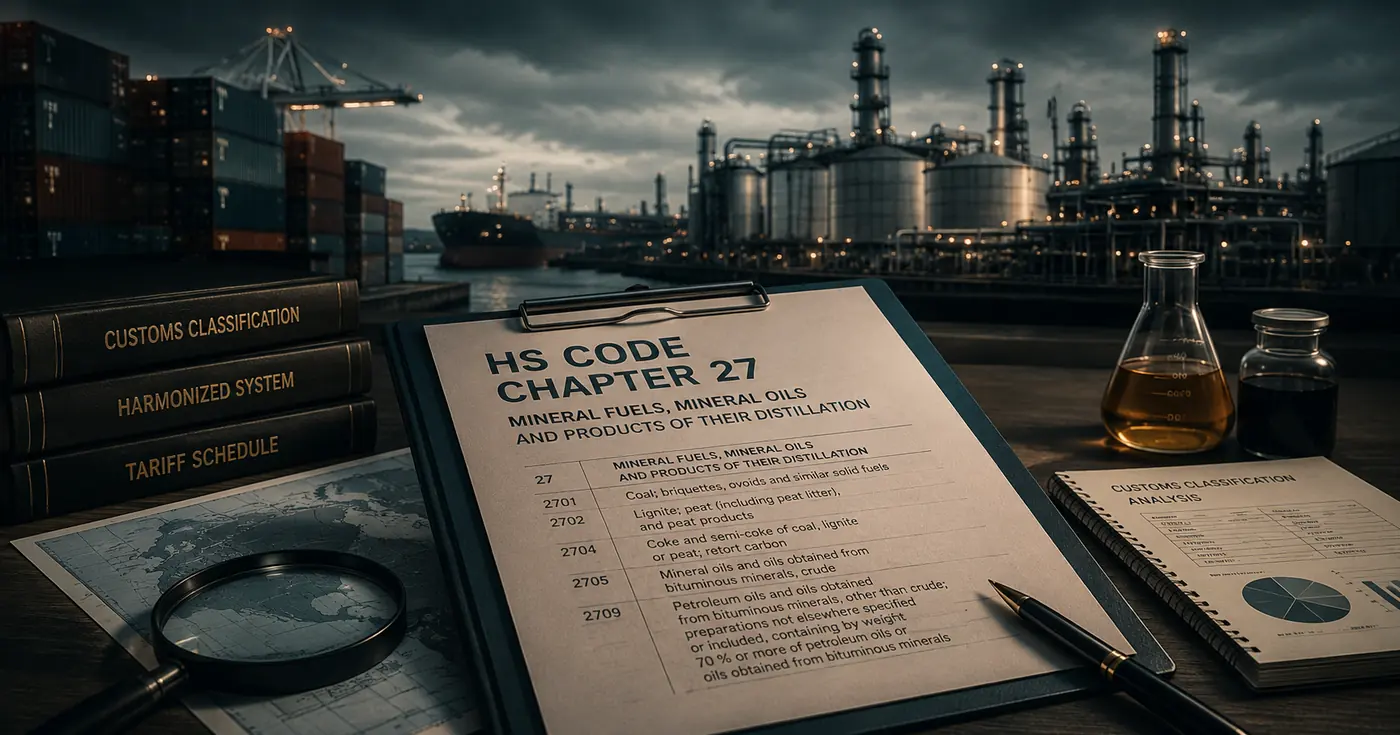
Heading 2708 belongs to Chapter 27 of the Harmonized System, covering mineral fuels, mineral oils and products of their distillation, bituminous substances and mineral waxes.
For the broader Chapter 27 structure, see: HS Code Chapter 27 Classification Guide .
The position of 2708 immediately after 2706 and 2707 is particularly useful when analysing the transformation of coal tar and other mineral tars.
- Heading 2706 covers qualifying tar distilled from coal, lignite or peat and other mineral tars, including the forms expressly described by that heading.
- Heading 2707 covers oils and other products of the distillation of high-temperature coal tar, together with qualifying similar aromatic-rich products.
- Heading 2708 covers pitch and pitch coke obtained from coal tar or from other mineral tars.
In an industrial process, coal tar or another mineral tar may be subjected to separation, heating or distillation. Lighter or intermediate fractions can leave the process while a progressively heavier residue remains.
The resulting heavy material may, depending on its actual identity and production history, be pitch. Further thermal treatment of pitch may produce a more carbonised material known as pitch coke.
That process history can therefore be highly relevant to the customs classification file, but the classifier must still identify the actual product presented at importation or exportation rather than classifying it only by reference to an earlier feedstock.
HS Code 2708 structure
At the international six-digit level, Heading 2708 has a comparatively simple structure with only two subheadings.
International HS6 subheadings under 2708
Pitch obtained from coal tar or from other mineral tars, provided the product satisfies the scope of Heading 2708.
Pitch coke obtained from coal tar or from other mineral tars.
This means that once Heading 2708 has been established at the four-digit level, the next major question is generally whether the imported material is pitch or whether it has undergone further processing and is properly identified as pitch coke.
GRI 1 remains central to establishing the four-digit heading from the legal heading text and relevant legal notes. GRI 6 then governs the comparison of subheadings at the same level when determining 2708.10 or 2708.20.
A document may use terms such as “pitch,” “coke,” “carbon,” “binder” or “bitumen” loosely. The classification file should establish what the material actually is and where it comes from.
Understanding pitch under HS 2708.10
Subheading 2708.10 covers pitch within the scope of Heading 2708.
In the context of coal-tar and mineral-tar processing, pitch is generally associated with the heavy material remaining after more volatile portions have been removed from the tar. Its commercial grade, physical form and technical properties can vary considerably.
A pitch product may be supplied as a hot or molten material, a solid mass, blocks, pieces, granules, pellets or another commercially practical form. Physical presentation alone is therefore not enough to determine the tariff heading.
Likewise, the final use does not by itself define HS 2708.10. Pitch may be intended for carbon or graphite-related applications, electrodes, binders, refractory materials or other industrial uses, but end use is normally supporting context rather than a substitute for product identity and origin.
Questions to ask when 2708.10 is being considered
- What is the exact product name?
- Is it specifically described as coal tar pitch or another mineral-tar pitch?
- What was the feedstock?
- How was the material produced?
- Is it a residue or product of coal-tar or mineral-tar processing?
- Has it been further carbonised into pitch coke?
- Has it been blended with other materials?
- Is the imported product still pitch, or is it a prepared formulation?
- Could it instead be petroleum bitumen?
- Could it be natural bitumen or asphalt?
These questions help prevent a classifier from relying on appearance or commercial terminology when the product may fall into another Chapter 27 heading.
Softening point and other physical properties
Technical specifications for pitch often contain physical-property data such as softening point, viscosity, density, ash, moisture or other quality parameters.
Such information can be extremely useful when establishing the identity and grade of the material, but it should not be transformed into an invented universal HS threshold unless the legal tariff text or relevant legal notes actually prescribe one.
In other words, a particular softening point may help prove what commercial grade was supplied, but the legal reason for Heading 2708 remains the heading text and the identity and origin of the imported material.
Understanding pitch coke under HS 2708.20
Subheading 2708.20 covers pitch coke obtained from coal tar or from other mineral tars.
The key distinction from pitch is that pitch coke represents a further transformed, more carbonised product rather than the pitch itself.
The material may be solid and carbon-rich and can resemble other coke products. That visual similarity makes the source and manufacturing process particularly important.
The word “coke” alone is not enough to establish 2708.20.
Chapter 27 contains several different coke-related products that are separated according to their origin and nature. For example, coke and semi-coke of coal, lignite or peat are covered by Heading 2704, while petroleum coke is covered under Heading 2713.
Pitch coke therefore needs to be identified specifically as pitch coke obtained from coal tar or another mineral tar.
Questions to ask when 2708.20 is being considered
- Was the immediate feed material pitch?
- Was that pitch itself obtained from coal tar or another mineral tar?
- What thermal or carbonisation step produced the final material?
- Is the commercial product specifically identified as pitch coke?
- Could it instead be coke of coal, lignite or peat under 2704?
- Could it be petroleum coke under 2713?
- Has the material undergone further manufacture into another article?
A manufacturing-flow description can be particularly valuable here because it provides evidence linking the final coke product back to the relevant pitch and mineral-tar source.
Coal coke, pitch coke and petroleum coke are not automatically classified together. Source and product identity can change the heading completely.
Why source and manufacturing process matter for HS 2708
Heading 2708 does not simply say “pitch and pitch coke.” Its wording specifically ties the covered products to coal tar or other mineral tars.
That source requirement makes manufacturing evidence especially important.
Two dark, viscous materials may look almost identical in a drum, tanker or bulk container but have different tariff classifications because one is coal-tar pitch and the other is petroleum bitumen.
Similarly, two black carbon solids may both be described commercially as “coke,” while one is pitch coke and the other is petroleum coke.
Useful manufacturing evidence may include
- feedstock declaration;
- process-flow description;
- supplier manufacturing statement;
- production specification;
- certificate of analysis;
- TDS;
- SDS;
- product-grade specification;
- plant or process terminology used consistently across the documents.
The aim is not to collect documents for their own sake. The aim is to establish a consistent technical story: what the material is, what it came from, what processing occurred, and what product was actually shipped.
Important classification boundaries for HS 2708
2706 vs 2708 — Mineral tar or pitch?
Heading 2706 covers qualifying mineral tars themselves. Heading 2708 covers pitch and pitch coke obtained from coal tar or other mineral tars.
The key distinction is therefore the identity of the material after processing.
If the imported material remains a qualifying tar rather than pitch, classification under 2708 may be premature.
If processing has produced the heavy product properly identified as pitch, 2708.10 may become relevant.
2707 vs 2708 — Distillation product or pitch residue?
Heading 2707 covers oils and other products of the distillation of high-temperature coal tar, together with qualifying similar products in which aromatic constituents predominate by weight.
Heading 2708 separately identifies pitch and pitch coke.
This distinction is important because a coal-tar processing plant can produce several fractions or products from the same starting material.
A lighter or intermediate distillation product should not be classified as pitch merely because coal tar was the feedstock, while an actual pitch residue should not remain under 2707 merely because it arose during a distillation process.
2708 vs 2713 — Coal-tar pitch products or petroleum products?
Heading 2713 covers petroleum coke, petroleum bitumen and other residues of petroleum oils or oils obtained from bituminous minerals.
This creates one of the most important boundaries for 2708.
If a product is petroleum coke, it is not pitch coke under 2708 merely because both are carbon-rich solids.
Likewise, petroleum bitumen should not be classified as coal-tar or mineral-tar pitch simply because both materials may be black, viscous, thermoplastic or used in overlapping industrial applications.
Source documentation therefore becomes critical.
2708 vs 2714 — Pitch or natural bitumen/asphalt?
Heading 2714 covers natural bitumen and asphalt, bituminous or oil shale and tar sands, asphaltites and asphaltic rocks.
These are not the same legal category as pitch obtained from coal tar or another mineral tar.
A material described simply as “bitumen” needs further identification because the name alone does not establish whether it is petroleum bitumen, natural bitumen or a pitch product.
2708 vs 2715 — Pitch itself or a prepared bituminous mixture?
Heading 2715 covers specified bituminous mixtures based on natural asphalt, natural bitumen, petroleum bitumen, mineral tar or mineral-tar pitch.
This boundary is especially important when pitch has been blended or formulated with other materials.
The fact that mineral-tar pitch is used as one of the bases of a preparation does not automatically mean that the final prepared mixture remains in 2708.
The actual imported material must therefore be evaluated: is it pitch itself, or is it a bituminous mixture prepared from pitch or another bituminous base?
| Heading | General classification context | Key question |
|---|---|---|
| 2706 | Qualifying coal, lignite, peat and other mineral tars. | Is the material still tar rather than pitch? |
| 2707 | High-temperature coal-tar distillation products and qualifying similar aromatic-rich products. | Is the material an oil/distillation product rather than pitch? |
| 2708 | Pitch and pitch coke obtained from coal tar or other mineral tars. | Is the product actually pitch or pitch coke of the required origin? |
| 2713 | Petroleum coke, petroleum bitumen and certain petroleum residues. | Is the product petroleum-derived rather than mineral-tar pitch or pitch coke? |
| 2714 | Natural bitumen, natural asphalt and specified naturally occurring bituminous materials. | Is the material naturally occurring rather than manufactured pitch? |
| 2715 | Specified bituminous mixtures based on asphalt, bitumen, mineral tar or mineral-tar pitch. | Has the pitch become part of a prepared mixture? |
Technical information to review for HS Code 2708
A reliable 2708 classification normally requires a clear understanding of the product and its production history.
| Information or document | Why it may matter |
|---|---|
| Exact product name | Helps establish whether the supplier describes the material as coal tar pitch, mineral-tar pitch, pitch coke, petroleum coke, bitumen or another product. |
| Feedstock / origin | Critical because Heading 2708 requires pitch or pitch coke obtained from coal tar or another mineral tar. |
| Manufacturing process | Shows whether the material is a heavy tar-processing product, pitch, further-carbonised pitch coke or something else. |
| Process-flow statement | Can connect the final material to the original mineral-tar feedstock and clarify the processing stage. |
| TDS | May identify product grade, physical properties, commercial form and intended industrial application. |
| SDS | May support product identity, composition and source information, but does not legally determine the HS code. |
| CoA | May provide physical or compositional information that supports the product identity and grade. |
| Softening point | Can help identify and distinguish pitch grades where included in the product specification, but is supporting evidence rather than a universal HS threshold. |
| Viscosity | May help describe molten or liquid-handling characteristics of certain pitch grades. |
| Ash / moisture / other quality data | Can support consistency with the supplier's declared grade. |
| Physical form | Helps describe whether the pitch is supplied molten, solid, granular, pelletised or in another form, or whether the product is solid pitch coke. |
| Supplier technical declaration | Particularly valuable when standard documents do not clearly state the original feedstock or production route. |
| End use | May provide useful context but should not replace classification according to the product's identity, origin and legal heading text. |
| Additives or blending information | Important where the material may no longer be pitch itself but a prepared bituminous mixture potentially relevant to Heading 2715. |
How to evaluate classification under HS Code 2708
Identify the actual imported product
Establish what is physically being imported or exported, not merely the umbrella commercial family to which the supplier says it belongs.
Confirm the exact commercial and technical name
Determine whether the material is described consistently as pitch, coal-tar pitch, pitch coke, petroleum coke, bitumen or another material.
Identify the feedstock
Confirm whether the product was obtained from coal tar or another mineral tar, since this origin is built into the legal wording of Heading 2708.
Review the manufacturing process
Understand whether the process produced pitch directly or whether pitch was subjected to additional carbonisation to produce pitch coke.
Check whether the material is still tar
If the product may still fall within the description of mineral tar, review Heading 2706 before moving to 2708.
Check whether it is a 2707 distillation product
If the product is an oil or another qualifying high-temperature coal-tar distillation product rather than pitch, Heading 2707 may need evaluation.
Distinguish pitch from pitch coke
Once 2708 is established, determine whether the actual imported material is pitch under 2708.10 or the further transformed pitch coke under 2708.20.
Exclude petroleum coke and petroleum bitumen
Review Heading 2713 when the product may be petroleum-derived.
Exclude natural bitumen and asphalt where relevant
Review Heading 2714 when documents indicate naturally occurring bituminous materials.
Check for blending or formulation
If pitch has been combined with other components to make a prepared bituminous mixture, evaluate Heading 2715.
Review supporting documents together
Reconcile the invoice, product name, TDS, SDS, CoA, supplier declaration and manufacturing information rather than relying on a single document.
Apply GRI 1
Determine the four-digit heading from the legal heading wording and relevant legal notes.
Apply GRI 6
If Heading 2708 is confirmed, compare 2708.10 and 2708.20 at the same subheading level.
Verify the destination tariff
After identifying the international HS6 code, verify the current detailed tariff code and declaration requirements in Saudi Arabia, UAE, Qatar, Oman, Kuwait or Bahrain.
Need help classifying pitch, pitch coke or a similar dark carbon material?
Use JAMAREK to analyse the product identity, source, manufacturing process, technical documents and competing tariff headings before finalising the customs classification.
Practical HS Code 2708 classification scenarios
Scenario 1 — Coal tar pitch confirmed by the manufacturer
The supplier identifies the product as coal tar pitch. Manufacturing documentation confirms that the material is the heavy pitch product obtained from processing coal tar.
Heading 2708 is directly relevant, and 2708.10 becomes the international HS6 candidate because the imported product is pitch rather than pitch coke.
Scenario 2 — Product described only as “industrial pitch”
The commercial invoice states “industrial pitch,” but the SDS and TDS do not identify the original feedstock.
This is not enough to confirm 2708.
A supplier declaration or manufacturing statement should be requested to determine whether the pitch came from coal tar, another mineral tar, petroleum processing or another source.
Scenario 3 — Pitch coke made from coal-tar pitch
The manufacturing route shows that coal-tar pitch was further thermally processed to produce a solid carbon-rich pitch coke.
If the product is technically confirmed as pitch coke, 2708.20 becomes the appropriate HS6 candidate within 2708.
Scenario 4 — Petroleum coke sold to the same industrial customer
A carbon product is supplied to an electrode manufacturer, but technical documents identify it as petroleum coke.
Its use in electrodes does not convert it into pitch coke. Heading 2713 should be evaluated because the product identity and origin are petroleum-based.
Scenario 5 — Black viscous material identified as petroleum bitumen
The product is black, viscous and visually similar to some pitch grades, but the refinery documents identify it as petroleum bitumen.
Visual similarity is not enough for 2708. The petroleum origin points toward the relevant provisions of Heading 2713.
Scenario 6 — Mineral tar itself
A supplier uses the phrase “tar/pitch material,” but production information shows that the imported material is still the qualifying mineral tar and has not become a pitch product.
Heading 2706 should be considered before 2708.
Scenario 7 — Coal-tar distillation oil
A dark liquid comes from a coal-tar distillation facility, but the TDS identifies it as an aromatic distillation oil rather than pitch.
The fact that it came from coal tar does not automatically place it in 2708. Heading 2707 should be analysed.
Scenario 8 — Pitch blended into a bituminous preparation
Coal-tar pitch is used as a base but has been mixed with other materials to form a formulated bituminous product.
The imported goods are therefore not necessarily pitch itself. Heading 2715 should be evaluated for the prepared mixture.
Scenario 9 — Natural asphalt product
The commercial name includes “pitch,” but geological and supplier information shows that the material is a naturally occurring asphaltic substance.
Heading 2714 may be more relevant than 2708.
Scenario 10 — Pitch supplied in granules
Coal-tar pitch is solidified and supplied in granulated form for easier handling and transportation.
The physical form alone does not remove it from 2708.10 if the material remains pitch and otherwise satisfies the heading.
Scenario 11 — Molten coal-tar pitch in a heated tanker
A product is transported hot because its commercial handling requires a molten condition.
The liquid state during transport does not, by itself, mean the product is an oil of 2707. The underlying identity as pitch must be established from the manufacturing and technical documents.
Scenario 12 — “Coke” with unclear origin
The invoice only states “industrial coke.”
This is insufficient for 2708.20. The importer should determine whether the product is coal coke, pitch coke, petroleum coke or another carbon product before choosing the tariff code.
Scenario 13 — Supplier code says 2708.10 but SDS says petroleum bitumen
A supplier enters 2708.10 on the invoice, while the technical documentation consistently identifies the product as petroleum bitumen.
The supplier's code should not override contradictory technical evidence. The classification should be independently reviewed.
Scenario 14 — Pitch coke with incomplete process history
The product is called “pitch coke,” but the documents do not identify whether the original pitch was derived from coal tar, mineral tar or petroleum feedstock.
Because source is part of the legal wording of 2708, additional manufacturing evidence should be obtained before classification is confirmed.
Common HS Code 2708 classification mistakes
1. Treating all products called “pitch” as HS 2708
The source and actual product identity still need to fit the heading.
2. Ignoring the words “obtained from coal tar or other mineral tars”
Origin is part of the legal description of Heading 2708.
3. Classifying mineral tar itself as pitch
A qualifying tar may remain under 2706 if it has not become pitch.
4. Keeping actual pitch under 2707 because it came from a distillation process
Heading 2708 specifically provides for pitch and pitch coke.
5. Treating petroleum bitumen as coal-tar pitch
Physical similarity does not override the petroleum origin of the product.
6. Treating petroleum coke as pitch coke
These products have different origins and different tariff provisions.
7. Treating every carbon-rich solid as pitch coke
Coal coke, pitch coke and petroleum coke must be distinguished.
8. Relying on end use
Use in electrodes, graphite production, refractories or another industry does not by itself determine the HS heading.
9. Using colour or appearance as the primary classification rule
Many Chapter 27 products may be dark, black or viscous.
10. Assuming molten pitch is an oil under 2707
Physical state during shipment does not automatically change the underlying identity of the material.
11. Ignoring Heading 2714 for naturally occurring bituminous materials
Natural bitumen and asphalt have their own tariff heading.
12. Ignoring Heading 2715 after blending or formulation
Pitch used as an ingredient in a prepared bituminous mixture does not necessarily remain classified as pitch itself.
13. Treating SDS as a binding HS determination
SDS is a technical support document, not the legal tariff decision.
14. Copying the supplier's HS code without checking origin
The supplier may have used a different national tariff, an old classification or a code for a different grade.
15. Not requesting manufacturing information
Manufacturing history can be decisive when differentiating coal-tar pitch, pitch coke, petroleum products and similar materials.
16. Confusing a product grade with a legal HS definition
Commercial specifications such as softening point or binder grade can support product identification but do not independently create the tariff heading.
17. Stopping at Heading 2708 without choosing the HS6 subheading
The international structure requires a distinction between pitch and pitch coke.
18. Stopping at HS6 without checking the destination tariff
The international six-digit code is only one stage of the complete customs declaration process.
How to build a defensible HS 2708 classification file
A strong classification file should allow another reviewer to understand why the product was classified under 2708 rather than one of the nearby Chapter 27 headings.
- Record the exact commercial product name.
- Record the manufacturer's technical product name.
- Identify the original feedstock.
- Confirm whether the feedstock was coal tar or another mineral tar.
- Obtain a manufacturing or process-flow description where necessary.
- Determine whether the product is pitch or pitch coke.
- Keep the latest TDS.
- Keep the latest SDS.
- Keep the CoA where relevant.
- Record physical form and product grade.
- Record relevant quality specifications such as softening point if supplied.
- Confirm whether additives or other ingredients have been introduced.
- Evaluate 2706 if the material may still be mineral tar.
- Evaluate 2707 if the material may be a coal-tar distillation oil or other product.
- Evaluate 2713 if petroleum coke or petroleum bitumen is possible.
- Evaluate 2714 if natural bitumen or asphalt is possible.
- Evaluate 2715 if the product is a prepared bituminous mixture.
- Document the application of GRI 1.
- Document the application of GRI 6.
- Explain why reasonable competing headings were rejected.
- Keep supplier technical declarations supporting origin.
- Verify the current tariff extension in the actual destination country.
HS Code 2708 in Saudi Arabia, UAE, Qatar, Oman, Kuwait and Bahrain
The international Harmonized System provides the common six-digit classification foundation used when analysing products traded with Saudi Arabia, the United Arab Emirates (UAE), Qatar, Oman, Kuwait and Bahrain.
For Heading 2708, the international HS6 structure is:
- 2708.10 — Pitch
- 2708.20 — Pitch coke
However, the six-digit international HS code should not be confused with the complete detailed tariff line required for an actual customs declaration in the destination market.
National or regional tariff extensions, customs procedures, declaration systems, documentary requirements and regulatory obligations may require additional verification.
Importers should therefore confirm the current detailed tariff and customs requirements before filing a declaration in Saudi Arabia, UAE, Qatar, Oman, Kuwait or Bahrain.
Identify the actual product → establish the feedstock → review the manufacturing process → distinguish pitch from pitch coke → compare 2706 and 2707 → exclude petroleum products under 2713 → review natural bitumen under 2714 if relevant → review prepared mixtures under 2715 → apply GRI 1 → apply GRI 6 → verify the destination tariff.
Future update: HS 2028
This guide is based on HS 2022, the international Harmonized System edition in force in 2026.
The World Customs Organization has adopted amendments for HS 2028, which are scheduled to enter into force on 1 January 2028.
In the official amendments accepted pursuant to the WCO Recommendation of 26 June 2025, the published Chapter 27 amendment concerns subheading 2710.91.
That subheading is to be deleted and replaced by new subheadings 2710.92 and 2710.93.
The published official recommendation does not list an amendment to Heading 2708.
Businesses should nevertheless check the final HS 2028 nomenclature, correlation tables and the implementation adopted by the destination customs authority before applying the new edition after it enters into force.
Frequently asked questions about HS Code 2708
What does HS Code 2708 cover?
What are the international HS6 subheadings under 2708?
Is coal tar pitch classified under 2708.10?
What is HS Code 2708.20?
Is pitch coke the same as petroleum coke?
Is coal tar itself classified under 2708?
What is the difference between 2707 and 2708?
Is petroleum bitumen classified under 2708.10?
Is natural asphalt classified under 2708?
Can a mixture containing coal-tar pitch remain under 2708?
Does the softening point determine HS 2708.10?
Can molten pitch still be classified as pitch?
Can pitch be supplied as granules or pellets?
Why is manufacturing information important for HS 2708?
Is SDS enough to classify coal tar pitch?
Is TDS enough to determine 2708.10 or 2708.20?
Can I use the supplier's HS code?
Does end use determine whether the material is pitch or pitch coke?
What documents are most useful for HS 2708?
How can I distinguish pitch coke from petroleum coke?
Do Saudi Arabia, UAE, Qatar, Oman, Kuwait and Bahrain share the same international HS6 basis?
Is HS 2708 changing in HS 2028?
Do we need separate articles for 2708.10 and 2708.20 now?
Build a stronger classification file before customs declaration
Use JAMAREK to review product identity, feedstock, manufacturing process, technical evidence and competing Chapter 27 headings before selecting the final tariff code.
Final takeaway
HS Code 2708 has a short legal description, but reliable classification still depends on understanding the actual material.
The heading covers two product categories: pitch and pitch coke, provided they are obtained from coal tar or another mineral tar.
At the international HS6 level, pitch is classified under 2708.10 and pitch coke under 2708.20.
The most important classification issue is often not choosing between those two subheadings, but first proving that Heading 2708 is the correct heading.
A dark viscous material may instead be mineral tar, a coal-tar distillation product, petroleum bitumen, natural bitumen or a prepared bituminous mixture.
Likewise, a black carbon solid may be coal coke, pitch coke or petroleum coke.
These products may look similar and can sometimes serve related industrial applications, but the Harmonized System separates them according to their legal descriptions, nature and origin.
That is why a strong classification file for 2708 may need more than a product name. Useful evidence can include the feedstock declaration, production route, TDS, SDS, CoA, supplier technical statement and information about whether the product has been blended or further processed.
Technical characteristics such as softening point, viscosity, ash, moisture and physical form may help confirm the commercial grade, but they should be treated as evidence rather than substituted for the legal tariff wording.
For a product believed to be pitch, compare 2708.10 with realistic alternatives such as 2706, 2707, 2713, 2714 and 2715.
For a product believed to be pitch coke, verify the feedstock and production route carefully, particularly where petroleum coke or another coke product may be a realistic competing classification.
Once the international HS6 classification has been established, importers and exporters dealing with Saudi Arabia, the United Arab Emirates (UAE), Qatar, Oman, Kuwait and Bahrain should verify the current detailed tariff line and declaration requirements in the actual destination market.
Official Sources
- World Customs Organization — HS 2022 Chapter 27
- World Customs Organization — General Rules for the Interpretation of the Harmonized System
- GCC Secretariat General — Customs Digital Library
- World Customs Organization — HS 2028 Amendments
- World Customs Organization — Official HS 2028 Amendment Recommendation
This guide is provided for general educational and informational purposes only. Correct customs classification depends on the actual identity of the goods, their feedstock, origin, manufacturing process, physical condition, composition, degree of processing, presentation, supporting technical documentation and the tariff in force at the time of import or export.
Documents such as a TDS, SDS, CoA, process-flow description, supplier declaration and manufacturing statement may provide important technical evidence, but they do not replace the legal wording of the tariff, applicable Section or Chapter Notes, subheading provisions or the General Rules for Interpretation.
Nothing in this article constitutes a binding customs ruling. Before using any classification in Saudi Arabia, the United Arab Emirates, Qatar, Oman, Kuwait or Bahrain, verify the current detailed tariff, customs requirements and any applicable regulatory obligations in the destination country.